Introduce subordination as averaging ordinary diffusion over a random operational time. This gives a concrete bridge between a microscopic event parameter and observed evolution.
01A statistical realization of dual temporal roles
The renewal-clock model distinguishes microscopic events, operational time u accumulated through those events, and the outer duration T used to describe observations. Standard diffusion or unitary motion is specified in u. An irregular relation between u and T then changes the observed evolution. This is compatible with the DTT idea that generative progression and completed time need not coincide, but it is a particular stochastic realization, with a chosen waiting-time distribution and independence assumptions. It does not derive those choices from the single-source ontology or from the six nested inner stages. Those stages would need a separate mechanism explaining the observed event statistics.
02Averaging ordinary evolution over a random time
Let T_u be a positive probability-preserving evolution in operational time u, and let h(u,T) be a normalized nonnegative density for u at a specified outer time T. The observed state is the integral of T_u weighted by h. One first specifies ordinary dynamics, then averages over uncertainty in how far those dynamics have progressed. The order matters: replacing T by its mean inside T_u is generally not the same operation, because evolution depends nonlinearly on time.
F(T)=∫₀∞h(u,T)T_uF₀ du
h≥0, ∫₀∞h(u,T)du=1
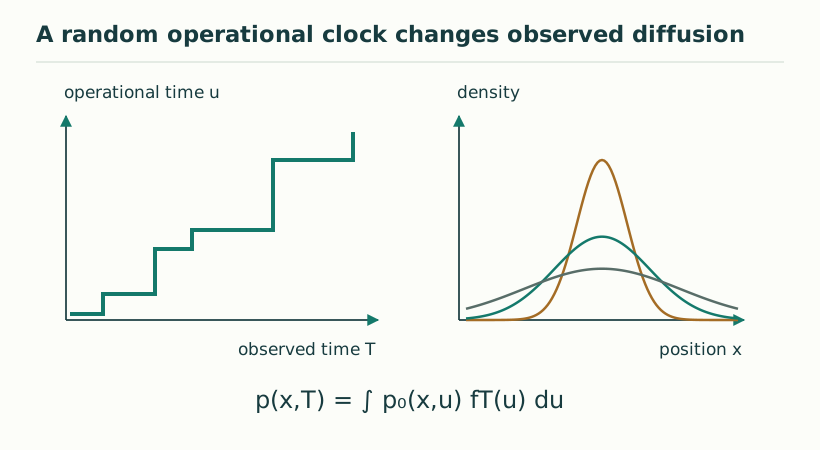
Figure 1. A random operational clock changes observed diffusion. The illustration subordinates diffusion in operational time u to an intermittent clock u(T). Flat portions represent waiting periods. The resulting memory does not imply two independently readable laboratory clocks. View full size ↗
03Properties that survive the average
For classical Markov evolution, each T_u preserves positivity and total probability, so the convex average does too. For quantum dynamics T_u(ρ)=U(u)ρU(u)†, the same argument gives a completely positive trace-preserving channel at each T. However the family of averaged channels need not obey a semigroup composition law in T. The random operational increments can retain age information, and composing two averages need not reproduce the law of one longer observation. Positivity and Markovianity are therefore separate questions.
04A two-clock phase example
Consider a quantum two-level system with angular frequency separation ω. Its off-diagonal coherence in operational time is multiplied by e^(−iωu). Averaging gives the characteristic function E[e^(−iωu(T))]. If u takes two values u₁ and u₂ with equal probability, the factor is their average, whose magnitude can be smaller than one even though both microscopic evolutions are unitary. When ω(u₂−u₁)=π the two contributions cancel. This is a simple loss of phase knowledge caused by clock uncertainty, not destruction of probability.
ρ₁₂(T)=E[e^(−iωu(T))]ρ₁₂(0)
05The fractional continuum limit
For an inverse-stable clock in dimensionless units, its Laplace-transformed density is s^(D−1)exp(−usᴰ). Integrating this against exp(uL) yields a resolvent, and inverse transformation gives a Caputo evolution equation. Restoring dimensional scales requires normalizing the kernel consistently. This derivation is stronger than inserting a fractional derivative by analogy: it states the underlying probabilistic mechanism. In DTT terms the ordinary operational evolution models inner progression and the averaged output models reduced completion, while the source law choosing the clock remains an open physical input.
∫₀∞e^(−sT)h_D(u,T)dT=s^(D−1)e^(−usᴰ)
C D_TᴰF=LF in consistently normalized dimensionless units
06Average channels do not obey an automatic composition law
For a deterministic clock, evolving through u₁ and then u₂ is equivalent to evolving through u₁+u₂. For a random inverse clock, the operational increments associated with successive outer intervals are generally not independent with the same distribution. Replacing them by independent copies changes the process. Thus the composition of two averaged channels may describe a different preparation protocol from one uninterrupted longer run. This offers an operational memory test: compare an uninterrupted evolution with a protocol that resets the hidden clock age between intervals. The difference diagnoses retained temporal information without assuming any particular metaphysical interpretation.
07What must be measured separately
The clock exponent D, the number of spatial coordinates, spectral dimension and a gravitational scaling dimension have different definitions. A random clock can change a diffusion diagnostic on a spatial manifold whose topology is unchanged. Similarly, an effective propagation delay is not automatically a change in a fundamental vacuum cone. A physical SMM/DTT application should identify a clock observable, state how its statistics are obtained, and compare the resulting predictions with a baseline using the same apparatus. Finite cutoffs, observation windows and normalization of probability kernels must be stated explicitly: their effects can be as important as the asymptotic power law.
Probability normalization is a practical consistency check throughout this programme. Integrating the clock density over operational time must give one at every observed time. Restoring a microscopic timescale inside a Laplace exponent can require a corresponding prefactor outside it; otherwise the averaged evolution will not preserve total probability. The same check should be made before calculating moments, return probabilities or quantum coherences. A fitted power law can look plausible even when a kernel is misnormalized, so explicit normalization is part of the derivation rather than a cosmetic convention.
KEEP THE CONNECTION
Key ideas
Subordination averages full evolutions, not merely their mean times.
Probability and complete positivity survive normalized convex averaging.
The observed family can have memory despite unitary microscopic evolution.
Scope of the argument. Conditional random-clock construction; a normalized kernel is required and the operational model is supplied.
Sources & further reading
smm_dtt_fractal_time_v3.pdf — working draftpp. 5–7, §4; normalization and two-phase example stated explicitly here
Source editions and catalogue entries
Working manuscript
Fractal time — stochastic renewal-clock model, working draft v3
Draft file: smm_dtt_fractal_time_v3.pdf
Working manuscript. Article-level references identify the consulted sections and the scope of the interpretation. No public URL was supplied for this exact manuscript version.