
Build the framework.
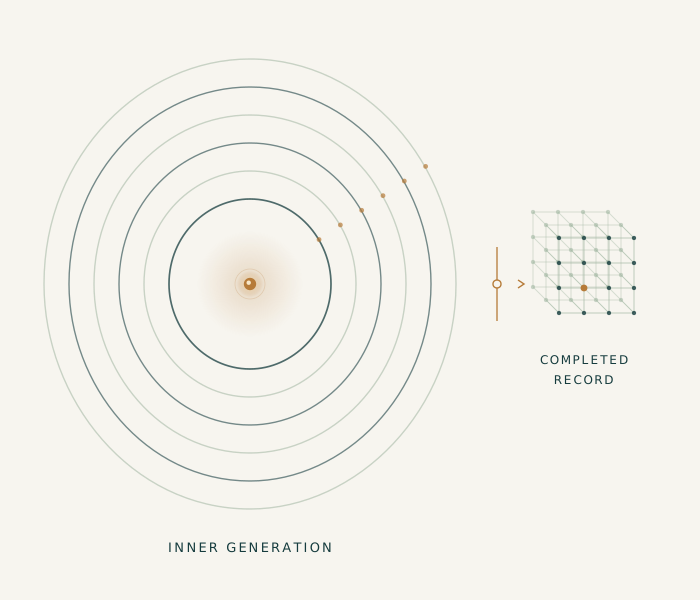
Understand the common source, observable records, six nested inner roles, and outer completion.
SINGLE MONAD MODEL · DUALITY OF TIME THEORY
Could space, matter, and motion emerge through temporal generation? Explore the ideas, mathematics, and open questions of the Single Monad Model and Duality of Time Theory.
NEW · THE FOUNDATIONS GUIDES
Eight expanded guides connect SMM and DTT to worked examples, six new diagrams, 60 glossary definitions, and 26 questions and answers.
Understand the common source, observable records, six nested inner roles, and outer completion.
Trace phase selection, clocks, geometry, memory, response, and atomic binding.
Look up the vocabulary and the questions that connect the concepts to physical models.
CHOOSE YOUR WAY IN
Meet the common source, inner generation, and outer completion. Build the vocabulary before following the formal arguments.
A guided introduction →Trace the route through phase, dimensions, clocks, matter, and constants. See what follows from each model and what remains to be selected.
Explore the research →Explore Ibn al-Arabi’s account of time and creation, the question of unity and multiplicity, and the books that develop the framework.
Enter the book series →THE CENTRAL DISTINCTION
SMM and DTT ask how the relations we observe could arise through a common generative process. The task is to connect each step with explicit mathematics and physical meaning.
Understand the framework →A proposed common origin of observable multiplicity, before spatial positions are treated as independently given.
Six functional roles organize the proposed construction of spatial relations. They are nested stages, not separate measured time axes.
A retained record becomes available to observation. A physical model must explain the clock, readout and memory that make this possible.
PUBLISHED RESEARCH
Completion, compatible complex structures, and the conditions behind positive-frequency geometry.
How real representations and their commutants constrain the selection of quantum phase.
A dual-time geometric approach to temporal asymmetry and reduced dynamics.
FROM THE ARTICLE ATLAS
Explain the draft’s same-cycle foundation: inner action is primitive, while outer record order comes from completed observable returns. Neither role automatically supplies a second readable laboratory clock.
Read article →Trace the latest draft’s route from quaternionic readout to a selected grammar with 137 distinguishable records. Keep each structural choice visible in the explanation.
Read article →Introduce the lower-bound and bound-state results of the effective model. Explain how the supplied kinetic and potential rules produce a meaningful atomic test case.
Read article →AN INTERACTIVE RESEARCH WORKBENCH
Trace the assumptions, equations, numerical outputs, and unresolved matching steps for α, ℏ, G, electron mass, the mass ratio, and Λ.
THE BOOK SERIES
Time and creation
Temporal generation of space
Symmetry and its interpretations
A conceptual introduction
EXPLORE THE WHOLE WEBSITE
Independent section indexes connect the current collection with its original readers and resources.