Introduce the paper’s phase-selection question in real Hilbert representations. Prepare an accessible route from the commutant to compatible complex structures and their physical interpretation.
01Phase selection rather than a formal change of notation
The Physics Letters A paper asks which imaginary units are compatible with a real Hilbert representation and which one an oriented orthogonal flow selects. The central object is an operator J with J²=-I and J*=-J. It can act as multiplication by i after compatibility with the representation has been established.
This reverses a familiar order of explanation. Instead of choosing complex scalars first and then placing a dynamics on them, one asks what phase structure the given real dynamics already supports. The construction concerns a specified kinematical sector; its explanatory power lies in that dependency, not in deriving every postulate of quantum theory at once.
02A plane demonstrates both existence and orientation
Write a real state as a pair (q,p). The map J₀(q,p)=(-p,q) rotates it by a quarter turn. The flow exp(tωJ₀) performs continuous rotations at angular rate ω. Orthogonality preserves q²+p², so the norm is unaffected by the evolution.
For ω>0, A=ωJ₀ has |A|=ωI and A=J₀|A|. For ω<0 the selected phase is -J₀. The two conventions are not distinguished by the unoriented circle alone. A direction of evolution is needed to choose between them. This is why orientation is an explicit ingredient.
exp(tωJ₀) = cos(ωt) I + sin(ωt) J₀.
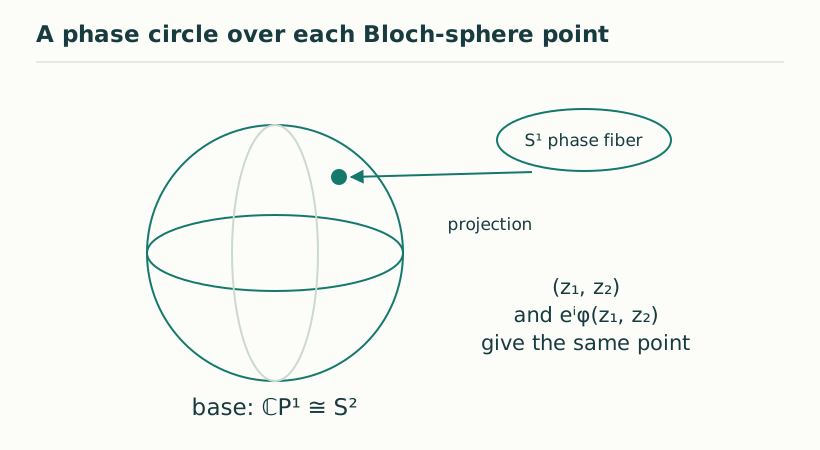
Figure 1. A phase circle over each Bloch-sphere point. For a normalized spinor (z₁,z₂), a common phase leaves the point of ℂP¹ ≅ S² unchanged. The Hopf bundle has total space S³; the drawing is a schematic of its fibers, not an embedding of S³ in ordinary three-space. View full size ↗
03Zero modes reveal what the flow cannot decide
Consider four real coordinates with generator A=diag(ωJ₀,0₂). The first plane rotates and its phase is selected. The second plane is stationary, so A supplies no choice of quarter-turn orientation there. One can append either J₀ or -J₀ on that kernel without changing the observed flow.
If the stationary sector has unsuitable real dimension or symmetry restrictions, extending a complex structure can face further obstructions. It is therefore better to state the selection on the dynamic sector and describe residual kernel freedom explicitly. A zero-frequency gap is not the same thing as the absence of a kernel: one concerns spectral separation, the other exact stationary vectors.
04Time reversal changes how scalars act
Let K(q,p)=(q,-p). Then KJ₀=-J₀K. Once J₀ is interpreted as multiplication by i, K sends i times a vector to -i times its image. In the reconstructed complex language this is an antilinear action. Because K preserves the real norm, it is the finite-dimensional prototype of an antiunitary time-reversal operation.
The example explains an otherwise mysterious terminology. A transformation can be a perfectly ordinary real-linear map and become antilinear only after a phase structure has been selected. Its relation to J, rather than a label attached in advance, determines the complex description.
KJ₀K⁻¹ = -J₀.
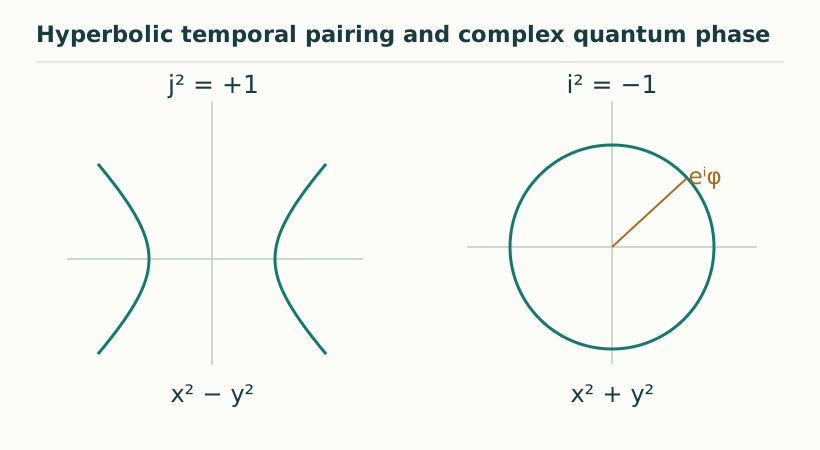
Figure 2. Hyperbolic temporal pairing and complex quantum phase. The split-complex unit j² = +1 supports a hyperbolic quadratic form. The ordinary complex unit i² = −1 supports circular phase rotations. A reconstruction must specify the bridge; the two units cannot simply be interchanged. View full size ↗
05Composition needs a compatible tensor rule
Two real planes have a four-dimensional real tensor product. Two complex lines have a one-dimensional complex tensor product, hence only two real dimensions. Selecting a J on each factor does not remove this discrepancy by itself. The phase actions must be balanced so that a phase assigned to one factor represents the same scalar as that phase assigned to the other.
The relation below describes that balancing at the algebraic level. Appropriate Hilbert completion then supplies the usual complex composite under its standard assumptions. This is a substantive composition rule, not a consequence of merely drawing two circles.
(J₁x) ⊗ y ≡ x ⊗ (J₂y).
06The precise DTT connection
In this paper the inner-generative role is represented by the reversible orthogonal flow. An irreversible record-forming process belongs to a later reduction or measurement layer. Neither the operator parameter nor its frequency dual should be renamed a second directly readable laboratory clock without a measurement model.
The result gives SMM/DTT a well-defined answer to one question: how oriented generation can select compatible complex kinematics. The remaining program asks how that same source produces accessible records and what physical restriction distinguishes it from an equivalent ordinary quantum description. This is a sharper target than claiming novelty simply because two temporal words appear.
KEEP THE CONNECTION
Key ideas
Orientation selects phase on the dynamic sector.
Zero modes retain information the generator cannot fix.
Standard composites require phase balancing as well as local phase selection.
Scope of the argument. The planar examples are exact finite-dimensional illustrations of the published construction; they are not a derivation of all quantum mechanics.
Journal metadata checked against the linked published text. The accompanying guide identifies the opening material consulted and develops explanatory examples; it is not an independent audit of every proof.