
In this article
- The question behind the paper
- Completion means agreement under future tests
- An imaginary unit can be a real operator
- How an oriented flow selects a phase
- Why a cone is a further construction
- Connection to the Single Monad program
A reading guide to the published paper’s relationship between completion principles, real representations, and positive-frequency geometry. Focus on the theorem assumptions before discussing physical interpretations.
The completion-principles paper organizes a reconstruction in layers: histories and their observable completion, a real representation, compatible phase, spectral geometry, and a conditional causal readout. Its mathematical center is the classification of complex structures compatible with an orthogonal representation. This is a useful foundation for SMM/DTT because it replaces the vague instruction to make time complex with a definite question about an operator acting on states.
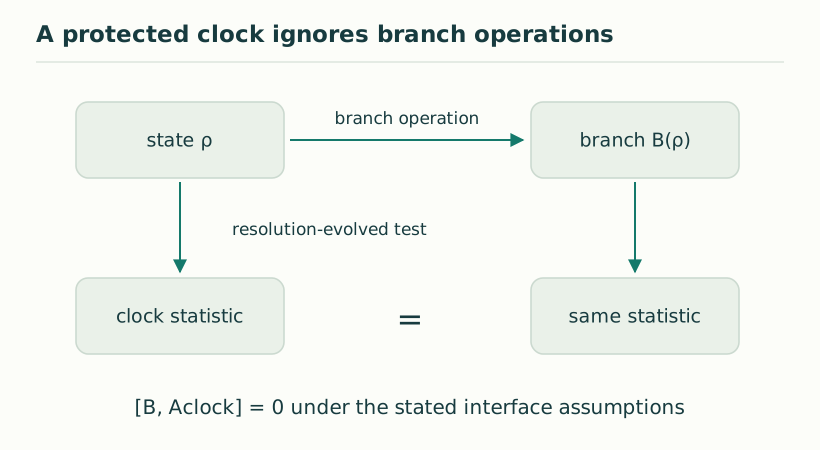
Read the layers as a dependency diagram. A later construction may require additional data even when the preceding theorem is correct. In particular, selecting phase does not automatically supply the algebra of stable records, a physical clock, or the field equations of gravitation.
Consider histories h and k that presently produce the same detector label. If an allowed continuation can distinguish them, identifying them now would erase information needed for future predictions. A robust observable equivalence therefore compares completed outcomes after every admitted continuation.
A simple example is a hidden two-state memory that prints the same symbol today but opposite symbols tomorrow. Today’s output is an inadequate predictive state. Enlarging the retained record or narrowing the admitted continuations changes the quotient. This illustrates why completion must specify an experiment language rather than merely declare an event finished.
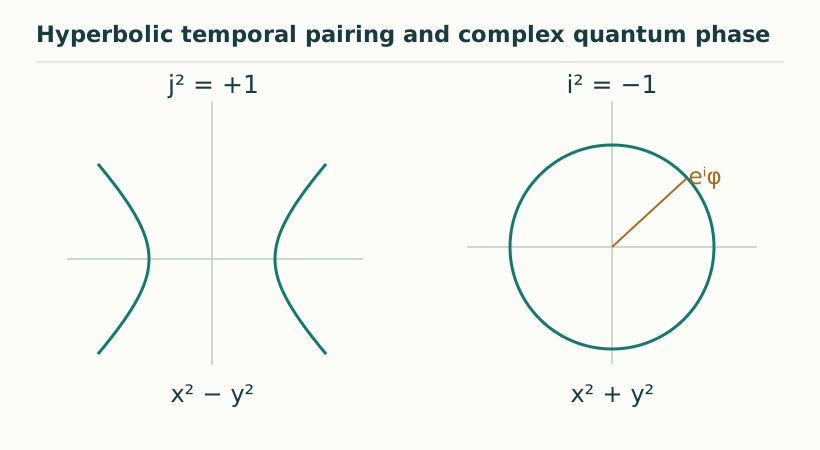
On a real plane, define J₀(x,y)=(-y,x). Applying it twice gives (-x,-y), while its transpose is its negative. Declaring multiplication by the complex number i to mean J₀ turns the real plane into a complex line. This is a reconstruction of scalar multiplication, not a new independent coordinate.
Now suppose a real state space carries a symmetry representation U(g). To use one phase convention consistently with those symmetries, require JU(g)=U(g)J. The admissible J operators lie in the commutant: the operators that commute with the representation. Not every real symmetry carrier admits the same family of choices.
For a nonzero planar rotation generator A=ωJ₀ with ω positive, the positive operator |A| is ωI. The factor A/|A| is therefore J₀. Reversing the orientation changes A to -A and selects -J₀. The positive magnitude determines the rate; the skew factor determines the direction in which phase rotates.
This finite-dimensional calculation makes the polar construction transparent. In an infinite-dimensional Hilbert space, domains, bounded extension of the phase factor, and the zero-frequency sector must be handled carefully. Writing an inverse symbol alone would hide those issues. A stationary direction cannot obtain an orientation from a generator that vanishes there.
Suppose a completed displacement has length at most a supplied length budget and takes a positive supplied delay. A bound of the form ||Δx||≤c*Θ defines a cone in the space of displacement-delay pairs. Rescaling the delay and length standards changes the numerical c* without changing the logical form of the inequality.
The important conceptual lesson is that a phase theorem and a causal-cone theorem solve different problems. The first constrains the algebra of state evolution. The second constrains admissible records of displacement. To identify the two descriptions as one physical world, the same source dynamics must provide the relevant interfaces and calibrations.
SMM supplies the ambition that one source underlies many observations. The completion framework makes part of that ambition precise: multiplicity is organized by the distinctions that remain observable after allowed processing. DTT adds the separation between generative ordering and the ordering of completed records.
A productive reading of this paper asks, at every arrow, what was supplied and what was obtained. The result is a reusable mathematical architecture. Its value does not require claiming that the architecture has already selected the unique dynamics of nature. The detailed phase, clock, geometry, and constants articles develop the next questions separately.
KEEP THE CONNECTION
Scope of the argument. Published mathematical framework; examples here are explanatory reductions, and physical matching remains a separate task.
Journal metadata checked against the linked published text. The accompanying guide identifies the opening material consulted and develops explanatory examples; it is not an independent audit of every proof.
Source register →