Four principles of quantum relativity: assumptions and consequences
Follow the four proposed principles through their mathematical dependencies. The guide connects complex temporal dynamics with SMM/DTT while identifying the extra assumptions needed to pass from an algebraic construction to a physical consequence.
The listed preprint proposes a temporal route toward a common limiting speed, Lorentz transformations, mass–energy equivalence, and an equivalence principle. These targets are connected, but proving one does not automatically establish the others. A useful reading organizes them into four questions: what limits propagation, what relates observers, what defines energy and momentum, and what couples matter to gravity?
SMM/DTT seeks a common origin for those answers in source generation and completion. The strength of the proposal therefore depends on whether the agreements follow from shared dynamics or were already inserted as independent interface assumptions.
02A finite update supplies a possible cone
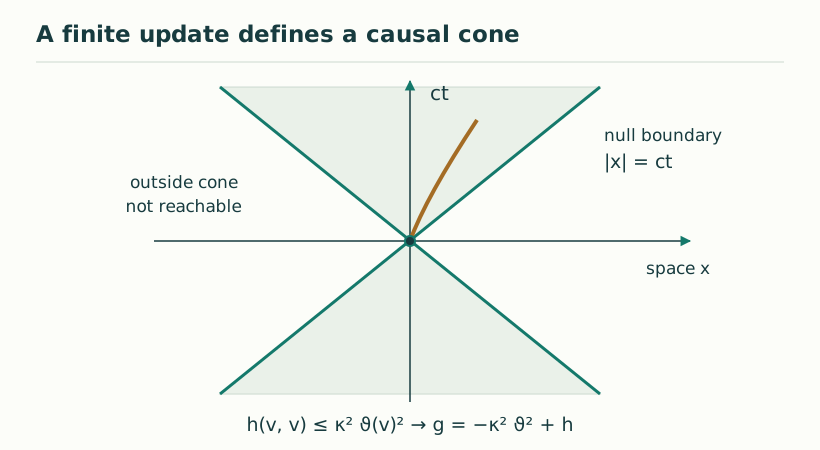
Suppose a completed step cannot advance a record farther than ℓ and requires at least a positive delay τ. With appropriate composition and a common calibration, many steps can satisfy ||Δx||≤(ℓ/τ)Δt. The ratio is an effective limiting speed for that specified update family.
The universality question is harder than this bound. Distinct species or detector channels could have different budgets and delays. A universal c requires a theorem or a physical selection law linking their extremal ratios. It cannot be obtained simply by writing the same letter on independently chosen parameters.
Figure 1. A finite update defines a causal cone. Illustrative finite-update geometry: displacement is bounded by update scale κ times projected inner duration. A Lorentzian metric or a shared light cone still requires the stated readout and field assumptions. View full size ↗
03Hyperbolic algebra reproduces a familiar transformation
For the split-complex unit j²=+1, multiplication by exp(jη)=coshη+j sinhη preserves x²-t², up to the assignment of units and coordinate order. Applied to z=ct+jx with a sign convention for η, it gives the standard algebraic shape of a one-space, one-time Lorentz boost.
This is an exact identity of the chosen algebra. To make it a derivation of physical observer transformations, one must show that measured durations and displacements obey that invariant and that observers realize the transformation. The algebra can represent the target symmetry without independently selecting nature’s readout.
04Mass–energy equivalence requires a dynamical dictionary
Once energy and momentum form a Lorentz four-vector with invariant mass m, the relation E²-p²c²=m²c⁴ gives E₀=mc² in the rest frame. The mathematical step is short; the physical content lies in identifying the source’s conserved quantities with measured energy and momentum.
A temporal oscillation frequency can be matched to energy through an action scale, but this does not determine that action scale. Similarly, a spectral gap can provide a candidate rest energy after its operator and calibration are fixed. A reconstruction must explain those identifications rather than count the final algebraic rearrangement as the whole derivation.
05The equivalence principle is a further universality demand
An inertial mass inferred from acceleration and a gravitational coupling inferred from motion in a gravitational field answer different operational questions. Their equality requires a common coupling structure. A model may possess Lorentz kinematics and still allow composition-dependent forces that violate the equivalence principle.
In the SMM/DTT program, the promising target is that source completion and matter propagation share the same locally calibrated geometry. The argument must show why different matter sectors couple to it in the required way. Naming their common substrate expresses the ambition but does not yet enforce the coupling law.
06A constructive route through the current article collection
Read the limiting-speed articles for the cone assumptions, the causal-reconstruction articles for observer geometry, and the quantum-generation articles for material clocks and propagation. Then construct a single table showing which primitive dynamics controls each observable. This exposes missing relations before they become hidden premises.
The result can still be valuable when conditional. An explicit model that satisfies all four targets under stated assumptions is a consistency witness and a place to search for new constraints. The next advance would remove a genuinely independent assumption or produce an additional observation fixed by the already calibrated model.
KEEP THE CONNECTION
Key ideas
The four principles impose different mathematical and physical requirements.
Split-complex algebra represents boosts once an invariant and readout are supplied.
A common-source explanation must derive agreement between the interfaces.
Scope of the argument. This article develops a dependency guide and elementary algebra, not a certification of every claim in the listed preprint.
Bibliographic status is as listed on the author’s papers page, checked 16 October 2026. The accompanying thematic guide states its source coverage and the additional steps needed to assess the proposed results.