Summarize the draft’s distinction between finite-volume constructions, screening results, and a volume-uniform quantum gap. Explain the connected-expansion step that remains unproved and the separate gauge-matching problem.
01Several positive results do not yet form a full gap proof
The seventh-revision gauge manuscript contains finite-cycle spectral calculations, exact center-selection thresholds and substantial regulated infrared analysis. Its strongest unresolved target is a volume-uniform quantum gap for the full periodic dual model, followed by controlled transfer to the gauge theory. The paper explicitly leaves this unproved. This is not a minor wording distinction: finite-volume positivity, local curvature and Euclidean screening answer different questions. The missing uniform estimate is consequently a specific target for further SMM/DTT gauge work; the existing finite and regulated results do not remove that obligation.
02Why finite volume is easier
At a finite regulator and volume, compactness or confinement in configuration space can give a self-adjoint Hamiltonian with a unique ground state and a positive first excitation gap. That gap may shrink as the spatial volume grows or the regulator is removed. A sequence of positive numbers can converge to zero, so positivity at every finite step is not enough. The required physical statement is a lower bound by one fixed positive scale, maintained in the stated limits and in the physical observable sector. A numerical spectrum in a small box cannot establish that uniformity.
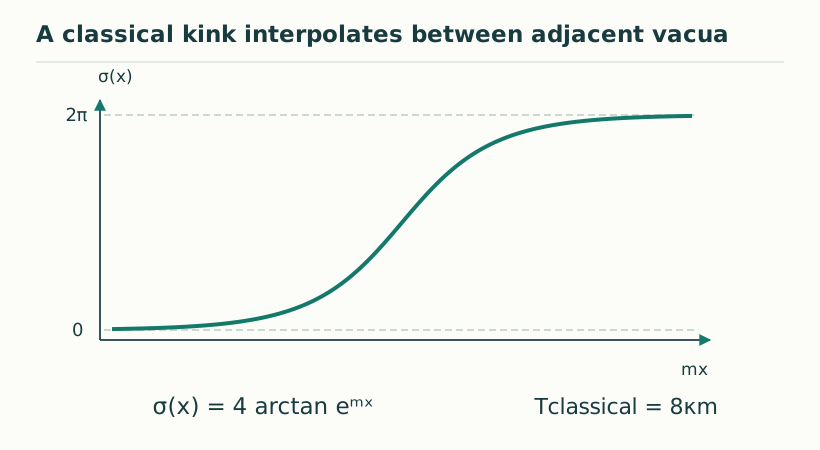
Figure 1. A classical kink interpolates between adjacent vacua. For the sine-Gordon-type dual-photon model, the classical profile σ(x) = 4 arctan exp(mx) interpolates from 0 to 2π and has Tclassical = 8κm under the stated normalization. Quantum gaps and matching remain separate questions. View full size ↗
03What the reference results establish
A convex continuation of one well admits a volume-independent gap bound under the manuscript’s assumptions. A separate periodic Euclidean regulator admits an established screening result. The full periodic quantum construction, in its declared zero-winding sector, has finite-volume vacuum control, reflection-positive time correlations, nontrivial subsequential limits and bounds on local moments and defect events. These are valuable ingredients. They do not become interchangeable merely because they involve similar cosine potentials. A proof must compare the actual Hilbert spaces, measures, regulators, observables and vacuum normalizations used in each result.
04The remaining marked connected expansion
The full periodic model includes excursions between lifted wells and correlated defect regions. The manuscript identifies a normalized connected expansion with marked observable insertions and uniform temporal decay as the missing step. Controlling the probability of a local defect is insufficient by itself: infinitely many possible locations and their correlations must be handled without a volume-dependent loss. Likewise, good-chart Gaussian decay must be combined with interfaces and defects in the normalized vacuum. The desired estimate would yield a common positive decay rate for the relevant connected correlations, supporting a spectral-gap conclusion under the appropriate reconstruction hypotheses.
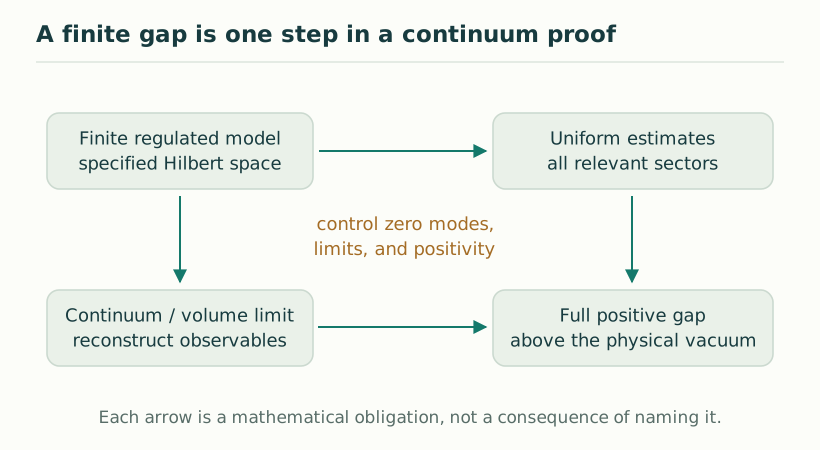
Figure 2. A finite gap is one step in a continuum proof. A finite-volume or charged-sector threshold does not by itself prove a full continuum mass gap. The diagram names distinct obligations: uniform control, physical-sector reconstruction, and a positive infinite-volume spectral threshold. View full size ↗
05Transfer to the gauge theory adds new obligations
Even a proved dual-model gap would need a controlled map to gauge observables and the physical gauge Hamiltonian. The matching must derive effective coefficients, bound omitted operators, retain source insertions and preserve a positive physical-unit gap uniformly in volume. Removing the gauge ultraviolet regulator is a separate limit from changing the dual cutoff. Finally, the undeformed four-dimensional target requires removing the physical circle and stabilizing deformation while retaining nontriviality, the quantum axioms and a positive gap. The weak-coupling small-circle hierarchy is not automatically valid in that continuation.
06The decay rate must be common, while amplitudes may vary
A spectral-gap argument based on connected correlations needs a positive temporal decay rate that applies across a sufficiently rich family of physical observables, with the precise reconstruction assumptions stated. Prefactors may depend on the observable; the lower spectral edge should not drift to zero as larger volumes are considered. A heavy-field matching error is not automatically controlled by a heavy decay rate: changing a light mass from m to m+δm changes long-time exponentials at the light scale. The draft highlights this issue because a small coefficient error can still spoil a long-time comparison if its decay is misidentified. Uniform control of the relevant normalized correlations is the needed bridge from local estimates to a quantum gap.
07What this means for SMM/DTT and the mathematical target
The official Yang–Mills problem asks for construction of a nontrivial four-dimensional quantum theory with a positive mass gap for each compact simple gauge group. The present finite-cycle and infrared analysis concerns a specified SU(2) deformed compactification and does not solve that problem. SMM/DTT can still contribute by deriving the action and matching data from one inner source or by proving a new uniform estimate. The six nested stages should generate an explicit dynamical restriction that helps discharge one of these obligations. A careful boundary statement strengthens the research program by identifying the exact theorem that would advance it.
KEEP THE CONNECTION
Key ideas
Finite-volume gaps and curvature masses do not establish a uniform quantum gap.
The full periodic model still needs the marked connected decay estimate.
Gauge matching and undeformed four-dimensional limits are additional open steps.
Scope of the argument. A scope audit of the working manuscript. No four-dimensional Yang–Mills existence or mass-gap solution is claimed.
Sources & further reading
Exact SU(2) Center-Selection Thresholds for a Finite-Cycle One-Loop Potential, seventh revisionyang_mills_holonomy_monopoles_v7(1).pdf, §§3–10, pp.8–32; gap and matching audit, pp.76–81
Working manuscript. Article-level references identify the consulted sections and the scope of the interpretation. No public URL was supplied for this exact manuscript version.