Introduce the exact minimization problem for the supplied one-loop potential with deformation. Explain how finite cycle size changes the center-selection threshold.
The draft studies SU(2) transport around a circle divided into M≥2 sites. Multiplying the links in order gives a holonomy Ω, defined up to conjugation by a gauge change. The question is not whether a cycle can be drawn, but which holonomy minimizes a specified effective potential. The potential combines the established one-loop gauge contribution with a supplied double-trace deformation. This is a well-posed finite-cycle minimization problem. In the SMM/DTT interpretation the ordered transports can model an internal operation sequence, while the physical compactification, action and couplings remain separate inputs.
02The holonomy coordinate and center symmetry
Write Ω=diag(e^(iφ/2),e^(−iφ/2)) with 0≤φ≤2π. Its trace is 2cos(φ/2). The center-symmetric conjugacy class is φ=π, where the trace vanishes and the eigenvalues are evenly spaced. This is different from a holonomy that lies in the group center, Ω=±I, occurring at the endpoints. Confusing these meanings reverses the spectral interpretation: central holonomies leave a larger neutral sector, whereas the center-symmetric class maximizes the smallest charged cycle frequency in the stated comparison.
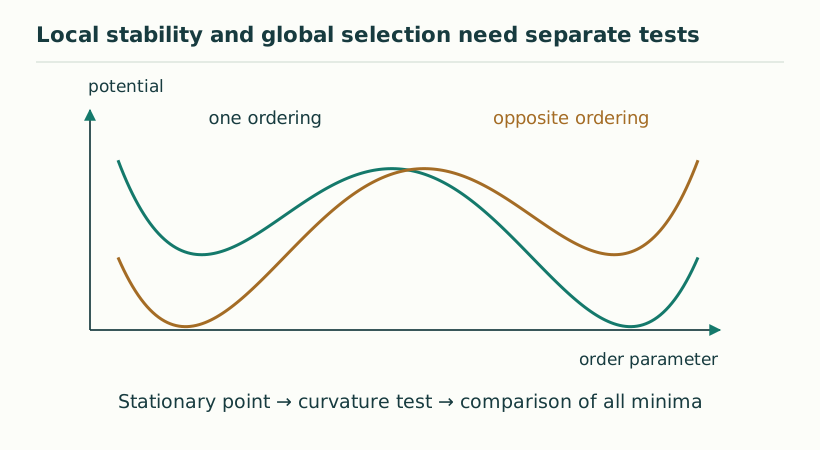
Figure 1. Local stability and global selection need separate tests. Illustrative order-parameter potentials distinguish a stable local well from the absolute minimum. The actual finite SU(2) threshold is obtained from the specified one-loop and deformation potential, not from this sketch. View full size ↗
03The specified effective potential
Normalize the gauge potential WM so that WM(0)=0 and add 4hcos²(φ/2), with h≥0. At the endpoints the total potential is 4h, while at the center it is WM(π). Comparing those values suggests a crossing, but a valid global proof must also exclude lower interior competitors. The draft establishes strict concavity when the potential is expressed in y=cosφ. The deformation is linear in y, so concavity remains. Every interior y lies above the chord between the endpoints and therefore cannot be a global minimum.
UM,h(φ)=WM(φ)+4hcos²(φ/2).
04The exact crossing and a numerical example
The global crossing is hc(M)=WM(π)/4. The finite sum evaluates to the displayed trigonometric expression. Below hc the two chamber endpoints minimize; above it the center minimizes; at equality all three are minima. At M=2 the threshold is approximately 0.497231, while at M=8 it is approximately 0.213836. These are dimensionless values for the supplied leading potential, not measurements of a fundamental interaction strength.
hc(M) = [M³/(6π)]{tan[3π/(4M)]−3tan[π/(4M)]}.
h<hc: φ=0,2π; h=hc: φ=0,π,2π; h>hc: φ=π.
05The continuum limit is controlled
As M grows at fixed circle length, the threshold approaches π²/48, with first correction π⁴/(192M²) and a controlled order-M⁻⁴ remainder in the draft. The potential and its first two derivatives also converge uniformly under stated bounds. This matters because a pointwise limit alone need not preserve stability information. If M is a regulator, these corrections are discretization effects. Treating M as a physical number of inner operations is a different interpretation and requires independent matching of M, spacing, physical length and the effective couplings.
hc(M)=π²/48+π⁴/(192M²)+O(M⁻⁴).
06What a source mechanism would have to explain
The undeformed one-loop determinant favors the chamber endpoints; it does not generate the stabilizing h. A SMM/DTT source theory should therefore calculate why the relevant completion dynamics produces a deformation of the required sign and magnitude, with a margin large enough to survive omitted corrections. It must also relate the operational cycle to the physical gauge compactification. The six nested inner levels are not automatically the M lattice sites of this regulator. The finite-cycle result provides a concrete selection threshold against which such a source proposal can be tested, without claiming that the threshold itself derives gauge dynamics.
KEEP THE CONNECTION
Key ideas
The global minimum is determined after interior competitors are excluded.
Finite-cycle center selection has an exact threshold and controlled continuum limit.
The stabilizing deformation is supplied, not generated by the one-loop calculation.
Scope of the argument. Exact minimization of the specified one-loop potential with deformation; not an all-order phase diagram or a derived SMM/DTT gauge action.
Sources & further reading
Exact SU(2) Center-Selection Thresholds for a Finite-Cycle One-Loop Potential, seventh revisionyang_mills_holonomy_monopoles_v7(1).pdf, §§3–10, pp.8–32; gap and matching audit, pp.76–81
Source editions and catalogue entries
Working manuscript
Exact SU(2) Center-Selection Thresholds for a Finite-Cycle One-Loop Potential
Working manuscript. Article-level references identify the consulted sections and the scope of the interpretation. No public URL was supplied for this exact manuscript version.