Use the operational-reduction result to assess whether two time variables carry distinct empirical content. The key question is which observations cannot be reproduced by the reduced description.
The phrase “two physical times” can mean two coordinates, two evolution parameters, a generative order and a record order, or two independently readable clocks. These statements are not equivalent. SMM/DTT’s minimal distinction concerns inner generation and outer completion; it need not posit two laboratory clock dials. An assessment should begin by stating the precise empirical claim. What observation would differ if the inner structure were removed? What controls are admitted? What resources may an alternative one-time model use? Without these declarations, a formal variable count is not a physical test.
02Write the complete interface
List the state preparations, continuous controls, closed protocols, output observables and laboratory clock convention. Preparations can reveal modes missed by control-only transfer functions. A transported detector can reveal holonomy hidden from a fixed parallel detector. A different time calibration can alter an apparent frequency law. The interface should therefore be treated as part of the model, not as an informal experimental afterthought. In an SMM/DTT construction it is also where completed records become public: the admitted tests determine which source-history distinctions count as observable.
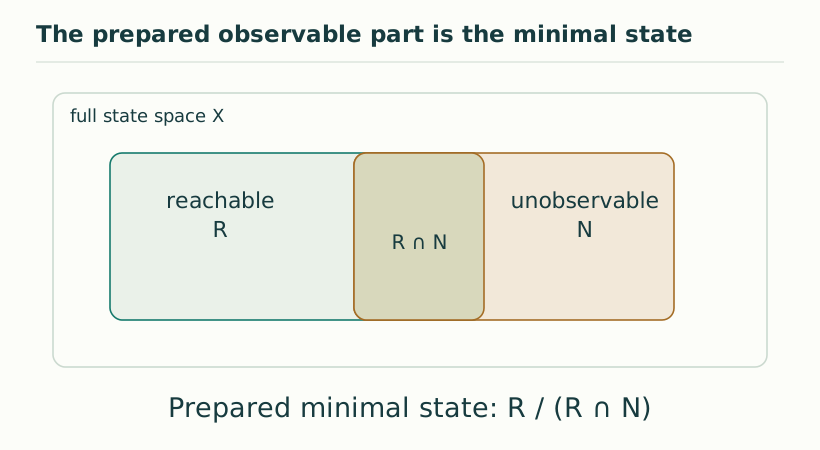
Figure 1. The prepared observable part is the minimal state. For a prepared linear interface, only reachable information that survives observational equivalence contributes to minimal behavior. The canonical state is R/(R∩N), not the entire hidden carrier. View full size ↗
03Test the finite linear reduction first
If the proposed behavior is finite dimensional and linear time invariant, construct the augmented source F=[B E], reachable space R and unobservable space N. Compute the minimal quotient and its Hankel rank. Check whether any memory kernel is strictly proper and rational; if so, it has a finite one-time auxiliary-state realization. This does not invalidate the generative interpretation, but it limits the claim that the behavior forces an extra time. A positive minimal-state dimension beyond a predeclared bound rules out that bound, not the entire one-time category.
04Check where holonomy acts
For a compact completion phase, calculate the full monodromy and its action on prepared minimal behavior. Under the parallel identities [H,A]=0, HF=F and CH=C, minimal monodromy is identity. A nontrivial H can survive only through an intertwiner from the unpreparable quotient to the unobservable sector. If the intended effect is visible, identify the precise reason these conditions fail or the category changes. A global geometric obstruction that never reaches a possible preparation or readout cannot explain a measured frequency, probability or clock discrepancy.
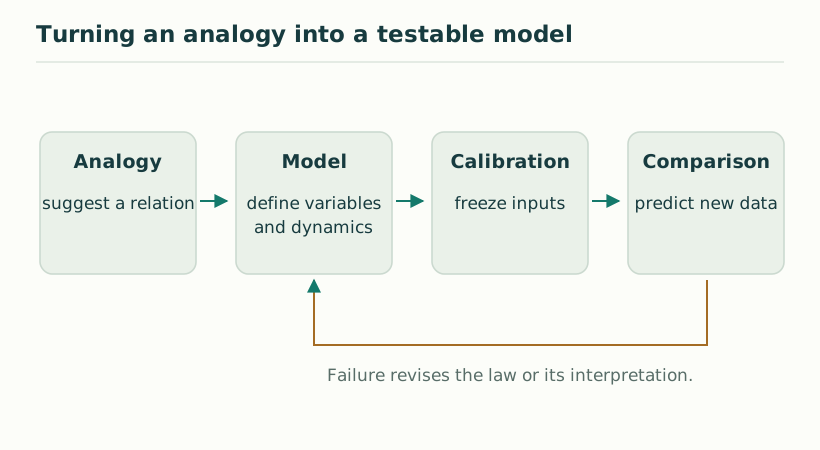
Figure 2. Turning an analogy into a testable model. A numerical or symbolic correspondence motivates a question. A physical claim needs a specified model, independent calibration, and a result that could disagree with observation. View full size ↗
05State the witness and the comparator together
A useful report pairs each witness with its exact exclusion. Nonrational memory can exclude finite linear embeddings. A loop-dependent output can exclude a fixed parallel interface. Accessible non-lumpability can exclude a current-record-only Markov predictor. None alone excludes a one-time model with arbitrary hidden memory, nonlinear controls or a continuum state. The comparison is stronger when both descriptions have the same resource budget. This is where the six nested inner levels might become scientifically distinctive: they could impose an economical or unavoidable relation that a specified comparator fails to reproduce.
06Exact no-go statements need a noise-aware counterpart
A theorem about identical transfer functions or zero loop response concerns exact mathematical data. A real protocol estimates responses with finite samples, calibration drift and limited bandwidth. Its conclusion should therefore be a bound: how far can an alternative model be from the observed response while remaining compatible with uncertainty? Near-unobservable modes and nearly rational kernels can be difficult to distinguish from exact reductions over a finite observation window. The source theory should specify a minimum effect size or resource-dependent separation that survives this uncertainty. This does not weaken the exact theorem; it supplies the missing bridge from an exact equivalence result to an experimental decision about a proposed temporal signature.
07An article-ready assessment table
The checklist should culminate in a transparent status statement rather than a binary verdict on the whole framework. A model may already establish an exact mathematical reduction, provide a possible witness and still lack a source-derived implementation. Separating those stages helps choose the next theorem or protocol.
An article-ready assessment table
Question
Evidence required
What does “two times” mean?
Operational definitions of generation and clock/record order
Which variables are accessible?
Prepared reachable and observable interface
Can memory be embedded?
Exact kernel and declared comparison class
Is holonomy visible?
A nonzero prepared loop response or richer invariant
What is distinctive?
A derived restriction and a precisely excluded comparator
What remains?
Source implementation, uncertainty and resource bounds
KEEP THE CONNECTION
Key ideas
Define temporal roles operationally before counting variables.
Attempt exact reduction within a declared comparator class.
A meaningful novelty claim pairs a witness with a specific exclusion.
Scope of the argument. A checklist grounded in the supplied finite linear theorem; broader theories require their own operational analysis.
Sources & further reading
Operational Reduction and Exact Holonomy Localization for Finite Linear Dual-Time ModelsOperational_No_Go_Exact_Holonomy_Localization_v4.pdf, complete manuscript, pp.1–9
Source editions and catalogue entries
Working manuscript
Operational Reduction and Exact Holonomy Localization for Finite Linear Dual-Time Models
Working manuscript. Article-level references identify the consulted sections and the scope of the interpretation. No public URL was supplied for this exact manuscript version.