Outline ways to move beyond the finite prepared linear interface: protocol-dependent access, noncommuting transport, or richer memory. Each route must be defined as an observable procedure.
An operational signature of dual-time structure must be attached to a procedure: how a state is prepared, how controls are ordered, what is transported and what is read. The no-go class in the holonomy draft assumes a fixed parallel interface. A richer protocol can leave that class by changing source or readout orientation, using noncommuting transports or accessing hidden predictive states. This is a constructive lesson for SMM/DTT. The task is to calculate a difference that a declared reduced model cannot reproduce, not merely to display two formal time variables in a set of equations.
02The prepared loop-response operator
For a loop γ with transport Hγ, compare the output after the loop with the output without it, using the same preparation. The difference is represented by Lγ(t)=Ce^(At)(Hγ−I)F. If Hγ commutes with A, fixes F and preserves C, this response vanishes. A nonzero result therefore identifies a failure of at least one parallel-interface identity or an incomplete interface description. The formula also makes the experiment concrete: choose an input direction v and an output component for which Lγ(t)v is nonzero.
Lγ(t)=Ce^(At)(Hγ−I)F.
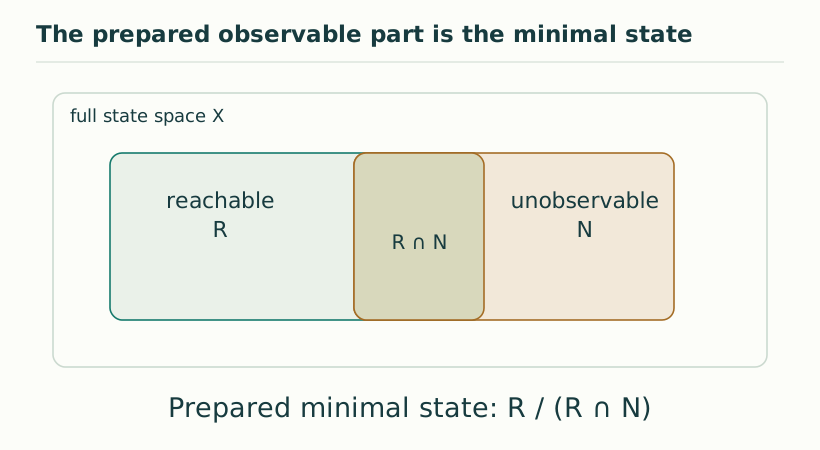
Figure 1. The prepared observable part is the minimal state. For a prepared linear interface, only reachable information that survives observational equivalence contributes to minimal behavior. The canonical state is R/(R∩N), not the entire hidden carrier. View full size ↗
03A simple detectable rotation
As an illustrative finite model, choose A=0 on a two-dimensional state space, prepare e₁ and read the first component. Let a loop apply an ordinary rotation Rθ. The output difference is cosθ−1. This is detectable for most angles and vanishes for a full return. It lies outside the invisible parallel class because the loop does not fix the preparation direction. The example is not proof of a second time: an ordinary one-time control sequence implementing the same rotation reproduces it. It shows what a protocol witness looks like and why the comparator must still be specified.
04Order-dependent controls provide another route
If two transported operations U and V do not commute, applying UV and VU can produce different completed records. The observable comparison should hold preparation, total clock convention and readout fixed while changing only the order. A commutator-based response can then be measured. Noncommutativity is familiar in quantum control, so its existence alone is not unique to DTT. A distinctive source result would constrain the commutator or relate it to another independently measured property of the nested inner hierarchy. The useful signature is the derived relation, not noncommutativity by itself.
05A predictive-state witness from record lumpability
Suppose two controllably prepared microscopic states yield the same current public record but different next-record distributions under the same intervention. If their total-variation distance is δ, any predictor using only the current record must make error at least δ/2 on one of the preparations. This follows immediately from the triangle inequality. For example, next-record probabilities 0.2 and 0.8 for a binary outcome differ by 0.6, so one record-only prediction has at least 0.3 error on one case. This proves the current record lacks predictive information, though a larger one-time hidden-state model may still suffice.
06Connect the witness to the source architecture
A future SMM/DTT protocol should state which inner histories are identified by current completion, which future tests separate them and how the six-stage update creates the difference. Then specify the one-time comparison class, including allowed memory, state dimension and control dependence. A witness can exclude a record-only Markov model, a bounded finite linear model or another resource-limited class without excluding every one-time description. Reporting that exact exclusion gives the result clear scientific content. The operational distinction is between two histories that merge into one present record yet separate under a common future test.
KEEP THE CONNECTION
Key ideas
A loop effect must be defined through a preparation–control–readout procedure.
A nonzero witness identifies which interface assumption fails.
The excluded one-time model class must be stated explicitly.
Scope of the argument. Constructive witness designs and exact bounds, not evidence that such a distinctive SMM/DTT effect has already been observed.
Sources & further reading
Operational Reduction and Exact Holonomy Localization for Finite Linear Dual-Time ModelsOperational_No_Go_Exact_Holonomy_Localization_v4.pdf, complete manuscript, pp.1–9
Source editions and catalogue entries
Working manuscript
Operational Reduction and Exact Holonomy Localization for Finite Linear Dual-Time Models
Working manuscript. Article-level references identify the consulted sections and the scope of the interpretation. No public URL was supplied for this exact manuscript version.