Two models can agree on every declared experiment while differing in mathematical structure that those experiments never access. Conversely, a change of coordinates can alter every displayed matrix while leaving the model exactly the same in an appropriate sense. The operational draft separates these questions for finite dual-time realizations. Empirical equivalence concerns prepared input–output behavior. Full structural equivalence concerns the bundle, its connection and all specified dynamical maps. SMM/DTT benefits from this separation because an interpretation of inner history need not be visible at every outer interface, but invisible structure cannot by itself establish a new observed effect.
02Behavior is represented minimally
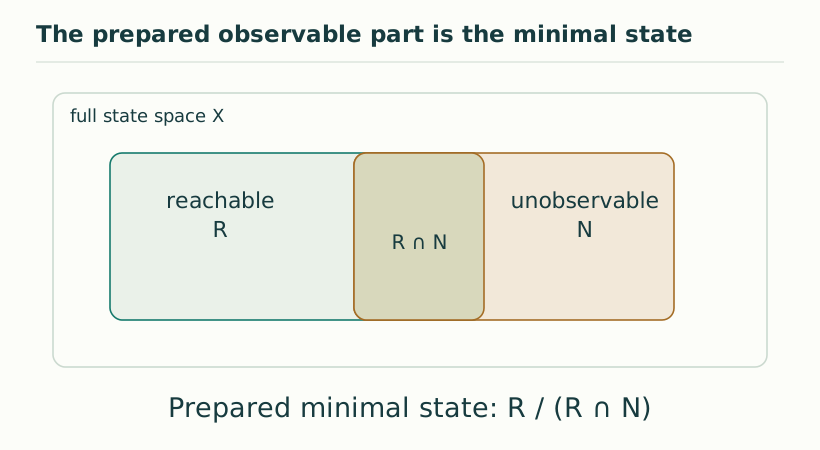
The canonical behavior uses Xcan=R/(R∩N), the reachable state space modulo unobservable distinctions. Minimal realizations of the same behavior are related by state similarity. A similarity changes the internal coordinates while preserving preparations, controls and readouts in the corresponding way. It is not a change of laboratory clock. The model may have many larger realizations with extra hidden states; those extensions can be behaviorally equivalent without being structurally identical. The appropriate notion of equivalence therefore depends on which structures the scientific claim treats as significant.
Figure 1. The prepared observable part is the minimal state. For a prepared linear interface, only reachable information that survives observational equivalence contributes to minimal behavior. The canonical state is R/(R∩N), not the entire hidden carrier. View full size ↗
03Global triviality of a cyclic connection
For a connection over a circle, a global parallel frame exists exactly when its monodromy H is identity. One way to see this is to lift the circle to its covering line, parallel-transport a basis and ask whether that basis returns unchanged after one period. If it does, the frame descends to the circle; if it does not, it cannot. This is a full-structure criterion. In the parallel prepared class, however, the induced monodromy on the minimal behavioral quotient is always identity even when the full H is not.
04A counterexample that separates the criteria
The two-coordinate model with A=diag(−1,−2), F=e₁, C=e₁ᵀ and H=diag(1,λ) has a one-dimensional accessible response for every λ>0. Choosing λ=1 or λ=2 does not change that response. The second choice nevertheless has nontrivial full monodromy and no global connection-preserving constant frame. Thus empirical reduction succeeds while full structured trivialization fails. This is not a contradiction: the second coordinate is neither preparable nor observable through the declared interface. The example proves that one criterion cannot be substituted for the other.
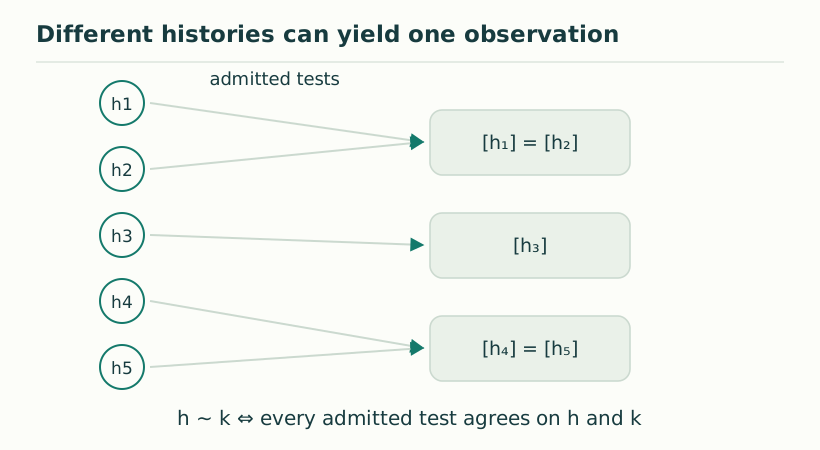
Figure 2. Different histories can yield one observation. The observational equivalence h ∼ k means that all admitted tests give the same result. Changing the test language can split an equivalence class and expose previously hidden distinctions. View full size ↗
05Why clock relabeling is another separate operation
A new parameter τ=φ(t) changes the coefficients of a differential equation by φ′(t) when waveforms are consistently pulled back. With nonzero dynamics or input coupling, preserving time invariance requires an affine φ. Even a constant rescaling changes the measured frequency response if the laboratory clock and input/output calibrations are held fixed. Therefore state similarity, gauge transformation and clock rescaling must not be conflated. An apparent removal of a second variable may succeed only by changing the measurement convention; an exact operational comparison should make that change visible.
06What a defensible SMM/DTT claim looks like
A source interpretation can remain mathematically richer than its minimal experimental representation. To claim empirical novelty, identify a preparation, transport or readout that detects that richness. To claim explanatory economy, state which structures the source unifies or constrains even if one interface alone cannot distinguish them. To claim inequivalence to a one-time model, specify the allowed comparator and which invariant it fails to reproduce. These are different achievements. Clear separation lets the framework retain a meaningful inner/outer architecture without turning every nontrivial internal connection into evidence for a second measured time.
KEEP THE CONNECTION
Key ideas
Prepared behavior and full bundle structure have different equivalence tests.
Nontrivial hidden monodromy can coexist with identical experiments.
Clock reparameterization is not ordinary state similarity.
Scope of the argument. A conceptual and mathematical distinction proved in the supplied finite linear setting, not a universal verdict on temporal ontology.
Sources & further reading
Operational Reduction and Exact Holonomy Localization for Finite Linear Dual-Time ModelsOperational_No_Go_Exact_Holonomy_Localization_v4.pdf, complete manuscript, pp.1–9
Source editions and catalogue entries
Working manuscript
Operational Reduction and Exact Holonomy Localization for Finite Linear Dual-Time Models
Working manuscript. Article-level references identify the consulted sections and the scope of the interpretation. No public URL was supplied for this exact manuscript version.