Introduce finite Markovian embeddings of strictly proper real-rational memory. Explain why a hidden-memory description does not automatically imply an additional observable temporal degree of freedom.
01Memory does not automatically mean a second time
A retained variable can depend on its past because unobserved variables store information. Eliminating those variables creates a memory kernel even when the full dynamics uses one laboratory time. The operational draft proves this explicitly for finite linear systems with rational kernels. The result matters for DTT because inner generation and outer completion are distinct roles, but the appearance of a history-dependent outer equation alone does not establish two independently observable time parameters. The question is whether the proposed behavior can be represented by a one-time system in a clearly declared comparison class.
02Eliminating an auxiliary state
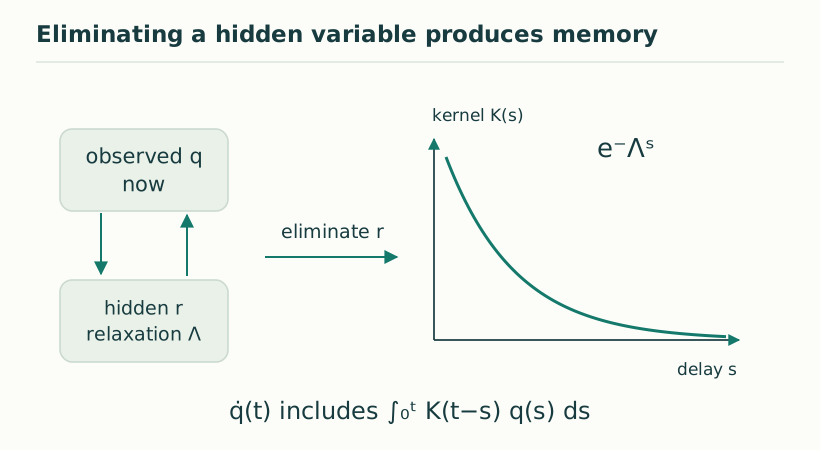
Split the state into retained z and auxiliary r, with dr/dt=Rr+Nz. Variation of constants gives r(t)=e^(Rt)r(0)+∫₀ᵗe^(R(t−s))Nz(s)ds. Feeding Lr into the z equation produces a memory term with kernel K(t)=Le^(Rt)N, plus an initialization term from r(0). The construction shows both the origin of memory and the importance of initial preparation. Discarding that preparation term can make two descriptions appear inequivalent simply because they were assigned different initial conditions.
K(t)=Le^(Rt)N; K̂(s)=L(sI−R)⁻¹N.
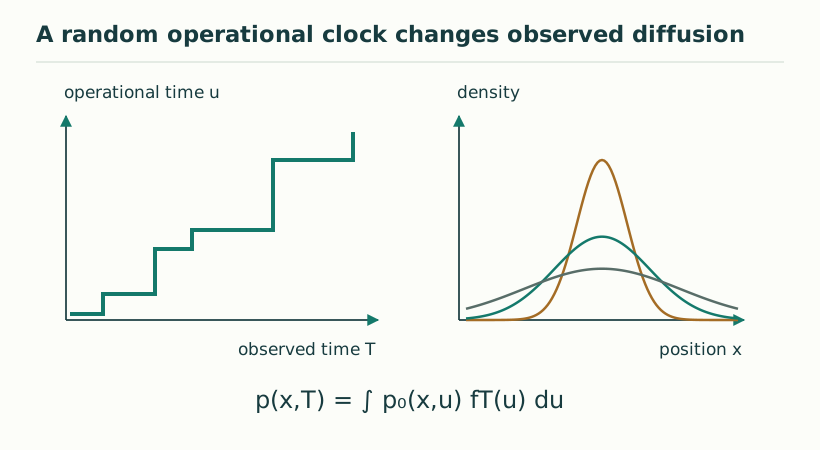
Figure 1. A random operational clock changes observed diffusion. The illustration subordinates diffusion in operational time u to an intermittent clock u(T). Flat portions represent waiting periods. The resulting memory does not imply two independently readable laboratory clocks. View full size ↗
03A one-exponential worked example
Suppose dz/dt=−az+br and dr/dt=−γr+dz, with constants chosen in a stable regime. Eliminating r yields an exponentially decaying memory term bd∫₀ᵗe^(−γ(t−s))z(s)ds and an initial contribution be^(−γt)r(0). Conversely, introducing the one auxiliary variable r converts that integral equation back into two ordinary first-order equations using the same time t. The retained equation remembers its past; the full state is Markovian. This is a concrete counterexample to the inference that an exponential memory tail proves a second physical time.
04The exact rational-kernel criterion
Every strictly proper real-rational matrix transfer kernel has a finite real state-space realization. Its minimal auxiliary dimension is its McMillan degree. Conversely, eliminating finitely many linear Markovian variables produces such a rational kernel. “Strictly proper” means the kernel vanishes at large Laplace frequency; instantaneous feedthrough terms can be separated explicitly. The theorem concerns exact behavior, not merely an approximation over a finite frequency band. In noisy experiments, a fitted rational response may be a useful approximation without proving that the underlying memory is exactly finite dimensional.
Figure 2. Eliminating a hidden variable produces memory. For a linear relaxing hidden sector, substitution produces a Volterra memory term. An exponentially decaying kernel is the simplest example; its fast limit can yield local effective dissipation under additional assumptions. View full size ↗
05What lies outside this comparator
A pure time delay has transform e^(−sT), which is not rational and therefore has no exact finite-dimensional linear state-space realization. A continuum reservoir can similarly produce branch cuts or infinitely many modes. Such behavior excludes the finite linear comparator, but it does not exclude ordinary one-time delay equations, infinite-dimensional fields or nonlinear hidden-state models. A physical interpretation must state the class being ruled out. Increasing the complexity of a one-time representation may be costly or conceptually revealing, yet that cost is different from a theorem that an extra time dimension exists.
06An algebraic realization need not be a physical reservoir
The rational-realization theorem guarantees finite real matrices, but additional physical requirements impose additional constraints. A stable reservoir needs appropriate pole locations; passivity or positivity can restrict residues and couplings; a quantum realization must respect the relevant commutation and complete-positivity conditions. A rational kernel fitted to data may have an algebraic embedding that violates those requirements. Therefore an SMM/DTT comparison should not stop at the existence of any matrix realization when the alternative is required to be a physical apparatus with a finite energy budget. The fair question uses the same declared physical constraints on both descriptions. Conversely, imposing extra constraints only on the comparator would create an artificial claim of temporal necessity.
07The constructive SMM/DTT question
A source model can use inner recurrence to generate a particular memory kernel. Its contribution becomes more than a reinterpretation if it derives a restricted kernel, a cross-observable relation or a resource bound that competing models do not share. The six nested stages might constrain the pole structure or the admissible realization dimension, but that relation must follow from explicit updates and retained memory. A useful test would compare several preparation and control protocols with one frozen kernel model. This asks what completion actually preserves while avoiding an unsupported inference from memory alone to temporal ontology.
KEEP THE CONNECTION
Key ideas
Finite exponential memory can be represented by extra states in one time.
Rational kernels have exact finite realizations with a definite minimal dimension.
Nonrational memory excludes that finite class, not every one-time theory.
Scope of the argument. Exact within the finite linear rational-kernel class; broader source or field models require separate comparison results.
Sources & further reading
Operational Reduction and Exact Holonomy Localization for Finite Linear Dual-Time ModelsOperational_No_Go_Exact_Holonomy_Localization_v4.pdf, complete manuscript, pp.1–9
Source editions and catalogue entries
Working manuscript
Operational Reduction and Exact Holonomy Localization for Finite Linear Dual-Time Models
Working manuscript. Article-level references identify the consulted sections and the scope of the interpretation. No public URL was supplied for this exact manuscript version.