
In this article
- A loop can be structurally real and experimentally invisible
- The parallel-interface assumptions
- Why reachable states see identity
- The exact classification
- A two-coordinate example
- How the result guides a dual-time proposal
Explain the draft’s classification of residual parallel monodromy invisible to the prepared interface. Nontrivial structure can survive outside the behavior an experiment can access.
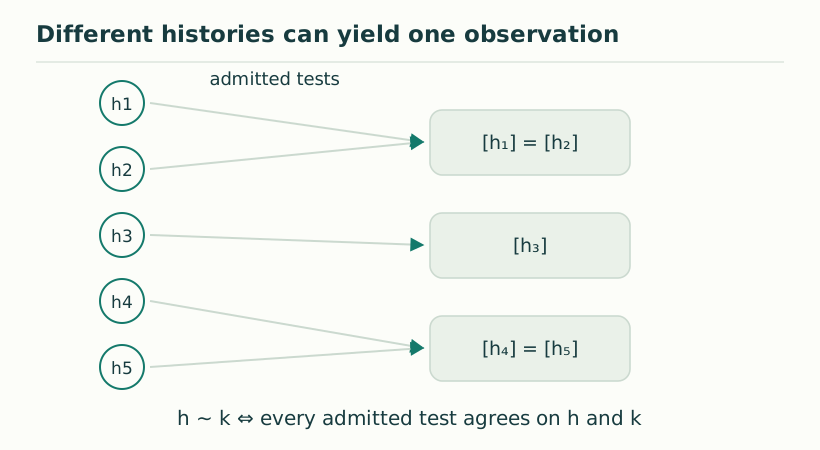
Transport around a cyclic completion parameter can return a state transformed by a monodromy H. A nonidentity H is meaningful structure of the full bundle and connection. Yet an experiment may be unable to prepare or read the directions on which it acts. The operational draft classifies this situation exactly for a finite linear interface. This sharpens SMM/DTT’s distinction between inner histories and outer records: hidden phase structure can survive mathematically without producing an additional observable temporal variable. Its location and compatibility with dynamics can be specified rather than left as a vague hidden sector.
The state bundle is over a compact phase circle, with generator A, source map F and output map C parallel under its connection. After one loop these assumptions imply that H commutes with A, fixes every source direction and leaves every output unchanged. They are substantive restrictions. A protocol that rotates the source or readout, or changes the dynamics along the path, may lie outside this class. On a one-dimensional smooth base the curvature two-form vanishes, but global monodromy can still be nontrivial.
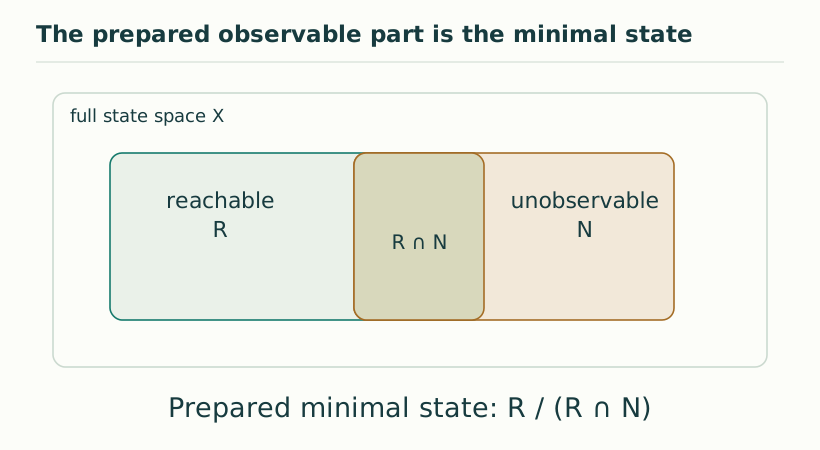
Every reachable state is a linear combination of AᵏFv. Commutation gives HAᵏFv=AᵏHFv=AᵏFv. Thus H fixes the entire reachable space pointwise. Moreover, CAᵏ(H−I)x=0 for every x and every k, so the image of H−I lies in the unobservable space. These two short calculations locate all possible nontrivial action: it must start from information that cannot be prepared and end in information that cannot be observed. In particular, the prepared minimal quotient has identity monodromy.
Let qR map X to X/R and let ιN include N in X. Every compatible invisible monodromy has the form H=I+ιN KqR, where K intertwines the induced dynamics on X/R with the dynamics on N and the resulting H is invertible. The factorization is unique. Conversely, every such intertwiner produces a compatible invisible monodromy when invertibility holds. If the system is completely reachable, X/R vanishes; if it is completely observable, N vanishes. Either condition removes this residual freedom.
Take A=diag(−1,−2), F=e₁ and C=e₁ᵀ. Only the first coordinate can be prepared and observed. A monodromy H=diag(1,λ), λ>0 and λ≠1, leaves every declared response unchanged while acting nontrivially on the second coordinate. The prepared minimal state is one-dimensional and has Hmin=1. The full connection is still not globally parallel-trivial. If a new preparation and readout channel gives access to the second coordinate, the old invisibility conclusion no longer applies to that enlarged interface. Operational status is therefore relative to what experiments are actually admitted.
A claim that inner temporal holonomy explains an observed effect should identify where it escapes this theorem. Does transport fail to commute with A? Is the source transported? Does the readout depend on the protocol? Is the state space nonlinear or infinite dimensional? Any of these can be a constructive route, but the resulting observable must be calculated. Merely adding a nontrivial loop in a sector inaccessible to every preparation and readout cannot explain a measured atomic shift. The theorem gives a precise design rule for making the proposed generative phase structure empirically relevant.
KEEP THE CONNECTION
Scope of the argument. Exact for a finite parallel completion bundle with the stated interface identities; it does not rule out nonparallel or richer protocols.
Draft file: Operational_No_Go_Exact_Holonomy_Localization_v4.pdf
Working manuscript. Article-level references identify the consulted sections and the scope of the interpretation. No public URL was supplied for this exact manuscript version.
Source register →