Introduce the regulated monopole-gas matching prescription as a conditional infrared application. Explain why the effective model still requires supplied couplings and weights.
At a center-symmetric small circle, charged gauge modes have a threshold while a Cartan gauge field remains perturbatively massless. The continuum application in the draft uses monopole-instanton sectors to generate an effective potential for the dual photon. This is an established compactified gauge-theory mechanism employed as a conditional matching target. SMM/DTT may interpret ordered internal transport as part of a generative process, but that interpretation does not calculate the gauge coupling, circle size or monopole event weights. Those quantities must be supplied or derived before the effective model has quantitative content.
02The regime must separate scales
The application assumes a small physical compactification circle and weak coupling, a stabilizing deformation safely selecting the center, and well-separated monopole events. The light dual-photon scale must be much smaller than the holonomy-scalar and charged-mode scales. These conditions permit heavy degrees of freedom to be integrated out while retaining a controlled low-energy description. Replacing a continuum charged threshold with a finite-lattice expression does not automatically produce finite-spacing monopole weights. Their saddle actions, determinants and measures require a separate matching calculation in the same regulator.
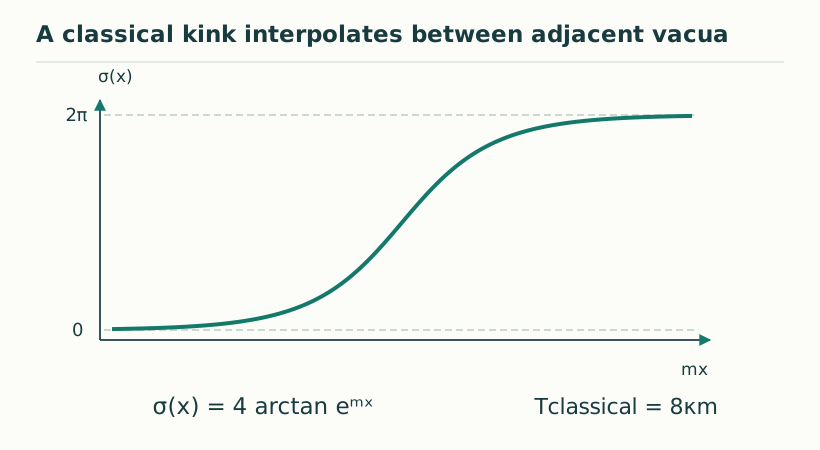
Figure 1. A classical kink interpolates between adjacent vacua. For the sine-Gordon-type dual-photon model, the classical profile σ(x) = 4 arctan exp(mx) interpolates from 0 to 2π and has Tclassical = 8κm under the stated normalization. Quantum gaps and matching remain separate questions. View full size ↗
03How the cosine arises
At fixed regulated dual field σ, an event with magnetic charge qi contributes a factor exp(iqiσ), and an anti-event contributes its conjugate. Summing independent event numbers with Poisson weights exponentiates their contributions into a cosine. For the two leading species at θ=0, both charge signs give the same cosσ term. With event weights fM and fK, the coefficient is A=2fM+2fK in the draft’s convention. This is an exact Poisson identity inside the regulated effective event model; matching it to the underlying gauge ensemble uses the dilute approximation.
After subtracting the vacuum constant, the leading action is ∫[κ(∇σ)²/2+A(1−cosσ)]d³x. Expanding near σ=0 gives a classical curvature mass mσ²=A/κ. The coefficient κ sets the gradient stiffness and A sets the potential scale. Both depend on matching conventions. Their ratio determines the leading light scale, but the result is not yet an exact quantum pole mass. Higher harmonics, derivative operators and quantum corrections can modify the low-energy predictions.
Sdual = ∫d³x [κ(∇σ)²/2 + A(1−cosσ)].
A=2fM+2fK; mσ²=A/κ.
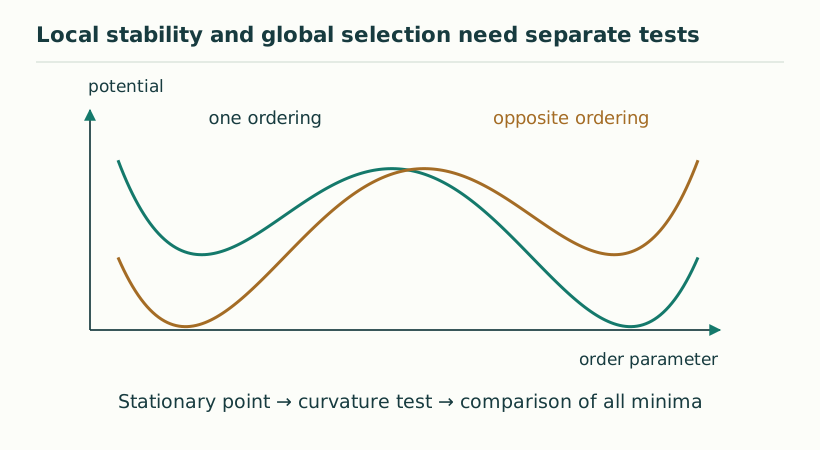
Figure 2. Local stability and global selection need separate tests. Illustrative order-parameter potentials distinguish a stable local well from the absolute minimum. The actual finite SU(2) threshold is obtained from the specified one-loop and deformation potential, not from this sketch. View full size ↗
05Why a symbolic fugacity is not a calculation
An event weight can be written schematically as L⁻³Ci exp(−Si), but the prefactor Ci includes fluctuation determinants, collective coordinates, regulator dependence and corrections to the chosen saddle action. Factoring out an exponential does not determine Ci. A shared ultraviolet prescription is necessary because changing the normal ordering of exp(iσ) changes the coefficient assigned to an event. Correlations between nearby events also generate corrections to the independent Poisson model. A reliable source derivation must control these effects rather than identifying an appealing exponential with the complete physical weight.
06A dimensional audit of the matched action
In the three-dimensional effective action, with natural mass units, σ is dimensionless, κ has mass dimension one and A has mass dimension three. Hence A/κ has mass dimension two, as required for mσ². The planar tension has mass dimension two, consistent with 8√(κA). Event weights fi also have mass dimension three, explaining the factor L⁻³ in a schematic fugacity. These checks are simple but valuable when an operational inner-cycle parameter is mapped to a physical compactification length. A dimensionless count M cannot replace L or κ by itself. A source proposal needs a length and action dictionary before its event count can be converted into a physical mass or tension.
07The connection to temporal completion
A compact internal sequence and a topological event are both compositional structures, but they have different mathematical definitions. The useful SMM/DTT question is whether one autonomous source generates the link action and measure whose effective event expansion has the required positive weights and scale hierarchy. The six nested inner levels must enter that update explicitly. If they merely motivate the names of cycle variables, the gauge calculation remains a downstream model study. The required matching chain runs from charged and holonomy modes to a regulated event gas and then the dual scalar. Each uncomputed coefficient remains a separate matching obligation.
KEEP THE CONNECTION
Key ideas
Monopole matching addresses neutral dynamics left open by the charged threshold.
The cosine follows from a regulated dilute-event construction.
Stiffness and event weights remain quantitative matching inputs.
Scope of the argument. A conditional small-circle semiclassical application with supplied matching data; no source-derived monopole weights or exact gauge mass gap is claimed.
Sources & further reading
Exact SU(2) Center-Selection Thresholds for a Finite-Cycle One-Loop Potential, seventh revisionyang_mills_holonomy_monopoles_v7(1).pdf, §§3–10, pp.8–32; gap and matching audit, pp.76–81
Source editions and catalogue entries
Working manuscript
Exact SU(2) Center-Selection Thresholds for a Finite-Cycle One-Loop Potential
Working manuscript. Article-level references identify the consulted sections and the scope of the interpretation. No public URL was supplied for this exact manuscript version.