
In this article
- A calculable benchmark in the dual model
- The small-fluctuation mass
- Deriving the kink tension
- A dimensionless example and its quantum limit
- A second harmonic changes the ratio
- What a temporal source prediction would require
Explain the classical dual-photon relation between kink tension, stiffness, and mass in the specified model. Discuss why additional harmonics change the relation and require an error analysis.
Once the effective dual-photon action is specified, one can derive an exact classical relation between the potential curvature and the energy of a winding profile. This provides a useful benchmark for normalization and correction analysis. It does not depend on treating the Single Monad as a literal magnetic object. In the SMM/DTT program, the relevance is methodological: a proposed temporal source should produce a definite effective action whose consequences can be computed and checked. The leading sine-Gordon action is such an action, but its coefficients are matching inputs until the source construction determines them.
Take gradient stiffness κ>0 and potential A(1−cosσ), A>0. Near a minimum, the potential is Aσ²/2 plus higher powers. With canonical variable χ=√κσ, the quadratic energy has mass parameter mσ²=A/κ. This is a classical curvature mass. It is not automatically the quantum spectral gap or the mass measured in every gauge-invariant channel. The distinction is particularly important because some physical operators may couple to multi-particle or symmetry-neutral sectors rather than directly to one dual-photon excitation.
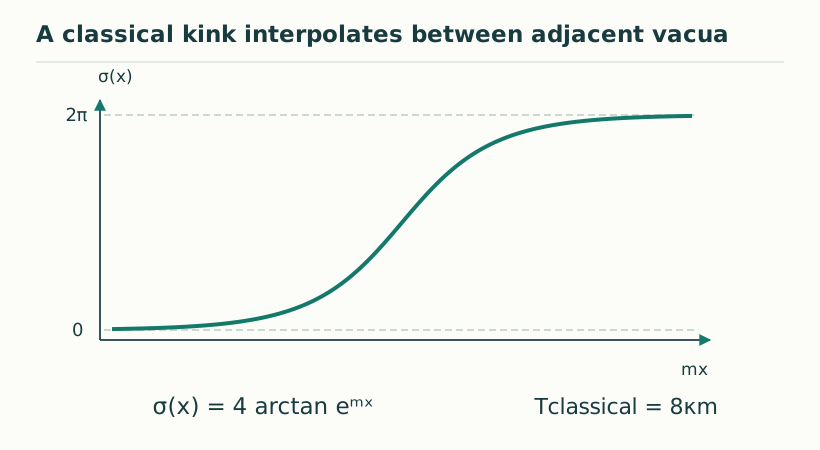
For a planar profile σ(z) joining adjacent lifts 0 and 2π, the energy per area is the integral of κ(σ′)²/2+V(σ). Completing the elementary square gives a lower bound ∫₀²π√(2κV(s))ds. A monotone profile saturates it when σ′=√(2V/κ). For the cosine potential, integration yields the familiar profile and tension. The two endpoints are equivalent lifts of the periodic vacuum; the construction does not assert two distinct physical vacua at θ=0.
Set y=mσ(z−z₀). The winding profile runs smoothly from zero to 2π, and its normalized energy density is 4sech²y. Its integral is eight, making an exact numerical check of any discretized classical solver. Quantum fluctuations can renormalize both the mass and tension. Rescaling the three-dimensional action shows the loop-counting parameter mσ/κ; the leading semiclassical treatment requires it to be small after matching. Enlarging the Wilson loop suppresses boundary effects but does not remove a quantum correction proportional to its area.
Add B(1−cos2σ) and define η=B/A. For η>−1/4 the adjacent lifted minima remain separated by a positive barrier. The curvature mass becomes mη²=(A/κ)(1+4η), while the tension becomes 8√(κA)I(η), with I(η)=∫₀¹√(1+4ηu²)du. Expanding gives T/(8κmη)=1−4η/3+O(η²). Thus the number eight is not a universal topological constant independent of the action. The draft supplies a controlled remainder for bounded |η|<1/4, and the expansion loses uniformity near the vanishing-curvature endpoint.
A source model could predict a relation among κ, A and B, producing a testable corrected ratio. It must compute those coefficients and the competing derivative and loop corrections in a common prescription. Choosing B to match a desired tension would be calibration, not a prediction from inner dynamics. The six nested levels may constrain allowed winding operators, but they do not by themselves fix their weights. This article therefore provides an exact classical target, a sensitivity calculation and a clear separation between the shape of a topological profile and the physical quantum observables of a matched gauge theory.
KEEP THE CONNECTION
Scope of the argument. Exact classical variational statements for the displayed effective action, with quantum and gauge matching treated separately.
Draft file: yang_mills_holonomy_monopoles_v7(1).pdf
Working manuscript. Article-level references identify the consulted sections and the scope of the interpretation. No public URL was supplied for this exact manuscript version.
Source register →