
In this article
- Which spectrum is being discussed?
- The exact finite-cycle eigenvalues
- The kernel is a centralizer
- What center symmetry optimizes
- The correct inequality includes a projection
- The SMM/DTT research consequence
Explain the importance of neutral modes and centralizer kernels when interpreting a cycle spectrum. A positive threshold in one sector need not gap every physical excitation.
The cycle operator measures the cost of varying an adjoint field around a holonomy-bearing compact direction. A positive frequency in one part of its spectrum does not imply every physical excitation is massive. The draft separates charged root directions from neutral directions commuting with holonomy. This is essential for SMM/DTT proposals that associate a compact inner cycle with a mass scale. A lowest nonzero cycle frequency can be a useful ingredient, but a complete quantum mass gap requires control of the entire physical spectrum after constraints and interactions are included.
For a holonomy with eigenangles φa, charged adjoint modes carry phase differences φa−φb. Their discrete Fourier eigenvalues are 4aτ⁻²sin²[(2πm+φa−φb)/(2M)]. Diagonal Cartan modes instead have 4aτ⁻²sin²(πm/M). At m=0 the Cartan family has zero eigenvalue. These formulas follow by distributing the holonomy uniformly around the cycle and diagonalizing the covariant difference operator. They are exact for that finite operator and its stated normalization, not direct eigenvalues of the full interacting quantum Hamiltonian.
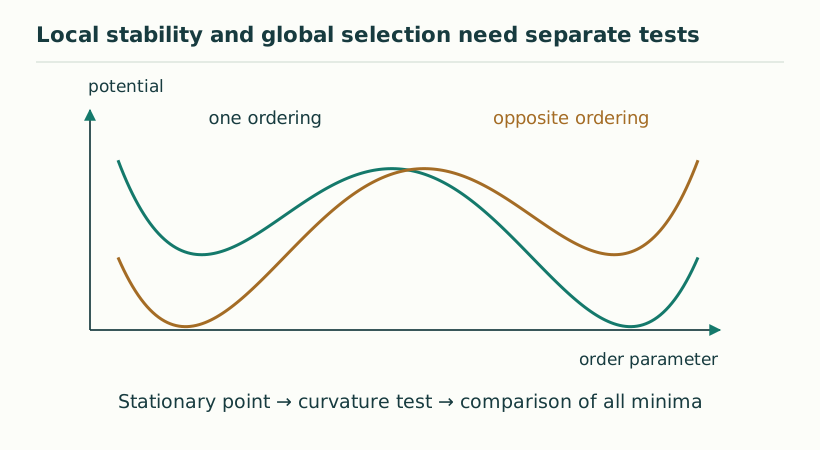
A zero mode is a covariantly constant adjoint section. Its value at one vertex must commute with the total holonomy, so the kernel is identified with the Lie-algebra centralizer z(Ω). For SU(Nc), regular holonomy leaves Nc−1 neutral directions; degeneracies enlarge the kernel. This is a gauge-covariant statement and cannot be removed simply by dropping inconvenient diagonal matrix entries. A physical projection must be justified by constraints and observables. Otherwise a claimed gap has been created by excluding real degrees of freedom from the statement.
Evenly spacing the holonomy eigenvalues maximizes their smallest circular separation, since all separations around the circle sum to 2π. This maximizes the minimum charged root frequency with zeros included. For SU(2), center symmetry gives mch=(2M/L)sin[π/(2M)], approaching π/L as the regulator is refined. The neutral Cartan zero mode remains. A central holonomy Ω=±I instead has zero charged root separation. This explains again why “center-symmetric” and “in the center” cannot be used interchangeably.
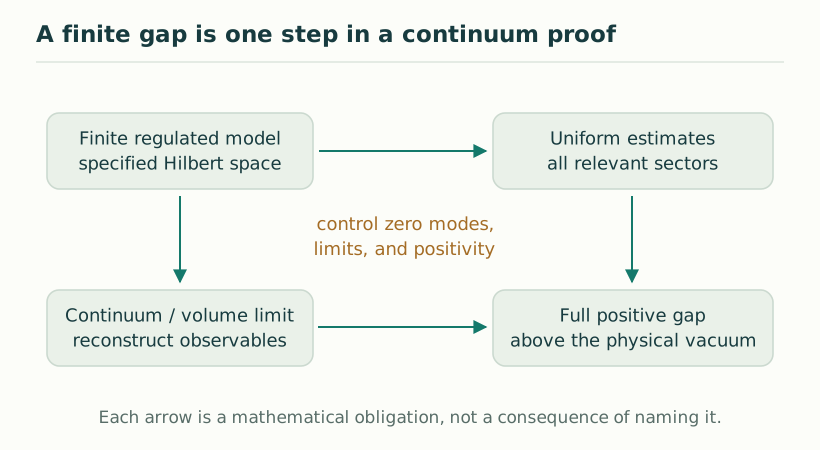
Let Pneu project onto neutral parallel sections. The cycle energy obeys a lower bound on the orthogonal complement: ||DUX||²≥mch²||(I−Pneu)X||² at regular holonomy. Removing the projector would make the statement false for any nonzero neutral X, whose left side vanishes. This one-line counterexample is a useful audit for mass-gap proposals. A charged threshold can justify integrating out certain heavy modes in a suitable regime, but the neutral sector then needs its own dynamics. In the compactified gauge model, monopole effects are introduced precisely to address that remaining sector.
If inner temporal transport is proposed as an origin of mass, the theory must identify which source modes become physical matter, which are constrained away and which remain neutral. The same source must supply their interactions and a positive lower bound in the relevant physical Hilbert space. A frequency scale π/L is not automatically an electron mass, a glueball mass or a universal gap. The six-stage hierarchy may organize representations, but a compact-cycle calculation alone does not settle the quantum spectrum. Its proper role is a rigorous sector-specific result and a guide to the missing neutral dynamics.
KEEP THE CONNECTION
Scope of the argument. An exact finite-operator spectrum and restricted inequality, not a proof of a full quantum or four-dimensional Yang–Mills mass gap.
Draft file: yang_mills_holonomy_monopoles_v7(1).pdf
Working manuscript. Article-level references identify the consulted sections and the scope of the interpretation. No public URL was supplied for this exact manuscript version.
Source register →