
In this article
- The distinction DTT needs to explain
- Histories, completion, and observation
- Why a returning phase must certify something
- A simple cycle example
- Where the six nested levels belong
- What this reconstruction achieves
Explain the draft’s same-cycle foundation: inner action is primitive, while outer record order comes from completed observable returns. Neither role automatically supplies a second readable laboratory clock.
The Single Monad Model proposes one generative source rather than a collection of independently existing spatial substances. Duality of Time Theory distinguishes the operations by which a configuration is generated from the completed records through which that configuration becomes available. These are two explanatory roles. A mathematical realization must specify how the same process supports both roles, instead of adding an unrelated second clock and naming it outer time.
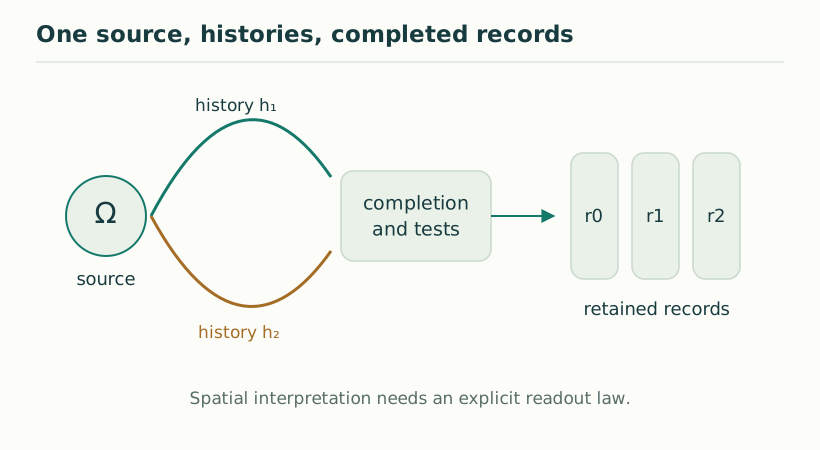
The same-cycle formulation makes a particularly economical choice: one inner action is primitive; an outer action is obtained only from those completed returns that act consistently on observable records. The proposal therefore starts with histories and their composition, before a duration scale or spacetime metric is supplied.
Let A denote the collection of admissible histories, including the rules for composing compatible histories. Completion identifies histories that produce the same completed record. A second identification uses the tests an observer can actually perform. Writing c for completion and q for observational identification gives a composite map Π=q∘c from a history to its observable class.
An inner operation Uᵢ can act on observable classes only if it respects this identification. If two histories have the same present observable class but Uᵢ sends them to different observable classes, the operation cannot be represented as a function of that class alone. This is an exact information requirement, not a matter of choosing notation.
A periodic marker attached to a model is not automatically a completion detector. The draft introduces a closure certificate κcl obtained from the record-formation mechanism, together with an equivariant phase map φ. Their compatibility requirement says that the phase root o is reached exactly on the certified section.
Equivariance means that moving a history and then reading its phase agrees with moving its phase by the induced action. Consequently, operations fixing o are precisely those preserving the certified section. The phase has become a description of the history process rather than an independent oscillator used as a substitute for a proof of completion.
Suppose an inner operation advances a phase by one of four equal steps, and a record is certified only at phase zero. The unlabelled phase returns after four steps. If the retained record register advances from n to n+1 at each certified return, the observed sequence can be indexed by nonnegative integers. Individual quarter-cycle transformations belong to the generating procedure; completed returns organize the readable sequence.
This example requires both the four-step completion law and the register update. The circular phase alone also admits backward returns. The register-availability rule is what selects an effective forward direction. Changing the register law while keeping the phase unchanged can therefore change the observed temporal structure.
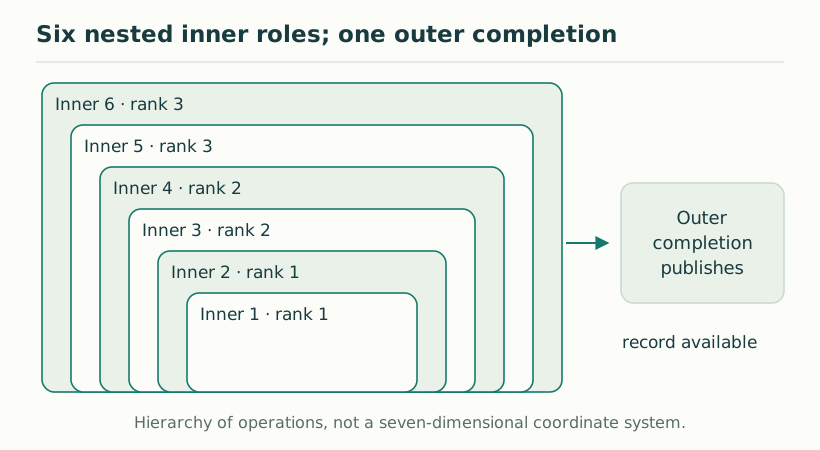
In the SMM/DTT interpretation, six inner stages are nested dependencies within generation, followed by a seventh completion interface. They should not be drawn as six independent time axes, nor equated with six unrelated oscillators. A proposed implementation must explain which lower-level operations are required before a higher-level record is valid and how those dependencies are retained.
The categorical same-cycle construction does not establish that precisely six stages are necessary. It supplies the language in which such a necessity claim could be stated: specify the nested history composition, identify the completion mechanism, and prove that the observable action follows from them. Counting labels in a diagram is insufficient.
The important gain is a disciplined separation of an operation, its completed record, and its observable action. A single underlying evolution can have substantial internal activity while producing no new public distinction. Conversely, one completed return can create a new observable event even when the recurrent phase has returned to its original value.
To become a physical theory, this architecture still needs a selected dynamics, a stable memory mechanism, an operational clock calibration, and a rule connecting record relations to spatial distances and propagation. The current result explains how those ingredients can be organized consistently. It does not calculate their values or establish that every physical clock follows the same law.
KEEP THE CONNECTION
Scope of the argument. Conceptual explanation of a conditional categorical reconstruction; it does not posit two independently readable laboratory times.
Draft file: SMM_DTT_Axioms_v4.pdf
Working manuscript. Article-level references identify the consulted sections and the scope of the interpretation. No public URL was supplied for this exact manuscript version.
Source register →