Explore how richer tests alter the distinctions retained by a record model. Introduce the draft’s correspondence between test languages and observational congruences.
In the operational part of SMM/DTT, an observer need not be a conscious subject. It can be a detector, a memory, or a network of instruments with declared preparations and readouts. Its observable distinctions are determined by its capabilities. Calling a variable observable without giving a test for it leaves this central issue unresolved.
A test language is the collection of permitted tests, including their admissible preparation and follow-up contexts. The language determines which completed records can be told apart. This makes observational limitation an explicit component of the model rather than an informal statement that the inner process is hidden.
02More tests usually mean fewer identifications
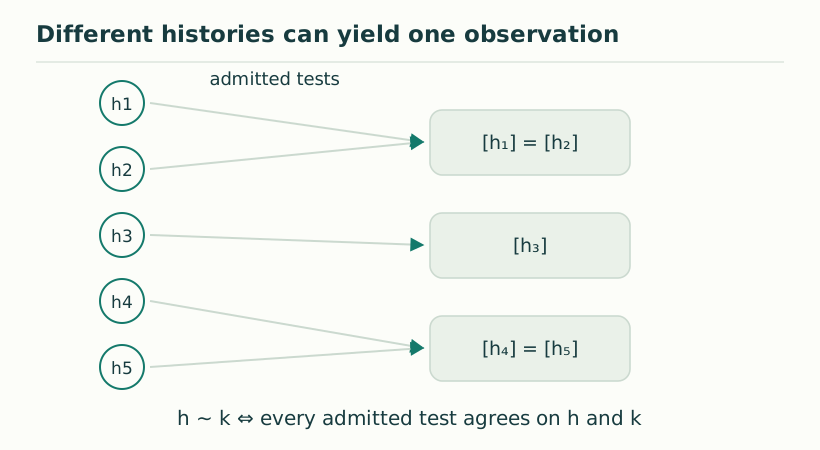
Let S be a set of tests and Eq(S) the relation identifying records that agree under every contextual test generated by S. If S is enlarged, agreement becomes harder to satisfy. Thus the set of equivalent pairs becomes smaller, while the number of observable classes may increase.
The direction can seem counterintuitive: a larger measurement language yields a smaller equivalence relation and a more detailed observable quotient. This is why the correspondence is called order reversing. It describes empirical resolution, not a change in the underlying histories.
S⊆T ⇒ Eq(T)⊆Eq(S)
Figure 1. Different histories can yield one observation. The observational equivalence h ∼ k means that all admitted tests give the same result. Changing the test language can split an equivalence class and expose previously hidden distinctions. View full size ↗
03Going in the opposite direction
Starting with a proposed congruence ξ, define Inv(ξ) as all admitted tests that are constant on its equivalence classes. The draft proves a precise correspondence: ξ makes no distinction detectable by S exactly when all tests in S are invariant under ξ.
One direction follows immediately: if ξ-related records agree under every S-test, those tests are invariant. In the reverse direction, contextual closure is essential. Because ξ is a congruence, its invariance survives placing records in allowed contexts; therefore all generated tests remain constant on ξ-classes.
ξ⊆Eq(S) ⇔ S⊆Inv(ξ)
04A detector example with delayed access
Suppose a two-level device allows a Z measurement. Two states with the same Z statistics can carry different relative phases. If no rotations are admitted, those phases are outside the stated test language. Add a calibrated rotation followed by the same Z detector, and one obtains access to another component of the state.
This illustrates two distinct ways to improve observation: add a new detector, or keep the detector and add a transformation that converts a hidden variable into a readable signal. The latter is especially relevant to DTT, where a completion process may transform internal phase information into a later record. The details of that transformation determine what survives the observational quotient.
05When two languages are empirically equivalent
A list of tests may contain redundancy. The closure Inv(Eq(S)) includes every admitted test that distinguishes no more than S already distinguishes. Two languages can look different while having the same closure and therefore the same observable quotient.
For example, a detector returning an integer count and a pair of detectors returning its quotient and remainder under a fixed divisor can encode exactly the same information if both components are available without error. Their displays differ, but their equality classes coincide. By contrast, retaining the remainder alone loses information. The criterion compares distinguishability, not the surface form of readouts.
Cl(S)=Inv(Eq(S))
Eq(S)=Eq(T) ⇔ Cl(S)=Cl(T)
06How this guides a physical reconstruction
A proposed SMM/DTT model should list the admitted source controls, the retained records, and the actual test language before claiming an observable dimension, an arrow of time, or a selected phase. A mathematically generated algebra of observables does not automatically grant experimental access to every element. Preparation limits can also hide distinctions even when the effects are available.
The framework suggests a practical development cycle. Begin with a modest test set, calculate its quotient, identify a pair of histories it merges, and design a feasible delayed test that separates them. If no such test is admissible, the merger may be operationally justified. If a test exists, the model needs a richer retained state. This is a systematic route from conceptual dual time to concrete questions about information and measurement.
KEEP THE CONNECTION
Key ideas
Observable distinctions depend on an explicit language of tests.
Adding tests refines the quotient instead of changing the source histories.
Equivalent test languages can be recognized by their common observational closure.
Scope of the argument. The Galois correspondence is a mathematical organizing result, not a derivation of physically available detectors.
Sources & further reading
SMM_DTT_Axioms_v4.pdfWorking draft, pp. 13–17
Source editions and catalogue entries
Working manuscript
Observation-Rooted Reconstruction of Outer Record Order in the Single Monad–Dual-Time Framework
Draft file: SMM_DTT_Axioms_v4.pdf
Working manuscript. Article-level references identify the consulted sections and the scope of the interpretation. No public URL was supplied for this exact manuscript version.