
In this article
- A cycle has recurrence but not yet direction
- The stabilizer calculation
- The circle example
- Why completion does not remove the obstruction
- What record availability adds
- What would strengthen the physical explanation
Explain the root-only no-arrow result for reversible recurrence. A return to the same phase does not by itself distinguish temporal advance from reversal.
A recurrent process returns to an earlier phase. It can supply a period, a root at which to compare successive cycles, and a useful completion marker. None of these facts alone distinguishes future from past when the underlying recurrence is reversible. The draft makes this limitation explicit because DTT seeks to obtain an observable temporal order from a generative process.
The issue is not whether a person experiences temporal direction. It is whether the mathematical structure introduced so far contains enough asymmetry to derive that direction. If the structure treats a return and its inverse identically, a one-sided arrow cannot follow without another ingredient.
Let a reversible group G act on a phase space Φ and select a root o. The return set H consists of operations fixing that root. The identity fixes o, products of returns fix o, and the inverse of a return also fixes o. Therefore H is a subgroup.
The inverse statement is the decisive step: from g·o=o, applying g⁻¹ gives g⁻¹·o=o. Any criterion using only membership in H accepts both g and g⁻¹. Marking a point on the phase circle changes a free cycle into a based cycle, but supplies no orientation between the two possible traversals.
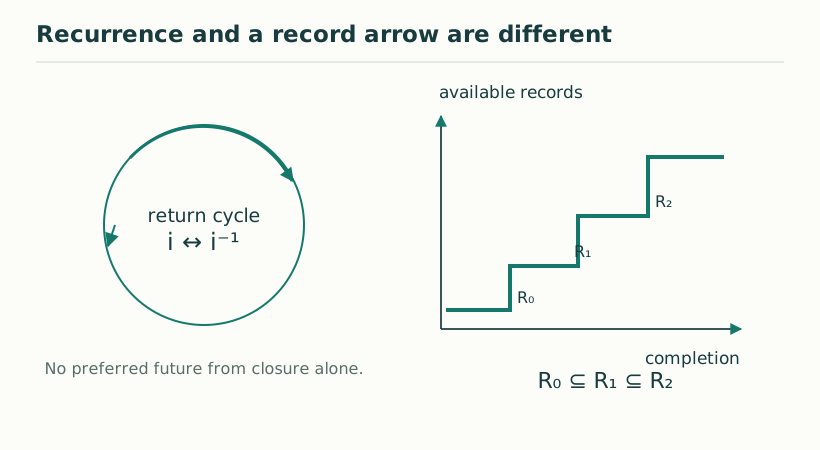
For uniform motion around a circle, the root may be phase zero and returns may occur after integer multiples of a period T. The return labels form the integers: …,−2T,−T,0,T,2T,… . Choosing T as positive in a coordinate convention does not prove that a physical observer can access only the positive returns.
Replacing the integers by nonnegative integers builds a forward schedule, but this replacement needs a reason. It could come from a preparation boundary, an increasing record register, a positive delay law, or restricted operations. Each possibility is additional physical or operational structure. The theorem prevents an arbitrary sign convention from being presented as a derived arrow.
The phase–completion compatibility law can make root returns genuine returns to a certified record section. This improves the interpretation of the phase but does not alter the subgroup argument. Reversible operations can preserve a certified section in both directions.
Likewise, quotienting histories into records does not automatically create irreversible dynamics. If a group action descends consistently to a quotient, the descended operation still has the descended inverse. An effective noninvertible update requires a different feature, such as a noninvertible reduced channel, a restricted forward schedule, or an information-discarding interface whose environment is accounted for.
Suppose the current observation has an ordered set of available records. A completed return is called record positive when it preserves or increases that availability. A reversed return may remove an accessible distinction, so it need not belong to the positive set. The asymmetry now comes from an explicitly declared record order.
This is conceptually close to the DTT distinction between ongoing generation and the accumulation of completed observations. It does not require the microscopic recurrence to become irreversible. Instead it selects a one-sided observable part of a reversible action. The record order must still be realized by a memory and access mechanism, rather than stipulated as an unexplained arrow.
A convincing physical model should derive its availability order from the dynamics, preparation, and resource budget. It should show when records can be read, when they can be overwritten, and what reversals are possible in the full system. For a finite closed unitary model, recurrences and finite retention windows must remain visible.
The no-arrow result is useful because it narrows the research target. More elaborate circular diagrams will not solve the missing asymmetry. A selected memory mechanism, an exact positive clock, or a justified boundary condition can. The resulting record arrow must then be compared separately with thermodynamic entropy increase and with relativistic causal order; these are related questions, not interchangeable definitions.
KEEP THE CONNECTION
Scope of the argument. This obstruction concerns reversible recurrence and root membership alone, not every possible mechanism for temporal asymmetry.
Draft file: SMM_DTT_Axioms_v4.pdf
Working manuscript. Article-level references identify the consulted sections and the scope of the interpretation. No public URL was supplied for this exact manuscript version.
Source register →