
In this article
- Records give temporal order operational content
- The positive-return definition
- Which returns remain reversible?
- An integer archive model
- From an order to an event clock
- Record arrow, entropy, and physical scope
Introduce record-positive returns as the steps that preserve or advance accessible records. Explain the conditions under which they define an effective forward action.
A present observation often contains evidence of previous events: stored outcomes, correlations, or an archive of completed operations. The draft formalizes this by distinguishing the recurrent phase from an ordered representation of available records. Temporal direction is associated with changes in that availability, rather than merely with motion around a phase circle.
For SMM/DTT this supplies a bridge between one generative process and many ordered observations. The bridge is conditional: the model must specify what counts as an available record and how admissible completed returns act on it. Availability can mean accessible information, not simply the total number of microscopic degrees of freedom.
Let L be an ordered set, ℓo its current record-availability state, and ρg the order-preserving action of a completed return g. Define C as the returns that do not decrease availability relative to ℓo. The identity belongs to C because it leaves the current record unchanged.
If i and j are positive, then ℓo≤ρi(ℓo), and applying ρi to ℓo≤ρj(ℓo) gives ρi(ℓo)≤ρiρj(ℓo). Transitivity proves that their composition is positive. Thus C is a monoid: it contains doing nothing and is closed under composition, even when it does not contain inverses.
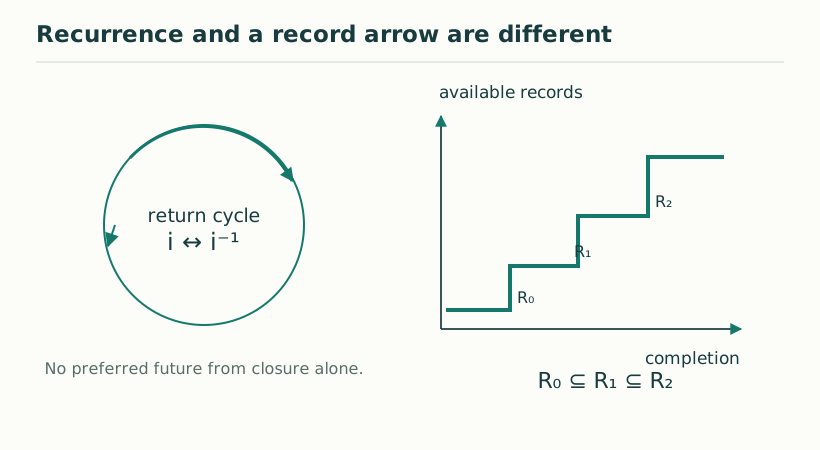
Assume the return action is by order automorphisms. If both g and g⁻¹ are positive, the two inequalities imply ρg(ℓo)=ℓo. Conversely, any return leaving the current availability unchanged is positive in both directions. Hence the intersection of positive returns with their inverses is exactly the stabilizer of the current record.
When the readout separates the root strongly enough that only the identity fixes its availability, the positive monoid is pointed: a nontrivial positive advance has no positive inverse. This is the mathematical content of a strict record arrow. If there are invisible stabilizing operations, they must be factored out or retained as neutral motions.
Take the reversible return group to be the integers and let availability also be represented by an integer archive level. Translation by k changes that level by k. At the current level zero, record-positive returns are exactly k≥0. Their composition adds nonnegative increments, while negative returns reverse the archive order.
This is a transparent consistency example, not a complete physical memory model. A real archive needs blank capacity, a writing operation, protection from later disturbance, and a declared observer access rule. The example shows how the one-sided order follows once those operational roles are represented by the stated ordered action.
A record order need not be a numerical duration. To attach a clock, assign additive delays to advances and require compatibility with the observable equivalences. For a global event time, the delay along an advance must be the difference between a time assigned to its target and one assigned to its source.
If this exact delay is strictly positive between distinct events, the resulting reachability relation is a partial order: two distinct events cannot each be later than the other. An additive delay around a closed loop would obstruct an exact global clock. The distinction between local durations and a global event-time potential is therefore important even in a record-based account.
A growing record order is not automatically a proof of increasing thermodynamic entropy. The latter requires a state space, probabilities, a coarse graining or bath, and an entropy balance. A reversible process can increase accessible records for a prepared observer while retaining information elsewhere in the full system.
The six nested inner dependencies can organize how an admissible record is assembled, while the outer interface exposes the completed result. This interpretation gives the hierarchy a functional role. To establish a physical arrow, however, the model must explain why its preparation and retention laws produce the ordered availability used in the theorem. That is a sharper task than declaring completion itself irreversible.
KEEP THE CONNECTION
Scope of the argument. The theorem assumes an ordered record-availability realization and does not derive thermodynamic irreversibility.
Draft file: SMM_DTT_Axioms_v4.pdf
Working manuscript. Article-level references identify the consulted sections and the scope of the interpretation. No public URL was supplied for this exact manuscript version.
Source register →