A080Public article topicExpanded article4 min read
Divine Theophanies and the Five Divine Presences
Introduce Divine theophanies and the five Divine Presences as a source-based study. Explain their relationships within the metaphysical framework before comparing them with other organizational schemes.
The source discusses Divine Presences as categories of manifestation and notes variation in how later authors systematized them. Its broad organization distinguishes divine knowledge, spiritual or intellectual existence, imaginal forms, sensory existence and the comprehensive human relation to these levels. It also stresses that the unknowable Essence is not simply another bounded item in the list. This is a metaphysical classification, not a measured stack of five physical dimensions.
02Why an intermediary matters
An intermediary can relate two domains without being identical to either. A translation connects languages while preserving some meanings and changing their expression. A coordinate chart connects an abstract geometric region with numerical coordinates. In each case, the connection is useful because its rule is defined and its limits are understood.
The source's language of an isthmus emphasizes a mediating role. A modern mathematical comparison should ask what is being related and which structure survives the passage, rather than treating mediation itself as an unexplained force.
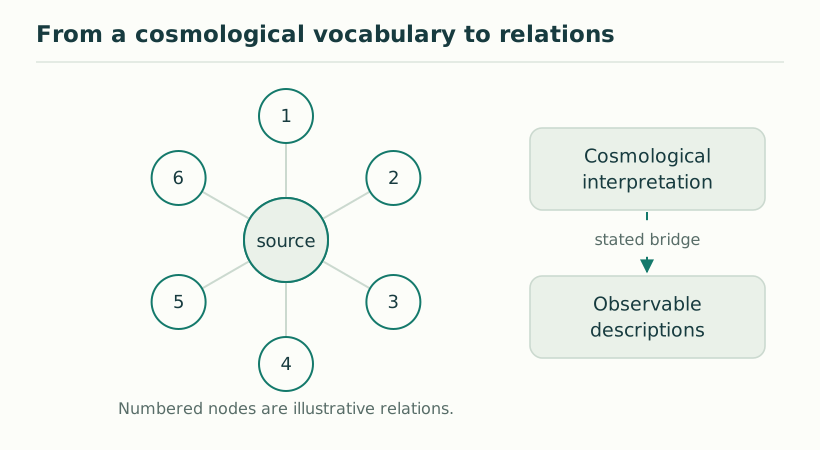
Figure 1. From a cosmological vocabulary to relations. The diagram is a reading aid for the SMM vocabulary: source, relations, manifested plurality, and observation. The arrangement does not assign physical locations to metaphysical terms. View full size ↗
03Classification and uniqueness
A classification can divide a domain into five categories because of its chosen criteria. That does not prove that every valid classification must have five parts. To establish uniqueness, one must state the criteria and show why alternative partitions fail them.
This is a general mathematical lesson. The same set can be grouped by color, size or function, yielding different numbers of classes. A cosmological taxonomy becomes clearer when its organizing questions are visible rather than when its total is compared with other unrelated lists of five.
04SMM and levels of description
SMM uses a shared-origin perspective to relate different forms of manifestation. A useful contemporary distinction is between source structure, generative histories, completed records and observers' interpretations. These are explanatory roles, not a replacement taxonomy of Divine Presences. Their value is to clarify how one can discuss dependence across levels without merging their meanings.
A model should specify each connecting map. If a history yields a record, the completion rule determines which information is retained. If an observer interprets the record, the interpretive scheme adds another relation. Neither map is determined solely by counting levels.
05DTT and the interface question
DTT's inner/outer distinction is especially concerned with an interface between generation and accessible outcome. The historical idea of mediation can motivate this inquiry, but the formal interface must have definite properties: consistency under composition, stable record availability and a relation to physical clock readings.
Such properties can be studied without identifying a theological presence with a Hilbert-space sector or a quantum field. A more ambitious identification would require additional definitions and independent consequences, including a reason that the proposed correspondence is unique or physically preferred.
06A hierarchy can organize without adding coordinates
A description can distinguish a pattern, its representation and an observer’s interpretation while referring to one physical situation. The levels differ by explanatory role, not by spatial position. This is a useful comparison for reading metaphysical hierarchies, whose ordering may concern dependence or intelligibility rather than distance. A scientific reconstruction should state which kind of ordering it uses. If DTT’s inner and outer descriptions are linked by completion, their relation can be analyzed through composition and accessibility without assigning each a separate laboratory axis. A further claim that a hierarchy corresponds to additional physical dimensions would require its own geometry and measurement procedures.
07Manifestation and a formal interface
Sensory, imaginal and intellectual descriptions form part of the source’s interpretive account; a completion map is a separately defined mathematical object. Their comparison can motivate inquiry without asserting physical identity. The shared question concerns lawful mediation: how does an underlying structure become available in a particular form? DTT makes that question constructive when it specifies the interface and proves properties of its resulting records.
KEEP THE CONNECTION
Key ideas
The Presences classify manifestation rather than measured spatial axes.
A number of categories depends on explicit classification criteria.
DTT can study mediation through a precisely defined completion interface.
Scope of the argument. Conceptual interpretation with explicit mathematical examples; a source proposal is not presented as an established physical identification.
Original public topic. This edition provides an independently written explanation; article-level references identify the passages and additional sources used.