
In this article
- Names and the relations they express
- One referent and several predicates
- Why context matters
- The SMM connection
- What DTT adds
- One state, incompatible descriptive arrangements
- Relational knowledge
Explore the relation between Divine unity and the multiplicity of Names in the theological account. Explain the interpretive vocabulary needed before drawing any analogy with physical symmetry.
The source distinguishes Divine unity from divisibility and distinguishes the unknowable Essence from Names through which relations to creation are discussed. It presents multiple Names as referring to one reality while expressing different aspects of its manifestation. The distinction is theological and relational. Its importance for the SMM discussion is that plurality in description need not imply a plurality of independent ultimate sources.
A familiar logical example helps separate the issues. A person can be described as a teacher, a neighbor and a parent. The predicates differ because the relations differ, even though their referent is one person. Counting predicates does not count persons. Similarly, one physical system can have position, energy and charge without those quantities being separate systems.
These examples explain the logical distinction between a referent and descriptions of it. They do not equate Divine Names with human roles or physical observables. The analogy concerns the structure of predication, while the theological meaning remains within its own discourse.
A word may function as a name, an attribute or a description of an action. Its interpretation depends on which question is being asked. Confusion arises when a relational expression is treated as a definition of an underlying essence. Knowing how something acts in one setting does not generally provide an exhaustive account of what it is.
In scientific modeling, this is familiar as the difference between an operational characterization and an ontological commitment. Measuring a response can establish a reliable relation without deciding every question about the nature of the responding system.
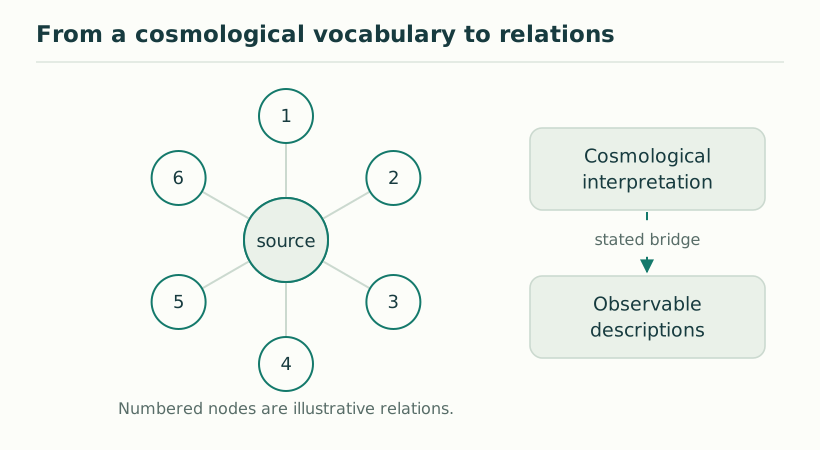
SMM's proposed common origin is compatible with diverse observable roles only if those roles are explained as relations within a coherent construction. A useful mathematical notation is rₐ = Rₐ(s): the label a selects a readout of one state s. Different readouts can reveal distinct aspects of a shared state without requiring an independent source for every aspect.
But shared notation alone does not unify a theory. The functions Rₐ must obey common constraints, and the state dynamics must explain how they change together. Otherwise the apparent unity is simply a container holding unrelated prescriptions.
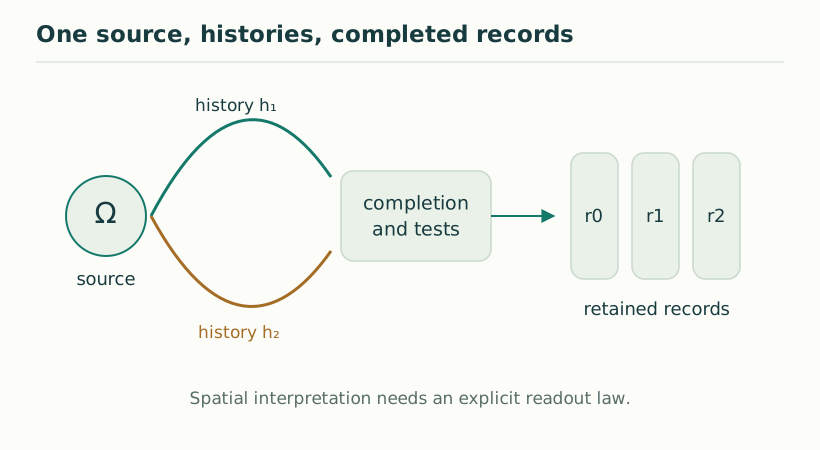
DTT places the relation between source and manifestation within an account of generation and completion. Inner processes organize the source state; completed outer records reveal particular accessible aspects. This makes the question of which properties can be read together especially important. Some readouts may be compatible, while others may require different experimental arrangements.
A precise model would specify those arrangements and the resulting probability rules. Theological language can motivate attention to relational manifestation, but it does not determine a quantum measurement algebra or the probabilities of its outcomes.
A system may admit several ways of being probed, and the procedures can constrain which properties are jointly accessible. This is a stronger claim than saying that an observer uses several names. In a formal theory, accessibility depends on the allowed operations, their composition and the disturbance or information they produce. A relational vocabulary becomes physically meaningful only after these structures are defined. The theological distinction between one referent and many Names can illuminate the logic of plurality in description, while the physical model must separately establish its own compatibility relations. This keeps the analogy useful without importing an unproved measurement rule from a metaphysical classification.
The positive connection is a shared concern with how one reality can be known through multiple relations. The distinction is equally useful: a scientific model describes measurable structures, while the source’s discourse on Essence also addresses limits of description. Multiple readouts of one model state can clarify the logic of relational knowledge without being identified with Divine Names or an exhaustive theological ontology.
KEEP THE CONNECTION
Scope of the argument. Historical interpretation and original conceptual analysis; illustrative mathematical constructions are not identifications of theological realities with physical objects.
Original public topic. This edition provides an independently written explanation; article-level references identify the passages and additional sources used.
Source register →