A052Public article topicExpanded article4 min read
Metaphysical triplicity in the cosmos
Introduce the threefold cosmological relation discussed by the source. Explain its own terminology and avoid assuming equivalence with unrelated theological doctrines or physical three-dimensionality.
The source develops several threefold relations, including Essence, Attributes and Actions, and the relation between a subject, a receptive object and an arising act. It also connects its discussion with length, width and depth. Here triplicity names a family of interpretive patterns. It should not be silently equated with Christian Trinitarian doctrine, nor should the appearance of three terms by itself be treated as a proof that physical space has three dimensions.
02A relation has more structure than its participants
Take a transformation F acting on a state s to produce a result r. The expression r = F(s) contains an operation, an input and an output. These are three logical roles, even when one physical system realizes all of them at different stages. The existence of three roles does not require three independent substances.
This example makes the generative pattern precise. It also shows why the roles cannot be inferred merely by counting objects. A model must specify what each role does and how it enters the relation.
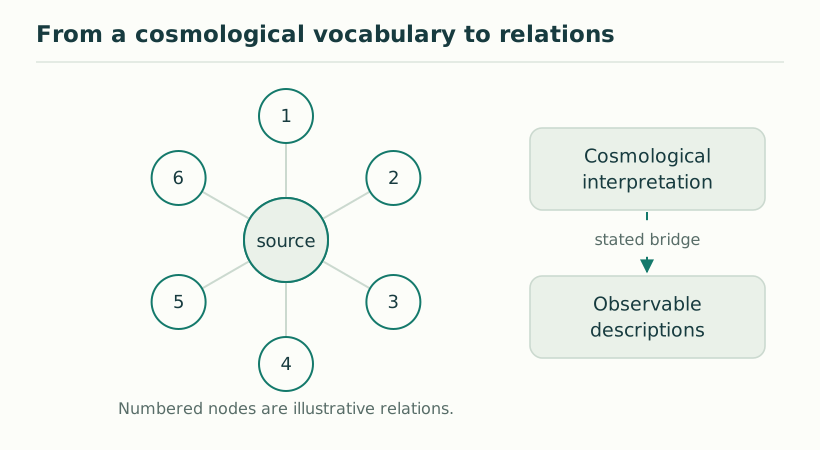
Figure 1. From a cosmological vocabulary to relations. The diagram is a reading aid for the SMM vocabulary: source, relations, manifested plurality, and observation. The arrangement does not assign physical locations to metaphysical terms. View full size ↗
03Pairing does not automatically produce geometry
The historical article constructs line, plane and body through successive combinations of points. A modern geometric clarification is useful: a cube has eight vertices, but a three-dimensional simplex has four. Thus eight points are not universally the minimum needed to represent a three-dimensional body. The minimum depends on the class of construction and on what is meant by representing the body.
The dimension of an affine span is determined by the number of linearly independent displacement vectors. Four noncoplanar points provide three such independent vectors. This example demonstrates why geometric assumptions must be stated before a numerical correspondence can carry a theorem.
04SMM and the need for a generative relation
SMM seeks to explain how a unified source gives rise to differentiated forms. The useful lesson of triplicity is that a source label alone is insufficient: a generative relation and an account of its result are also required. A formal construction should state its source states, admissible transformations and observable completion rule.
These may be aspects of one dynamics rather than independent ingredients. Establishing that dependence is the substantive unification task. If every map can be chosen independently, the construction does not yet explain why its outputs belong to one coherent world.
05DTT and ordered completion
The inner/outer distinction gives a temporal interpretation to the operation-result relation. Inner stages prepare the conditions of an outcome, while completion produces a readable record. The six nested inner roles are therefore not interchangeable with the three logical roles just described. One scheme counts stages of a proposed construction; the other distinguishes functions within an explanation.
A careful account can compare these structures while keeping their counting rules explicit. Three dimensions, three predicates and three phases of an explanation should not be merged simply because all contain the number three.
06Counting roles versus counting dimensions
A calculation can contain an input, an operation and an output while acting on a one-dimensional variable. Conversely, a single operation can act on a state with a thousand coordinates. Thus the number of explanatory roles and the dimension of the state space are independent. This simple comparison prevents a threefold logical pattern from being used as a direct proof of three spatial dimensions. A valid derivation would instead begin with specified structural assumptions and show that only a three-dimensional observable geometry satisfies them. The triplicity motif may motivate the search, but the proof must identify the mathematical obstruction to other dimensions rather than merely restate the preferred count.
07Explanatory completeness
Triplicity is useful as a question about explanatory completeness: what acts, on what, and with what result? For a physical model, each answer must become a mathematical object or operational procedure. These roles may have one implementation, but their relation has to be shown. The historical pattern thus motivates a disciplined inquiry into generation without making a repeated number a proof of physical dimensionality.
KEEP THE CONNECTION
Key ideas
Triplicity can describe roles rather than separate entities.
A threefold pattern does not itself derive spatial dimension.
A generative model needs an operation and a defined completion rule.
Scope of the argument. Historical interpretation and original conceptual analysis; illustrative mathematical constructions are not identifications of theological realities with physical objects.
Original public topic. This edition provides an independently written explanation; article-level references identify the passages and additional sources used.