
In this article
- Dependence and identity are different claims
- Why a shared basis does not erase differences
- Possibility is not yet actuality
- The SMM translation
- DTT and renewed actuality
- Identity through a relational invariant
- Dependence and dynamics
A source-based introduction to the Oneness of Being and its role in the broader cosmology. Clarify terminology before comparing metaphysical dependence with a model of shared physical origin.
The source presents the Oneness of Being through distinctions among necessary existence, contingent possibility and impossibility. It notes that the familiar doctrinal label has a complicated later interpretive history. Its concern is how the world depends on a reality that is not itself dependent in the same way. A careful reading therefore begins with modes of dependence rather than the loose assertion that every ordinary object is simply identical to every other object.
Two melodies can be realized through vibrations in the same instrument. Their common physical basis does not make the melodies identical. Likewise, several mathematical patterns can be states of one system while remaining distinguishable through their structure. This is a limited analogy: it clarifies how common grounding and genuine differentiation can coexist.
The analogy does not settle the metaphysical nature of Being. It helps prevent a logical mistake in which unity of basis is taken to imply sameness of all properties. Distinct manifestations require distinct relations even when their existence is described as dependent.
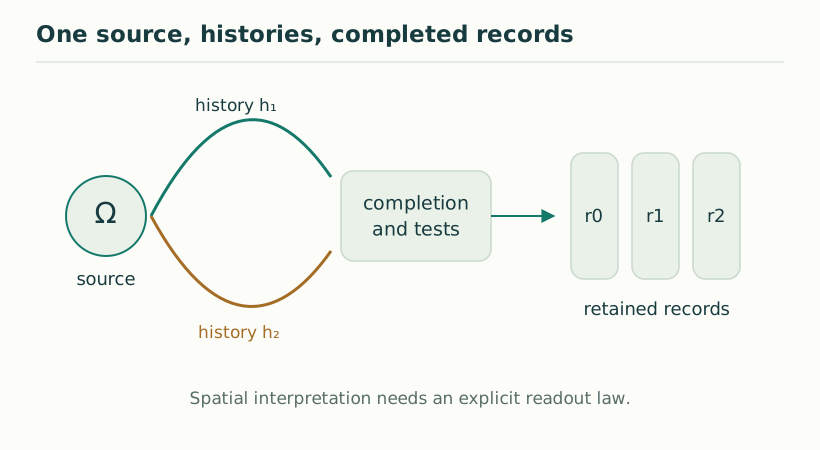
A state space lists possible states of a model. A trajectory selects which states occur under a dynamics and initial conditions. The distinction between allowed possibilities and realized history is essential: merely listing every possible configuration does not explain why one history is observed.
For example, a two-state system has possibilities 0 and 1. Its update rule may keep its state unchanged, alternate states or choose probabilistically. The state set is the same in all three cases, while the histories differ. A theory of manifestation needs the rule as well as the possibilities.
SMM places the unity of origin at the center of its account. A constructive mathematical version would describe one generative system whose relational states yield distinguishable records. It would not gain explanatory power by replacing every occurrence of the word matter with the word manifestation. The replacement becomes useful only when it changes the model's constraints or clarifies a previously hidden dependence.
One test of explanatory content is whether apparently separate phenomena must share an invariant, a coupling relation or a common response because of the proposed origin. Such a result makes unity operationally consequential.
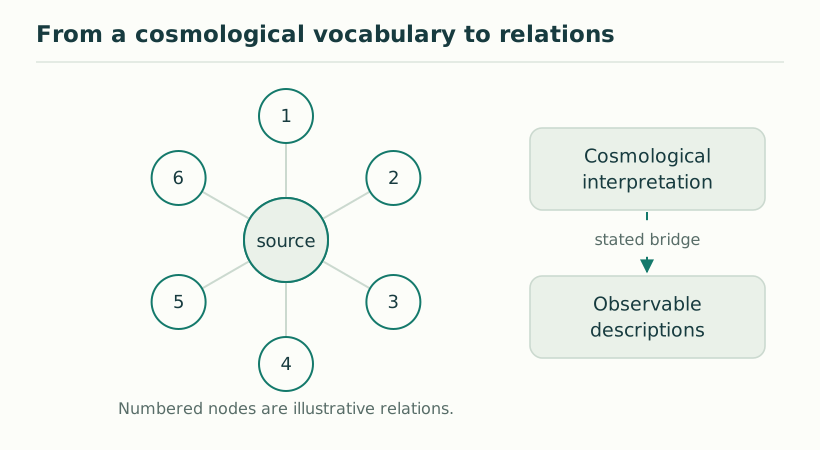
DTT adds a proposed temporal mechanism: inner generation prepares relations and outer completion supplies observable events. Persistence then concerns the continuity of relations across completions rather than the unexamined endurance of a self-sufficient object. A particle-like entity might be represented as a stable pattern in successive records, with identity defined through a preserved structure.
The pattern must include enough information to explain memory, conservation and interaction. If every completion were unrelated to the previous one, there would be no observed regularity to support the idea of a persistent world.
Suppose a sequence of changing configurations each contains a closed loop with the same winding number. The local shape may change, yet the invariant can identify a persistent structural feature. This is one way to make continuity through manifestation mathematically meaningful. It does not show that every physical identity is topological; it provides a precise example of the kind of relation a model can preserve. SMM can interpret the successive forms as dependent realizations of a common generating process. DTT can ask how the invariant passes through completion and becomes measurable. The mathematical result concerns the invariant and allowed transformations, while the metaphysical interpretation concerns their proposed origin.
Metaphysical dependence and physical dynamics address different explanatory levels. They can inform one another when their connection is stated openly: the former motivates common origin, while the latter specifies how observable differences arise and endure. Allowed states, a generating rule and a realized history are distinct ingredients. Keeping them distinct prevents a list of possibilities from being mistaken for an explanation of actuality.
KEEP THE CONNECTION
Scope of the argument. Historical interpretation and original conceptual analysis; illustrative mathematical constructions are not identifications of theological realities with physical objects.
Original public topic. This edition provides an independently written explanation; article-level references identify the passages and additional sources used.
Source register →