A079Public article topicExpanded article4 min read
Oneness and the Four Levels of Symmetry
A guide to the four levels of symmetry in the source account. Define each level and distinguish its conceptual role from a precisely specified physical symmetry group.
The source distinguishes Normal, Super, Hyper and Ultimate Symmetry. In its presentation, Normal concerns familiar manifested structures; Super relates proposed physical and psychical counterparts; Hyper concerns a spiritual level; and Ultimate concerns the unifying limit of the account. These are author-specific cosmological categories. Their names should not be assumed to establish the technical structures denoted by similarly named concepts in mathematical physics.
The four levels in the source's vocabulary
Source terminology
Role in the source account
Formal identification still needed
Normal
Manifest structures
Specified transformations and invariants
Super
Proposed physical–psychical pairing
A defined algebra and representation
Hyper
Spiritual level
A mathematical carrier and operational map
Ultimate
Unifying limit
Precisely stated equivalence or invariance
02What symmetry means mathematically
A symmetry is a transformation that preserves specified structure. For a circle, rotations preserve the set and its distances. For an equation, a transformation may carry solutions to solutions. For a state, the transformations that leave that particular state unchanged form its stabilizer.
These are different but related uses. One must identify the object, the allowed transformations and the preserved quantities before a symmetry claim can be checked. The adjective higher does not determine a group or an observable consequence.
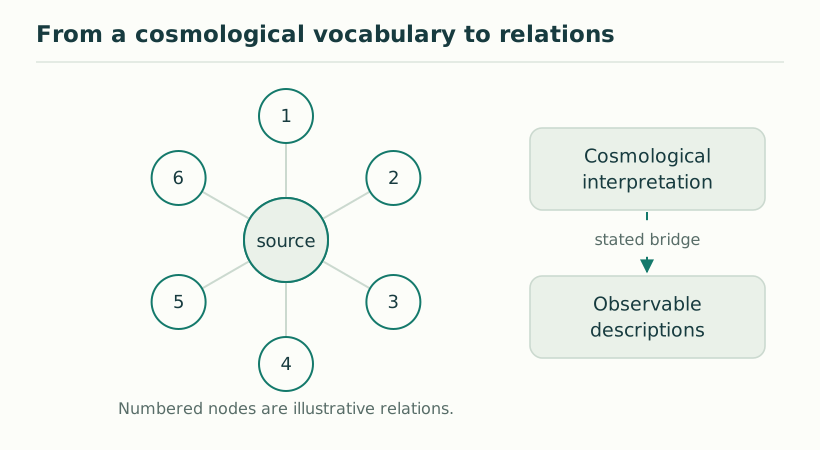
Figure 1. From a cosmological vocabulary to relations. The diagram is a reading aid for the SMM vocabulary: source, relations, manifested plurality, and observation. The arrangement does not assign physical locations to metaphysical terms. View full size ↗
03A concrete example of symmetry reduction
An unmarked circle is invariant under every planar rotation about its center. Marking one point reduces the transformations preserving the marked configuration to the identity among those rotations. Marking three equally spaced identical points instead preserves rotations by multiples of 120 degrees.
The underlying ambient geometry has not necessarily changed; the state or marked pattern has changed. This illustrates why symmetry of laws, symmetry of a background and symmetry of a particular record should be distinguished in a temporal theory.
04SMM and unity through invariance
A common source might impose transformations under which many observable relations remain invariant. That would be a precise way for unity to constrain multiplicity. The source need not look like an infinitely symmetric geometric object; its relevant unity could instead be expressed through a common composition law or an equivalence relation on histories.
The scientific question is which invariants follow from the dynamics and which are assumed. Merely calling a source ultimately symmetric does not fix the geometry or field content of its manifestations.
05DTT and accessible symmetry
Completion can change which distinctions are accessible. A transformation that changes an inner description while preserving every completed record acts as a redundancy of the observable description. Another transformation may relate genuinely different records while preserving their dynamical laws. These two roles should not be conflated.
This provides a productive DTT route to symmetry: specify the inner action, the completion map and the transformations surviving in the observable quotient. A proof can then identify an actual group or semigroup and its representation on records.
06Observable redundancy and physical symmetry
If two inner descriptions produce identical outcomes for every allowed test, transforming between them may represent a redundancy of description. A physical symmetry can instead relate distinguishable states while preserving the laws. The distinction is essential when interpreting an observable quotient. Removing redundant labels does not necessarily remove a physical degree of freedom, and a large redundancy group is not automatically evidence for many observable symmetries. DTT can make these relations precise by specifying the action on histories and its induced action on records. The resulting theorem should state whether a transformation acts trivially, faithfully or only approximately on the measurable structure.
07Two kinds of comparison
The four cosmological levels organize the source’s interpretation, while group actions and stabilizers organize mathematical symmetry. Technical supersymmetry requires a specified graded algebra and its action, not simply a pairing of domains. Distinguishing the two comparisons clarifies the work required for a physical identification. DTT can contribute by deriving which transformations descend consistently from inner histories to observable records.
KEEP THE CONNECTION
Key ideas
The source has four interpretive symmetry categories.
Mathematical symmetry requires transformations and preserved structure.
DTT can investigate which symmetries survive completion on observable records.
Scope of the argument. Conceptual interpretation with explicit mathematical examples; a source proposal is not presented as an established physical identification.
Original public topic. This edition provides an independently written explanation; article-level references identify the passages and additional sources used.