
In this article
- Why the heart is an effective image
- A cycle can sustain change
- What persists through renewal?
- From pulse to completion
- Coherence and local appearance
- Turning the image into a research tool
Explore the cosmic heart as an organizing image of renewal, perception, and dependence. Treat the image as a conceptual resource whose physical translation requires additional definitions.
A heart suggests repeated activity that sustains an organism while the organism’s state continually changes. The cosmic-heart image in the source article similarly expresses a proposed repeated generation of the world. The central idea is continued dependence: existence is not pictured as a machine built once and then left wholly independent of its source.
Within SMM, the heart is therefore a metaphor for generative unity and renewal. It should not be understood as a physical organ at the centre of the universe. Its explanatory value lies in the relationship between recurrent activity and sustained manifestation.
A repeated cycle does not require every surrounding state to repeat. A pump can execute the same mechanical cycle while transferring different amounts of fluid over a changing history. A clock hand can return to its mark while a counter accumulates new entries. Recurrence of one component and novelty of the larger state are compatible.
This distinction helps articulate DTT. Inner organization may possess recurrent phases, while completed outer records form a nonrepeating history. The model must specify the memory or state variable that distinguishes one completion from another. Otherwise an advancing history has been assumed by an external numbering convention.
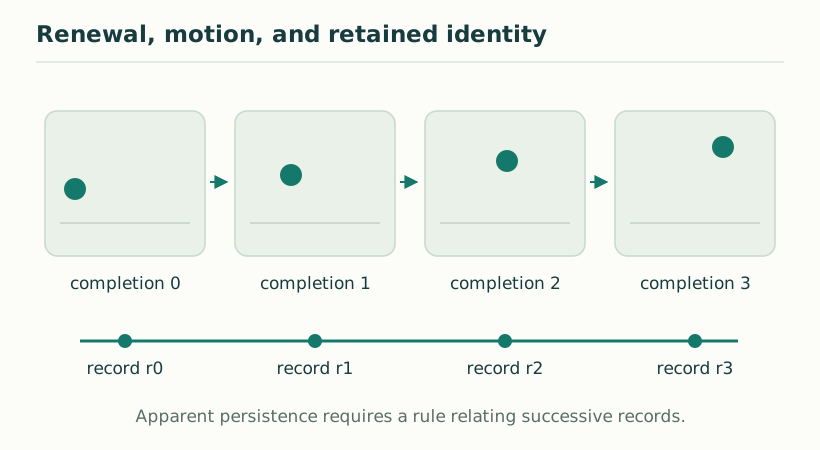
A theory of repeated creation must account for recognizable persistence. If every event is wholly unrelated to its predecessor, neither an object nor an observer can maintain a history. The relevant continuity can be relational: a conserved pattern, a stable correlation or a recoverable record can connect successive states even when the internal realization changes.
Consider a melody encoded in repeatedly refreshed electronic memory. The physical charges may be maintained through ongoing operations, while the encoded pattern remains available. This is an analogy for persistence through active maintenance, not a claim that the universe literally stores a digital score.
A metaphorical pulse becomes a mathematical operation only after a state space and update rule are specified. Let U act on the current generative state, and let a completion criterion select which returns become observable. A record map then determines what an observer can distinguish. Different choices of these ingredients produce different physics, even when all are called a cosmic heartbeat.
DTT’s six inner stages can organize dependent operations within such an update. Outer completion is the publication of a result, not a seventh independent heartbeat added to six others. The hierarchy must be defined by its functions and interfaces if it is to explain more than the metaphor.
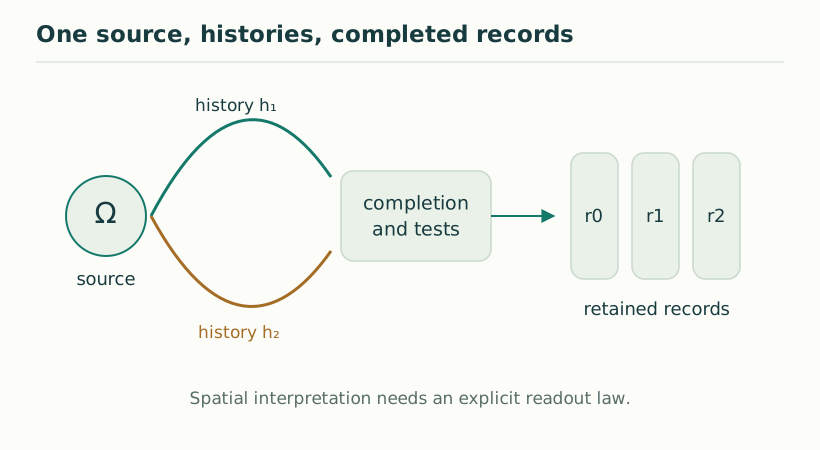
One motivation for a single source is the possibility of coordinating phenomena that appear spatially separated. However, common origin alone does not establish quantum entanglement. A mathematical model must provide the relevant state structure, probability rule and measurement relations. Ordinary common causes can also correlate outcomes without reproducing every quantum correlation.
Likewise, a common source does not automatically ensure a local speed limit. The observable operations must preserve an appropriate causal structure. The ambitious SMM aim is to explain both global coherence and local propagation through the same generative organization, while respecting the distinction between correlation and controllable signalling.
The cosmic-heart metaphor is most useful when it prompts specific questions. What closes a cycle? What is retained? What changes? Which observables distinguish successive completions? Why does the same process support both stable structures and new events? These are questions a formal model can answer.
A completed theory would replace the metaphor’s suggestiveness with derivations of particular laws. Until then, the image serves as a compact conceptual guide to the programme: unity of source, recurrent generation, retained structure and evolving records. Its strength is the organization of the problem, rather than a claim that the image alone proves a theory of everything.
KEEP THE CONNECTION
Scope of the argument. A disciplined explanatory metaphor; no universal physical solution is inferred from the image.
Original public topic. This edition provides an independently written explanation; article-level references identify the passages and additional sources used.
Source register →