
In this article
- Several meanings of relative time
- Relative clock rates without curvature
- What curvature adds
- A comparison procedure
- Temporal generation and a metric readout
- The conceptual connection that remains
An introductory discussion of relative time and the geometric language of curvature. Prepare a careful comparison between historical temporal imagery and modern spacetime descriptions.
The source article places spiritual accounts of unusually experienced duration beside relativistic ideas about clocks and curvature. The comparison can stimulate questions, but the terms must be separated. A long experience reported during a short clock interval is not the same observation as two physical clocks accumulating different durations. A poetic image of bending time is not a measurement of spacetime curvature.
The productive connection is a shared challenge to the assumption that one intuitive duration must describe every perspective. Physics answers this challenge through specified clocks, trajectories, metrics and reproducible comparisons. Spiritual accounts address a different kind of experience and meaning.
In flat spacetime, two inertial coordinate systems can assign different temporal intervals to the same pair of events. Moving clocks can also accumulate different proper times along different histories. Neither fact requires curved spacetime. Relativity of simultaneity and kinematic time dilation already occur in special relativity.
This is an important diagnostic for DTT. If a construction reproduces a Lorentz transformation or a moving-clock factor, it has not thereby derived gravitational curvature. The local symmetry of clock and distance comparisons and the dynamical geometry of gravity are related but separate achievements.
Curvature concerns how local geometrical comparisons fit together across a region. In gravitational physics, it is associated with effects that cannot all be removed by a single choice of freely falling coordinates, such as relative acceleration among neighbouring freely falling trajectories. A coordinate-dependent clock rate alone is not a complete curvature diagnostic.
An instructive contrast is an accelerated description of flat spacetime. Its coordinate clocks and distances can look nonuniform even though the spacetime curvature remains zero. This shows why a proposed temporal metric needs invariant analysis, rather than relying on the appearance of its coefficients.
To compare two clocks, specify how they are prepared, where they travel, which signals are exchanged and where their records are compared. The result then concerns an operational protocol. If the clocks reunite, their accumulated readings can be compared directly. If they remain separated, synchronization and signal propagation become part of the procedure.
For SMM/DTT, all these ingredients should ultimately arise within the generated world. A source model must produce the clocks and the relations used to compare them. An external observer who assigns durations from outside the construction can help define a simulation, but does not yet explain physical time internally.
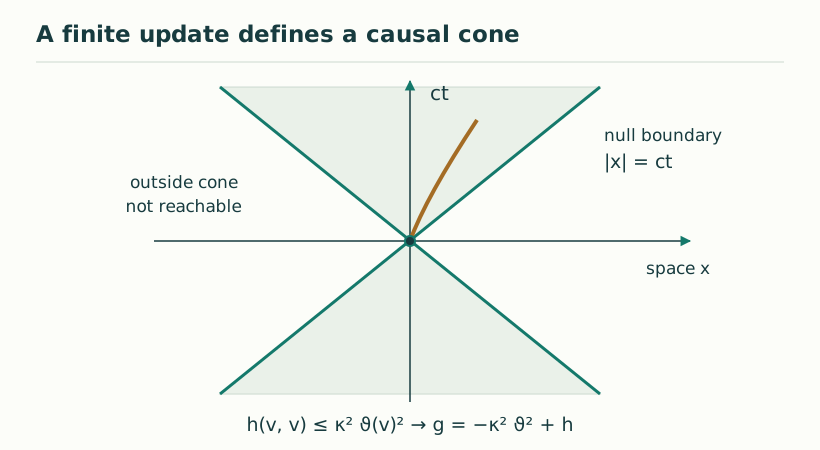
DTT suggests that changes in generative organization could affect the geometry inferred from completed records. To make this concrete, one would define a metric or equivalent relational structure from those records and calculate how it changes under the source update. The model must distinguish a physical change from a relabelling of the same records.
A successful bridge to gravity would additionally supply matter coupling and a dynamical law for the effective geometry. Merely allowing completion rates to vary can imitate some clock effects, but it does not establish the full equivalence principle or Einstein’s field equations. Those require broader consistency.
The most useful lesson is to avoid treating time as a uniform substance whose rate can be discussed without saying what is compared. Both historical reflection and modern measurement show that the standpoint and the relevant process matter. Their methods and evidential standards nevertheless remain distinct.
SMM/DTT can build on this lesson by making every temporal comparison explicit. Inner organization, outer records, clock readings and geometrical curvature should have separate definitions. The framework becomes more explanatory when a common dynamics relates these definitions, rather than when several different phenomena are all described as curved or relative time.
KEEP THE CONNECTION
Scope of the argument. Conceptual clarification; spiritual narratives are not used as empirical evidence for gravity.
Original public topic. This edition provides an independently written explanation; article-level references identify the passages and additional sources used.
Source register →