A065Public article topicExpanded article4 min read
Simultaneity
Introduce simultaneity as a relation between events rather than a self-explanatory universal fact. Connect the concept to clock conventions and the role of completed records.
The source contrasts ordinary simultaneity, relativistic frame dependence and its proposed sequential generative account. A clear analysis distinguishes local coincidence, distant clock synchronization and source-level ordering. Two events at the same location can be compared by one clock. Two distant events require a convention and a physical procedure for relating clocks. A theorist's source index is a third structure and should not be silently substituted for either measurement.
02A synchronization construction
In an ideal inertial setting, a clock at A emits a light signal at t₁ and receives its reflection from B at t₃. Einstein synchronization assigns the reflection event at B the time t₂ = (t₁+t₃)/2. The associated radar distance is c(t₃−t₁)/2. This procedure makes clear that assigning a distant time is connected to a rule about signal propagation.
The construction is an operational definition within special relativity. It is not an observation of an external universal present.
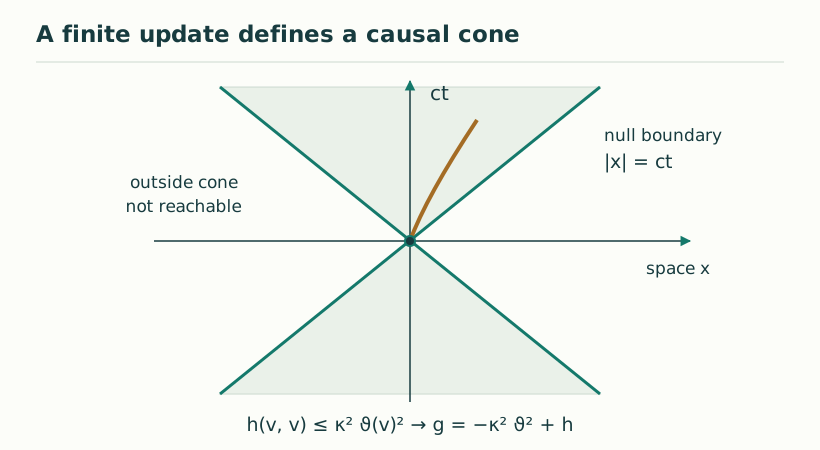
Figure 1. A finite update defines a causal cone. Illustrative finite-update geometry: displacement is bounded by update scale κ times projected inner duration. A Lorentzian metric or a shared light cone still requires the stated readout and field assumptions. View full size ↗
03A worked transformation
For frames moving at relative speed v along x, the Lorentz time transformation gives Δt′ = γ(Δt−vΔx/c²), where γ = 1/√(1−v²/c²). If two separated events have Δt = 0 in one frame, then Δt′ = −γvΔx/c² in the other. Unless v or Δx vanishes, they are not simultaneous in both frames.
This result concerns how spacetime events are coordinated. It does not mean that an observer causes the events to happen by changing coordinates. Different descriptions assign different distant-time relations while preserving the invariant spacetime structure.
Δt′ = γ(Δt − vΔx/c²)
γ = 1/√(1 − v²/c²)
04Source order is not measured simultaneity
A generative model may use an index n to order updates. Calling all records produced at one n simultaneous would introduce an additional physical interpretation. To justify it, the model must show how physical clocks recover that relation and why it is compatible with observed transformations.
If n is inaccessible bookkeeping, it may label an internal construction without defining a preferred observable frame. If it is accessible through a measurable effect, the model has a stronger claim and must calculate the consequences. The distinction cannot be settled by terminology.
05The SMM/DTT connection
SMM proposes unity of generation despite multiplicity of records. DTT allows inner ordering and outer clock relations to differ. This can organize the simultaneity problem productively: one asks how local clocks and signal exchanges emerge from the same dynamics that generates spatial relations.
The six inner stages remain nested generative roles, while outer records carry measured clock comparisons. A joint reconstruction should derive compatible clock and propagation laws rather than attach a Lorentz transformation after independently choosing a hidden schedule.
06Coincidence is different from distant agreement
If two events occur at the same spacetime point, every valid coordinate description identifies their coincidence. If they occur at different positions, assigning them the same time coordinate depends on the chosen frame and synchronization procedure. The difference is visible directly in the Lorentz transformation: when both Δx and Δt vanish, the transformed differences vanish as well; when only Δt vanishes, the transformed time difference need not vanish. This small calculation isolates an invariant relation from a coordinate-dependent one. DTT should recover the invariant content of record comparisons before interpreting a source-wide update as a universal present.
07Every simultaneity claim needs a procedure
Two inertial descriptions can assign different distant-simultaneity relations while preserving the same spacetime structure. An internal update label belongs to another descriptive level unless a physical procedure makes it accessible. Thus every use of simultaneity should identify its clock comparison and its scope. The central DTT task is to derive how completed source records support those operational comparisons.
KEEP THE CONNECTION
Key ideas
Local coincidence, distant synchronization and source order differ.
Lorentz transformations make distant simultaneity frame-dependent.
DTT must derive the relation between source updates and physical clocks.
Scope of the argument. Source-based conceptual interpretation with original worked examples; physical conclusions are stated with their assumptions.
Original public topic. This edition provides an independently written explanation; article-level references identify the passages and additional sources used.