
In this article
- What the paradoxes expose
- The dichotomy calculation
- Achilles and the tortoise
- The arrow and instantaneous velocity
- The DTT contribution
- A finite difference is not automatically a derivative
- Limits and generation
A proposed article revisiting Zeno’s paradoxes through motion, divisibility, and completed description. Use the paradoxes to motivate precise distinctions between mathematical limits and physical updates.
The source revisits Zeno's arguments in connection with unity, motion and temporal divisibility. Their continuing value is to force a distinction between an infinite mathematical decomposition and the physical process being described. A rigorous modern treatment should acknowledge that convergent limits resolve the elementary distance-summing obstruction. Questions about the ontology of time may remain, but they should not be sustained by an incorrect claim that an infinite series cannot have a finite sum.
Divide a path of length L into successive portions L/2, L/4, L/8 and so on. After n portions, the distance is Sₙ = L(1−2⁻ⁿ). As n grows, Sₙ approaches L. At constant speed v, the corresponding times sum to L/v. Infinitely many terms can therefore represent a finite total distance and a finite total duration.
The limiting statement does not require a traveler to perform a separate conscious action at every mathematical subdivision. The subdivisions belong to the analysis of one trajectory.
Let Achilles run at 10 units per second and the tortoise at 1, with an initial lead of 10 units. Their positions are x_A(t)=10t and x_T(t)=10+t. Equality gives t=10/9 seconds. The successive catch-up stages form a geometric series whose sum is this same finite time.
This worked example shows why listing endlessly many intermediate positions does not prevent overtaking. The mathematical model has a well-defined crossing event. Whether nature has an underlying discrete description is a separate question that this calculation neither proves nor excludes.
Knowing position at one instant is not the same as knowing motion in a neighborhood of that instant. In a differentiable model, velocity is the limit of displacement divided by elapsed time as the interval shrinks. A nonzero derivative is compatible with a definite position at every time.
The arrow paradox is therefore useful as a warning against replacing a relation across times with a property inferred from one isolated snapshot. A still image omits temporal information; it does not establish that the represented object is motionless.
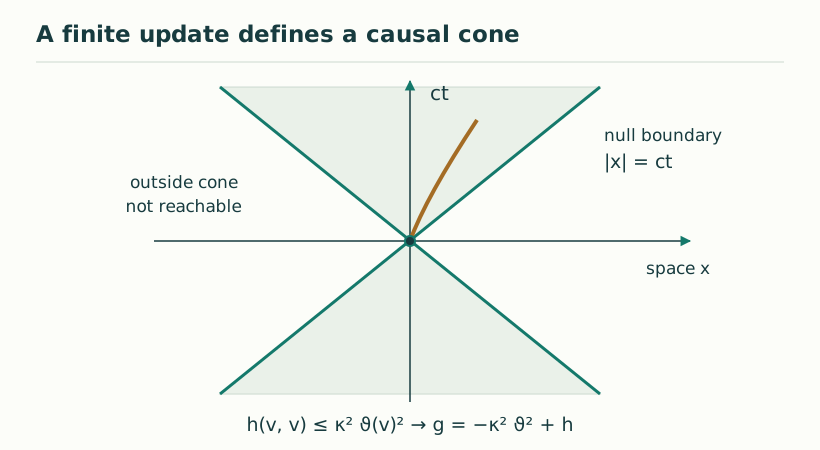
DTT can reinterpret a trajectory as a relation among completed records produced through inner generation. If it uses discrete updates, it must specify how a smooth trajectory arises as an approximation or limit. For positions xₙ at times nΔτ, a difference quotient gives vₙ=(xₙ₊₁−xₙ)/Δτ. A continuum limit requires controlled behavior as Δτ and the corresponding spatial scale become small.
The six inner roles do not themselves prove convergence. Stability, bounded errors and a clear scaling relation must be established for the chosen update.
For x(t)=t², the forward difference over interval h is [(t+h)²−t²]/h = 2t+h. The derivative is 2t, recovered as h approaches zero. At a finite interval the extra h remains. This example shows exactly how a discrete description can approximate a continuous rate while retaining a calculable correction. A DTT model with finite completions should specify whether such corrections are observable, canceled by the dynamics or only part of an approximation. The presence of a discrete index alone does not determine the answer. What matters is the update law, its scaling and the readout used to define the effective velocity.
A geometric series, a differentiable trajectory and a discrete sample sequence can provide compatible descriptions of a motion problem. They answer different questions about decomposition, local rate and recording. Zeno helps sharpen these distinctions but does not uniquely select SMM. A generative theory adds content when it supplies the update law and demonstrates why the observed continuous approximation succeeds in its stated regime.
KEEP THE CONNECTION
Scope of the argument. Source-based conceptual interpretation with original worked examples; physical conclusions are stated with their assumptions.
Original public topic. This edition provides an independently written explanation; article-level references identify the passages and additional sources used.
Source register →