A004Public article topicExpanded article4 min read
Preliminary Outline of Ibn Arabi's Cosmology
An introductory map of Ibn al-Arabi’s cosmological vocabulary and its place in the Single Monad reading. Explain how symbolic descriptions organize relationships between unity, manifestation, and knowledge.
Ibn al-Arabi’s cosmology combines visible nature, spiritual realities and the relation of creation to the divine Names. Its vocabulary cannot be reduced to a catalogue of physical objects. Intellect, Soul, Cloud, Pen and Tablet participate in an account of knowledge, manifestation and dependence. Reading every term as the name of a hidden particle would erase the questions the text is addressing.
The source article places this cosmology within Ibn al-Arabi’s wider writings and describes the Universal Intellect and Universal Soul through the symbolism of writing. It also emphasizes that his concern is spiritual knowledge rather than astronomy as an independent technical discipline.
02A hierarchy need not be a stack of places
A cosmological diagram can place one principle above another to express explanatory dependence. The higher principle is not necessarily located at a greater altitude. For example, the rule of a language is prior to a meaningful sentence in one explanatory sense, although the rule does not sit physically above the printed words. The comparison helps explain how a metaphysical hierarchy can organize relations without supplying geographical coordinates.
In this reading, the Intellect–Soul relationship concerns the articulation and reception of intelligible order. Pen and Tablet give that relationship a concrete image. The image is powerful precisely because it relates activity, receptivity and inscription; it should not be mistaken for a claim that the heavens contain literal writing implements.
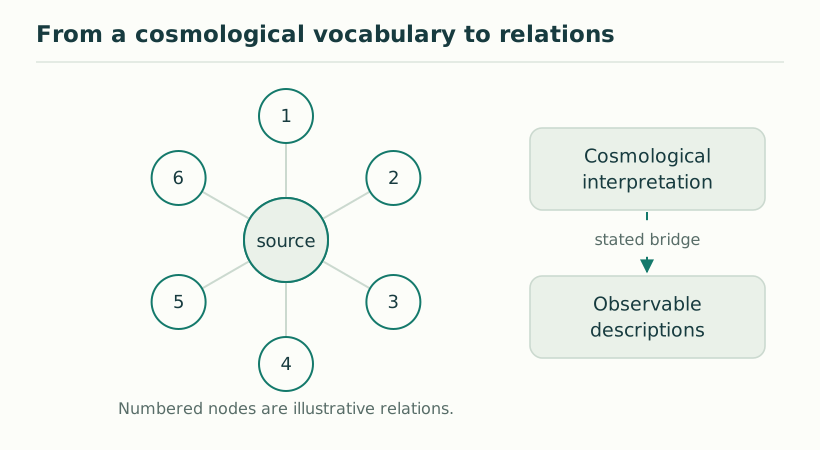
Figure 1. From a cosmological vocabulary to relations. The diagram is a reading aid for the SMM vocabulary: source, relations, manifested plurality, and observation. The arrangement does not assign physical locations to metaphysical terms. View full size ↗
03Unity does not erase distinctions
The claim that manifestation has one source does not make every manifested distinction meaningless. A single musical composition can contain different notes and relations without becoming many unrelated compositions. The unity is found in the organizing dependence; the multiplicity is found in the articulated expression. The analogy is limited, but it shows why unity and differentiation need not be logical opposites.
SMM adopts this as a foundational question: how can one source sustain genuine observable variety? A mathematical answer would identify the admissible relations among histories and the distinctions retained by observation. It would not simply declare that all differences are illusions and then use those same differences to make physical measurements.
04From symbolic articulation to a temporal model
DTT interprets generation and manifestation through inner organization and outer completion. The relationship resembles the difference between constructing a meaningful arrangement and making that arrangement available as a record. This is an interpretive bridge, not a translation rule guaranteed by the medieval text. Modern notions such as Hilbert spaces, detector algebras and causal cones bring their own mathematical content.
The six nested inner roles and the outer completion role offer one way to organize the proposed transition into three-dimensional experience. A physical model must show what each role does and why all are needed. A cosmological diagram can motivate this architecture; it cannot substitute for the proof that the resulting readout has the required geometry.
05How to compare without reducing either side
A careful comparison asks what relation is shared. Is it dependence, succession, reception, differentiation or closure? Once that relation is specified, one can explain the analogy and its limits. For example, inscription and stable records both involve preservation of a distinction, but the metaphysical Tablet is not thereby identified with a laboratory memory device.
This approach preserves two kinds of inquiry. Historical interpretation asks how Ibn al-Arabi’s terms work within his own system. Physics asks whether an explicit model reproduces measurable relationships. SMM/DTT can be inspired by the first while being assessed by the second. The conceptual connection is strongest when both are made clear, rather than when symbolic language is retrospectively presented as an unrecognized equation of modern science.
06A reading procedure for a symbolic diagram
Take one link in a cosmological hierarchy and ask whether it expresses origin, knowledge, resemblance or causal action. Then ask whether the relation is symmetric. If the Soul receives from the Intellect in the cited symbolism, reversing the arrow changes the claim even when the same two labels remain. This exercise makes the diagram intellectually precise without pretending it is a physical circuit. A modern DTT diagram should receive the same scrutiny: every arrow should identify a defined map or dependency, and a missing map should remain a research question.
KEEP THE CONNECTION
Key ideas
Ibn al-Arabi’s hierarchy expresses dependence and meaning as well as cosmological imagery.
Unity of source is compatible with differentiation of manifestation.
DTT develops a modern interpretive bridge whose physical content must be established independently.
Scope of the argument. Interpretive comparison with Ibn al-Arabi’s cosmology; symbolic terms are not identified with physical observables.
Original public topic. This edition provides an independently written explanation; article-level references identify the passages and additional sources used.