
In this article
- One word, several questions
- Order comes before duration in a simple construction
- Experience adds memory and anticipation
- Where SMM and DTT enter
- A productive way to ask the next question
- An operational thought experiment
Frame the major questions about time shared by philosophy and science: order, duration, change, and the present. Establish a vocabulary for comparing answers without collapsing their differences.
Asking what time is can mean several different things. One person asks how to compare durations. Another asks why the past is remembered while the future is anticipated. A third asks whether events would possess an order without observers. A fourth asks why physical laws contain a temporal parameter at all. These questions overlap, but an answer to one is not automatically an answer to the others.
The source introduction collects this family of problems and places time at the intersection of physics, philosophy and experience. That is a useful starting point for SMM/DTT because the framework deliberately distinguishes the production of events from the order in which completed events become available.
Suppose events A, B and C occur in that order. This tells us that B lies between A and C, but not whether the interval A–B is longer than B–C. A duration requires extra structure: a clock, a measure or a rule for comparing intervals. One can therefore have temporal order without already possessing a numerical time coordinate.
This distinction is elementary but consequential. A theory that derives a sequence of completions has not yet derived a physical clock rate. If τ assigns a duration to each interval, its additivity and calibration must be justified. Multiplying every reading by a positive constant changes units while preserving order; a more general distortion may preserve order but alter the claimed dynamics.
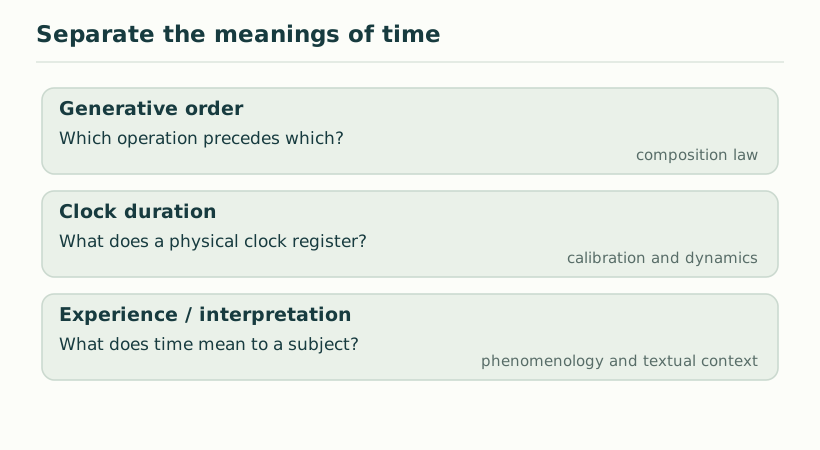
The felt present includes more than an isolated numerical timestamp. It involves retained traces of what just happened, expectations and changing attention. Two activities with the same clock duration can feel different because their experiential organization differs. This does not mean the clock has malfunctioned or that physical time is whatever a person feels.
A useful example is waiting for a result. The uncertainty and repeated checking can dominate experience even while a regular clock continues unchanged. The example separates a public measure from an individual mode of access. It also explains why an account of time that ignores observers entirely may leave important philosophical questions untouched.
SMM asks whether observable events depend on a single generative foundation. DTT distinguishes inner production from outer record order. In this vocabulary, the internal operations needed for an event are not automatically additional elapsed time on the observer’s clock. The observer’s own available records are part of what must be explained.
One can formalize the distinction by considering many internal histories that complete to the same record. An observer cannot infer every internal step from the record alone. This is a precise sense in which manifestation can conceal generation. It is different from claiming that the internal process is supernatural or inaccessible in principle; a future model might provide indirect tests.
Every temporal claim becomes clearer when its ingredients are named. What counts as an event? Which relation orders events? Which system acts as a clock? What information survives? How is the observer coupled to the process? These questions prevent the word time from doing several incompatible jobs in the same argument.
For SMM/DTT, a major result would connect these ingredients through one dynamics. A partial result can still be valuable: a theorem about event order, a criterion for an operational clock, or an obstruction to generating irreversible records. What matters is stating which problem has been solved. Philosophy supplies distinctions that sharpen the target; mathematics and measurement determine how far a proposed physical construction reaches.
Imagine a device that prints A, B, C on successive completions but contains no stable oscillator. It establishes an order. Now add an oscillator and record its phase beside each letter. The device can compare intervals, but only if its oscillator is repeatable and its coupling is understood. Finally, give a receiver memory of earlier letters: the receiver can recognize a history. These three additions show why order, duration and access to a past are distinct achievements. A complete temporal theory should explain their compatibility rather than assume that one automatically supplies all three.
KEEP THE CONNECTION
Scope of the argument. Introductory conceptual analysis with illustrative models, rather than a unique definition of time.
Original public topic. This edition provides an independently written explanation; article-level references identify the passages and additional sources used.
Source register →