A008Public article topicExpanded article4 min read
Time in Western Philosophy
Compare absolute, relational, and experiential approaches to time in Western philosophy. Use the comparison to clarify what a theory must mean when it calls time fundamental or emergent.
Western philosophical debates repeatedly ask whether time exists independently of events or is constituted by relations among them. The source article presents this contrast through Newton and Leibniz and then introduces questions about experience and temporal order associated with Augustine, Kant and McTaggart. The positions address different aspects of the problem and should not be collapsed into a single contest between real and unreal time.
An independent temporal framework can serve as a useful mathematical background. A relational account asks what distinguishes two supposed temporal situations if every physical relationship remains the same. That question becomes especially important for a theory seeking to derive time rather than assume it.
02The empty-shift thought experiment
Imagine an entire history shifted by ten units along an otherwise empty time axis. Every event keeps the same duration and the same temporal relation to every other event. If no observable difference follows, what distinguishes the shifted history from the original? The example does not prove that absolute time is impossible, but it shows why an unobservable origin can be treated as descriptive freedom.
Operational physics routinely distinguishes such freedoms from measurable differences. A clock’s zero can be reset without changing its rate. By contrast, altering its coupling to the system may change comparisons with other clocks. The relevant distinction is between relabelling the same relations and modifying those relations.
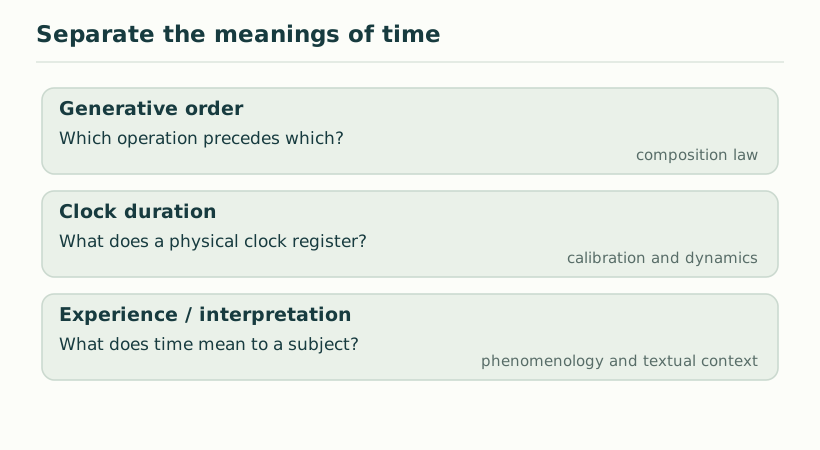
Figure 1. Separate the meanings of time. An interpretive map separates generative order, measured duration, and experienced or theological meanings. A relation between them is a question to formulate, not an automatic identification. View full size ↗
03Experience is structured, not merely timestamped
Experiencing a sequence requires more than being assigned successive coordinates. A melody is heard through retention of earlier notes and expectation of later ones. If every note erased all traces of its predecessors, there would be successive sounds but no experienced melody. This illustrates the importance of memory in temporal consciousness without reducing the philosophical problem to a single neural mechanism.
For SMM/DTT, the example emphasizes that a completed event must carry or connect to appropriate records if an observer is to recognize succession. A bare list of externally numbered states is not yet an account of time from within the model. The observer’s continuity belongs among the things requiring explanation.
04Tense and ordered relations
The description of an event as past, present or future depends on a standpoint within a history. Its relation of occurring earlier than another event can remain fixed. These are different descriptive structures. Neither should be silently substituted for the other when discussing whether time flows.
In a simple record model, a current state contains traces of earlier events and predictions about possible later events. The asymmetry can be expressed through the availability of records. It does not follow merely from assigning increasing integers to states, because the reverse numbering would otherwise work equally well. A physical arrow needs an asymmetric structure or condition.
05SMM/DTT as a relational reconstruction
The monadic proposal is compatible with asking how temporal relations arise from a common source. DTT then distinguishes the internal organization of histories from the public order of completed records. A modern version can represent observationally indistinguishable internal histories by the same class, removing distinctions that have no available physical test.
The philosophical contribution is a disciplined set of questions: which temporal distinctions are physically meaningful, which are conventions, and which belong to experience? A successful DTT model need not settle every metaphysical debate. It should show how its own clock, record and causal structures are defined, why they agree, and what changes of description preserve their observable content.
06The difference between changing a label and changing a clock
If all timestamps are increased by the same constant, a meeting that lasted an hour still lasts an hour. If one clock instead runs twice as fast as another, their comparison changes even though both readings increase monotonically. This simple distinction explains why temporal order alone cannot determine physical duration. A DTT model that derives only an ordered completion count still needs to identify which physical process realizes that count and how its readings compare with independently prepared clocks. Otherwise a coordinate convention can be mistaken for a dynamical prediction.
KEEP THE CONNECTION
Key ideas
An arbitrary clock origin differs from a physical clock rate.
Experienced succession requires retained relations, not just external timestamps.
DTT can make relational questions precise through completion and observation.
Scope of the argument. Philosophical comparison, avoiding claims that any one historical position is simply equivalent to relativity.
Original public topic. This edition provides an independently written explanation; article-level references identify the passages and additional sources used.