
In this article
- A debate within a shared intellectual world
- Duration cannot be identified with distance travelled
- Atomism and renewed creation
- Creation and explanatory priority
- How DTT develops the problem
- An explicit persistence criterion
Introduce selected Islamic philosophical debates about time, motion, and creation. Place Ibn al-Arabi’s approach alongside these debates while retaining differences between philosophical and theological methods.
Earlier Islamic discussions of time developed through encounters among philosophy, theology and scriptural interpretation. The source article contrasts accounts linking time to motion with atomistic accounts in which the world’s states are repeatedly renewed. It highlights Ibn Sina’s attention to the relation between change and measure, alongside debates about creation and an eternal world.
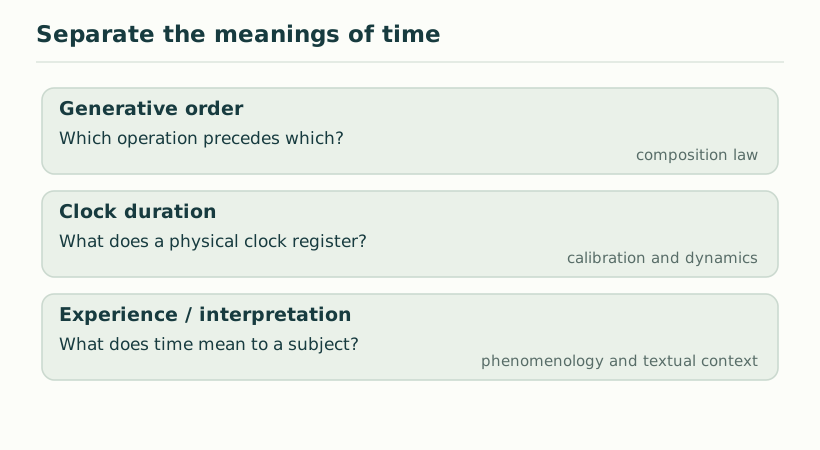
These were not simply disagreements about the precision of clocks. They concerned dependence, possibility, causation and what it means for something to begin. A useful reading preserves these distinctions instead of dividing all positions into those that allegedly agreed with modern physics and those that did not.
Two travellers may cover different distances during the same interval. One traveller may cover the same distance on two journeys of different duration. The example shows why time cannot simply be equated with distance or with an undifferentiated amount of motion. A measure must distinguish the duration of a process from its spatial extent.
This issue returns in generative physics. If an internal update both creates additional records and refines their spatial scale, a clock could respond to either operation or to both. Naming one operation temporal does not ensure that a material clock follows it. Its coupling and accessible readout have to be specified.
A temporal atomist picture treats change as a succession of distinct states. It can make the dependence of each state on its source especially vivid: persistence becomes the continued production of an appropriate sequence rather than the uninterrupted self-sufficiency of a substance. The picture raises a further question, however: what connects adjacent states?
Without a transition rule or retained relation, every new state could be unrelated to the last. A world of arbitrary replacements would not explain stable objects or reliable memory. The important constructive task is therefore not only to posit renewal but to explain lawful continuity across renewal. This is where a formal notion of record identity becomes valuable.
A cause can be described as earlier in a temporal sequence, but dependence need not always be temporal. The truth of a conclusion depends on premises without waiting for those premises to age. Similarly, an account that regards the whole temporal order as created cannot automatically place its ground at an earlier clock reading.
This distinction helps avoid a familiar regress: if the first temporal event requires an earlier event of the same kind, the first event was not first. One response is to deny a first event; another is to distinguish temporal succession from the kind of grounding being asserted. Which response is adopted is a substantive philosophical choice.
DTT can be understood as seeking a formal account of lawful renewal. Inner histories compose; selected completions become observable; retained records support persistence and comparison. The connection to earlier debates lies in the problem structure, not in an identity between a medieval atom and a quantum state.
The six inner levels in the nested formulation are organizational roles within this construction. Their relevance must be shown through the relations they produce, such as a stable readout or a repeatable completion law. A physically successful model would then explain why particular temporal distinctions are observable and why others remain internal. This offers a clear way to develop the philosophical insight while respecting the additional demands of mathematical physics.
Let rₙ be the record after completion n, and suppose a predicate P(rₙ) identifies a stable pattern. Persistence over several completions means that P remains true along the permitted update, even though rₙ itself changes. This is already more informative than saying that an object is recreated: it tells us what counts as the same object for the chosen purpose. A richer model must identify several compatible predicates, including position, charge or other measurable properties. The construction turns the old problem of continuity through renewal into a set of concrete mathematical obligations.
In SMM, unity of the source motivates a common account of this renewal across different objects. DTT distinguishes the inner construction from the sequence of retained records. A persistence predicate then connects the two: it states exactly which observable relation the source update must preserve through repeated completion.
KEEP THE CONNECTION
Scope of the argument. Interpretive overview, with modern examples offered as analysis rather than historical attribution.
Original public topic. This edition provides an independently written explanation; article-level references identify the passages and additional sources used.
Source register →