
In this article
- Time appears differently in different physical descriptions
- A clock follows a path
- Quantum evolution and temporal records
- An arrow requires more than a parameter
- The reconstruction target
- A check on any hidden-time interpretation
An introduction to the operational roles of time in modern science, distinguishing clock readings, dynamical parameters, and irreversible processes before connecting them with the generative and observed roles of time in DTT.
In a laboratory model, time may enter as a parameter controlling a state’s evolution. In relativistic geometry, physical clocks trace durations along their own histories. In statistical physics, the direction in which records and macroscopic processes develop raises additional questions. These uses are connected, but they are not a single solved definition of time.
The public article introduces relativity, the early universe and temporal asymmetry. Several popular claims require care: quantum correlations do not by themselves provide faster-than-light messaging, and the existence of a hot early universe does not by itself establish a complete theory of an absolute first instant.
For inertial motion in flat spacetime, a clock moving at speed v relative to a chosen inertial frame accumulates dτ=dt√(1−v²/c²). This is a relation between measured durations, not a statement that the moving observer’s feelings slow down. The proper-time reading is associated with the clock’s worldline.
For example, at v=0.6c the factor is 0.8. An interval of ten coordinate-time units corresponds to eight proper-time units along that constant-speed segment. The comparison presupposes the relativistic framework and suitable clock behaviour. DTT cannot count this familiar result as newly derived merely by renaming τ inner time.
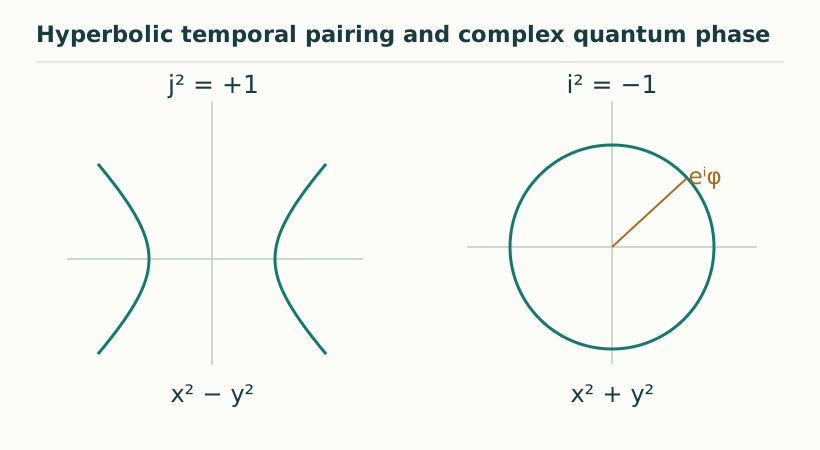
A quantum system can preserve phase information that affects later observations. A measurement can also create a durable record while coupling the system to additional degrees of freedom. The distinction between coherent evolution and recorded outcomes is central to a generative interpretation of time, but it does not mean that every unobserved process literally stops occurring.
Imagine a two-path device. If the paths retain coherence, amplitudes combine. If a distinguishable path record is created and ignored, interference can be reduced. The physically relevant issue is which information remains available and how it enters the state. An interpretation must reproduce these relationships before claiming to explain them more deeply.
A symbol t can increase in an equation even when the underlying law is reversible. Choosing the direction of the axis does not explain why observers possess records of one side and not the other. A temporal arrow involves states, boundary conditions, coarse observation or other physical structure in addition to formal evolution.
DTT’s distinction between recurrent generation and ordered completion is useful here. Repetition of an internal phase need not be irreversible. A completed record order may introduce a direction of availability. The two statements can coexist, but the model must identify the resource and mechanism that make records stable and distinguish earlier from later.
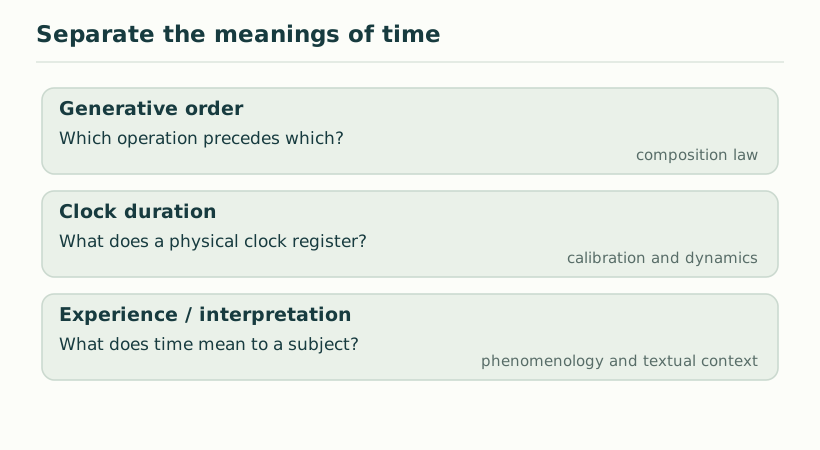
SMM/DTT seeks a common origin for the structures that established physics uses successfully. The task is not to discard proper time, quantum phase or thermodynamic reasoning. It is to derive their applicable forms from an explicit source model and show where the resulting theory agrees or differs.
This requires careful interfaces. A geometrical time parameter must be linked to a material clock. A completion event must be linked to a detector record. A proposed hidden phase must affect an observable in a calculable way. Keeping these interfaces visible turns a broad idea about temporal duality into a programme with specific mathematical milestones and possible empirical consequences.
Suppose an internal variable advances during a process but no allowed measurement, either immediate or delayed, can distinguish how much it advanced. It may still be useful mathematically, but it has not yet been identified as a measured duration. Conversely, a variable that changes a later interference pattern has an operational effect even if it is not directly displayed by a clock. This distinction between an unobserved parameter and an indirectly testable degree of freedom is important for DTT. It prevents both premature dismissal of hidden structure and premature identification of that structure with physical time.
KEEP THE CONNECTION
Scope of the argument. Established relativistic illustration followed by conditional SMM/DTT interpretation.
Original public topic. This edition provides an independently written explanation; article-level references identify the passages and additional sources used.
Source register →