A003Public article topicExpanded article4 min read
Summary of Modern Theories of Cosmology
Map the conceptual transition toward modern cosmology, highlighting the roles of gravitation, observation, and cosmic evolution. Explain where SMM proposes a different starting point.
Cosmology studies the large-scale organization and development of the physical universe. Its questions include how matter and radiation are distributed, how cosmic distances evolve, how structure forms and which assumptions describe the earliest accessible conditions. These are connected questions, but they are not interchangeable. A model can describe expansion well while leaving the origin of its initial conditions unexplained.
The original article introduces the growth of the modern cosmic picture and the motivation for combining gravitation with quantum theory. For a contemporary SMM/DTT discussion, the useful starting point is a hierarchy of explanatory tasks rather than a list of dated numerical estimates.
02Expansion is a relational statement
In a homogeneous model, one writes the separation of ideal comoving markers as d(t)=a(t)χ. The coordinate separation χ remains fixed while the scale factor a changes. The expansion rate H=(1/a)(da/dt) measures the fractional change of that scale. This language does not require an explosion outward from a central point into a surrounding empty container.
As a simple example, if a doubles while χ is fixed, the modeled separation doubles. This is different from saying that every local bound object doubles its size. Local dynamics and the domain of applicability of the homogeneous approximation matter. Any emergent-space proposal should explain when this coarse description is valid and what microscopic quantity its scale factor represents.
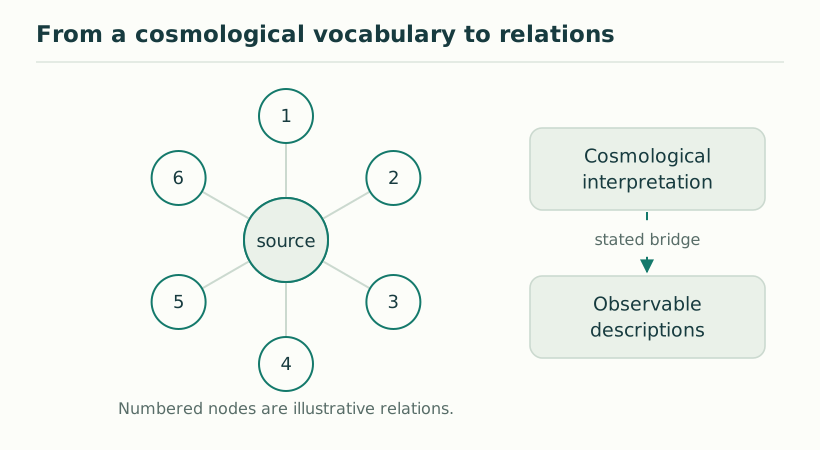
Figure 1. From a cosmological vocabulary to relations. The diagram is a reading aid for the SMM vocabulary: source, relations, manifested plurality, and observation. The arrangement does not assign physical locations to metaphysical terms. View full size ↗
03Background evolution and structure are distinct
A perfectly uniform background has no galaxies by definition. A realistic account therefore needs deviations from that background and a law for their development. The existence of a simple large-scale description does not remove the need to explain fluctuations, correlations and the processes that amplify some of them. This distinction is important for evaluating claims that a unified source automatically produces homogeneity.
One source could generate highly irregular outcomes. Homogeneity requires a symmetry or statistical mechanism in the observable distribution. Likewise, a model of a smooth background does not by itself predict the spectrum of fluctuations. In SMM/DTT the readout map and the source dynamics must supply these separate pieces of information.
04What temporal generation would contribute
DTT proposes that spatial organization is reconstructed through inner generative activity and registered through outer completion. Applied cosmologically, this suggests asking whether an evolving completion pattern can produce the effective scale and causal structure used in cosmological models. The proposal changes which objects are fundamental; it does not automatically change the observed expansion law.
A useful construction would begin with explicitly defined histories, show how large collections of records admit an approximately homogeneous geometry, and identify a physical clock built from the same dynamics. Only then would it be meaningful to calculate an expansion rate. Calling a generative step a cosmic second before defining the clock would hide the calibration problem.
05The origin question remains more than a boundary condition
An initial condition tells a dynamical model where to begin its evolution. An explanation of why such conditions occur is a further question. SMM addresses this by proposing a common ontological source; a physical DTT model must translate that proposal into restrictions on admissible states or their weights. Without such restrictions, virtually any initial universe could be assigned to the same source.
This separation creates a clear route to progress. One may first recover a known effective cosmology under stated assumptions, then identify additional constraints arising from completion, retained memory or source symmetry. A novel prediction would be a relation among observables that survives calibration and differs from alternative models. A conceptual origin story is valuable motivation, but its scientific reach depends on those calculable restrictions.
06What would a common source constrain?
Suppose a generative model has one free function controlling its expansion and another independently adjustable function controlling its fluctuations. It may fit both sets of observations, but the common source has not yet explained their relation. A stronger construction would link these functions or constrain their allowed forms. The improvement can be expressed without claiming a final theory: after calibration against one class of observations, the model should leave less freedom in another. This is the practical meaning of seeking explanatory unity rather than a universal fitting framework.
KEEP THE CONNECTION
Key ideas
Expansion describes changing relations within a cosmological model.
Homogeneity and fluctuation dynamics require mechanisms beyond the assertion of one source.
DTT becomes cosmologically useful when generated records yield a clock, geometry and calculable evolution.
Scope of the argument. Conceptual overview; no new cosmological fit or observational parameter estimate is asserted.
Original public topic. This edition provides an independently written explanation; article-level references identify the passages and additional sources used.