A002Public article topicExpanded article4 min read
A Brief Overview of Early Cosmological Models
A historical reading guide to early cosmological pictures and the questions they tried to answer. Use their different ideas of order, motion, and origin to frame later discussions.
An early cosmological model was rarely just a map of objects in the sky. It could combine a method for predicting appearances, a theory of motion, an account of cosmic order and a theological interpretation of humanity’s place. Separating these tasks makes historical comparison more informative. A diagram can predict a planet’s apparent position reasonably well even when its physical interpretation is mistaken. Conversely, a profound account of meaning can leave the numerical prediction of an eclipse untouched.
The source article follows the transition from geocentric descriptions through heliocentric astronomy to a dynamical universe. Its lasting relevance to SMM/DTT is the lesson that familiar background assumptions can become objects of explanation. The historical details should not be used as a shortcut to validate a new cosmology.
02Changing the organizing centre
In a geocentric description, observations are organized around Earth. A heliocentric description reorganizes planetary motion around the Sun. The change matters physically when it simplifies the relations and supports a coherent dynamical account, not simply because one drawing has a different object in its middle. Coordinate choice and physical explanation must therefore be kept separate.
This distinction also prevents a misleading picture of the Single Monad. The monad is not proposed as another astronomical centre replacing Earth or the Sun. In SMM it is a non-spatial generative source. An observer should not expect to point a telescope toward the monad as though it occupied a privileged location among galaxies.
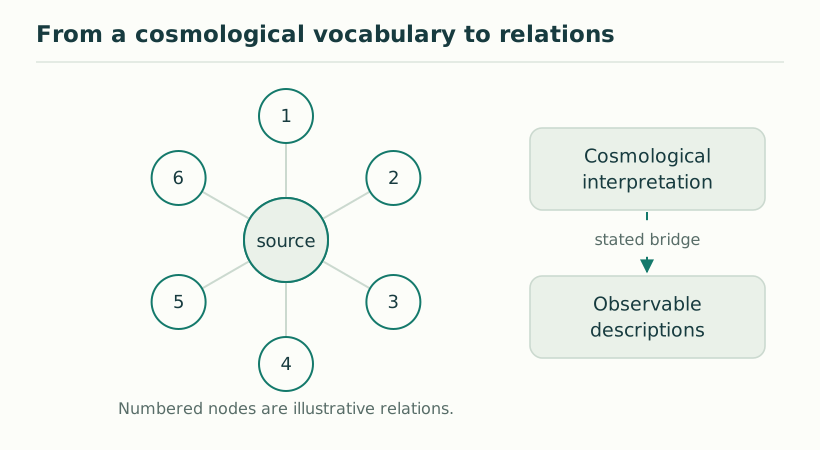
Figure 1. From a cosmological vocabulary to relations. The diagram is a reading aid for the SMM vocabulary: source, relations, manifested plurality, and observation. The arrangement does not assign physical locations to metaphysical terms. View full size ↗
03From geometric fitting to common dynamics
Consider a set of circular tracks chosen independently to fit several observed motions. Such a construction can reproduce selected data, but it does not explain why the tracks are mutually consistent. A dynamical law is stronger if the same rule governs all the bodies and produces their relationships from a common set of parameters. The distinction between fitting and explanation is especially important when a model has many adjustable ingredients.
For DTT, the corresponding challenge is to avoid assigning each observed phenomenon its own temporal mechanism. A clock law, a propagation law and a dimensional readout can each look plausible separately. Their common origin becomes significant only when one construction constrains them together and remains successful in cases that were not used to select its parameters.
04The observer belongs inside the account
A sky chart is drawn from an observing position. Its apparent motions depend on that position and on the motion of the observer. The broader methodological point is that data are relational: an angle is measured between directions, a period against a clock, and a distance through some calibrated procedure. A theory must explain which comparisons are physical and which changes merely describe the same situation differently.
SMM/DTT extends this point by asking whether the observer’s rods, clocks and records are products of the same generative process as the objects measured. This is more demanding than adding an observer symbol to a cosmological drawing. It requires a model of how records remain stable and comparable across different parts of the emergent world.
05A disciplined comparison with modern proposals
The history of cosmology offers both encouragement and a constraint. Deep changes of framework are possible, but a replacement earns its place by resolving concrete problems and recovering successful earlier predictions. Disagreement with an established picture is not itself evidence of a breakthrough. The key question is what the new assumptions enable one to calculate.
A useful comparison asks four things: what is primitive, what is derived, what is measured, and what would count against the model? For early models the primitives might be spheres and circular motion. For SMM/DTT they concern a source, composable histories and completion. The new framework becomes a physics theory when these choices yield a coherent observable structure, rather than only a new vocabulary for the old one.
06A comparison that survives a change of picture
Imagine two cosmological diagrams that use different centres but predict exactly the same recorded angles and periods. Their pictorial difference alone is not a new observation. To choose between physical interpretations, one asks about dynamical simplicity, additional predictions and consistency with other measurements. The same standard applies to a monadic description that reproduces an existing theory: it may offer valuable understanding, but a distinct physical claim requires some additional restriction or observable consequence. This helps distinguish a change of explanatory perspective from a change of empirically tested law.
KEEP THE CONNECTION
Key ideas
Historical cosmologies combine prediction, dynamics and interpretation in different proportions.
The Single Monad is a proposed generative source, not an astronomical centre.
A common dynamical explanation is stronger than independent fits to separate phenomena.
Scope of the argument. Historical orientation and methodological comparison, without treating conceptual resemblance as evidence.
Original public topic. This edition provides an independently written explanation; article-level references identify the passages and additional sources used.