
In this article
- One source and many observable events
- The duality of generation and completion
- A minimal mathematical language
- An example of emergence without multiplication of sources
- What the framework must jointly explain
- A small consistency test
Introduce the Single Monad Model as a proposal connecting one generative source with the many events of experience. Set out its vocabulary before approaching its physical interpretations.
The Single Monad Model begins with an ontological question: why does the world appear as a multiplicity of objects, places and events if its generative foundation is one? The monad in this proposal is not a small particle situated somewhere in an already existing universe. It names the single source from which spatial distinctions and observable histories are to arise. A successful construction would therefore explain the relations between objects as well as the objects themselves. Placing a tiny source at the centre of a ready-made space would leave the central problem unanswered.
The original article presents renewed creation as a possible common foundation for relativistic and quantum phenomena. Its ambitious physical claims are best read as motivations for a research programme. The explanatory task is to turn the source–manifestation relationship into a mathematical model whose observable consequences can be checked.
DTT gives this programme a more specific distinction. Inner time concerns the organization of generative activity; outer time concerns the completed events through which observers obtain a public history. These are related roles within one process. They need not be two independently running clocks. In the nested account, six inner stages organize the construction associated with three-dimensional readout, and the seventh role is completion into an observable event. Calling them stages does not assign six additional laboratory time coordinates.
A useful bookkeeping picture is a document assembled through several dependent operations and then committed as one readable version. The operations have an order, but a reader comparing successive versions sees another order. This analogy clarifies the distinction without proving that physical reality is a computer or a sequence of documents.
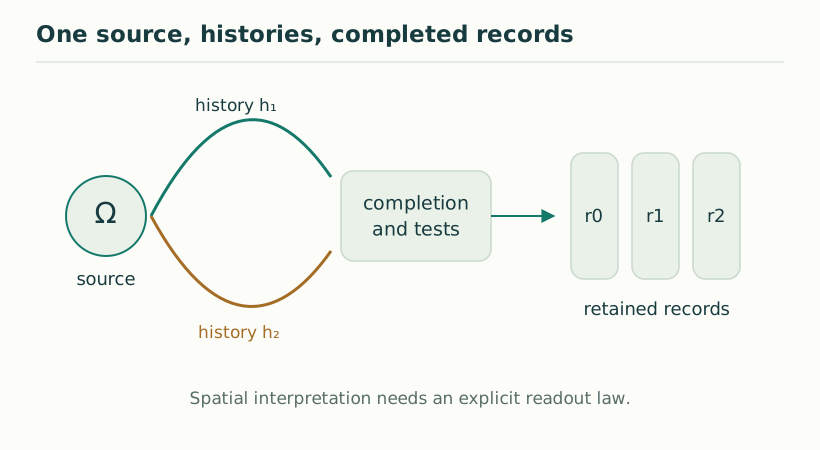
Let H denote admissible generative histories and let C identify histories that count as the same completed result. An observation map R takes completed results to detector records. If two internal histories give exactly the same results in every allowed observation, an operational description treats them as equivalent. The observable world is then represented by equivalence classes, rather than by every internal detail.
This construction separates three questions that are often conflated: which histories exist, which histories complete, and which completed distinctions remain observable. Merely defining the quotient does not guarantee that its classes form space. Distance, neighbourhood, dimension and persistence require additional structure and demonstrations.
Imagine one source that generates sequences of symbols, while a receiver records only whether each sequence ends in one of three distinguishable configurations. Many different sequences can yield the same record. Three observable alternatives therefore coexist with one generating source. Nothing contradictory occurs: source number and outcome number measure different things.
Now suppose successive records retain information about earlier records. A stable pattern can persist even though the underlying operations continue. This illustrates how identity through change might be defined by an invariant record relation. To model a particle, however, one must also establish propagation, interactions, energy and localization; a repeating label alone is insufficient.
The strongest SMM/DTT objective is a shared derivation of geometry, clocks and matter propagation. If one rule generates a spatial graph, a second unrelated rule sets clock rates, and a third stipulates a signal speed, their agreement has been inserted. A deeper model makes these quantities consequences of the same update and independently defined readouts.
The current axiomatic draft develops completed returns, observation equivalence and record order, while explicitly leaving physical locality and Lorentzian geometry open. This is a useful division of labour. It identifies mathematical progress without treating an attractive ontology as an experimental result. The conceptual unity of SMM becomes scientifically productive when it restricts which combinations of observable laws are possible.
Suppose two completed records are called adjacent because a local operation connects them. If the source update later permits an equally easy operation between arbitrarily distant records, the proposed adjacency has no stable dynamical meaning. The model must either forbid such shortcuts, explain why they are inaccessible, or modify its distance definition. This example shows why an emergent picture of space needs more than a static drawing of points. Locality is a relationship between available operations, retained information and the geometry inferred from them.
KEEP THE CONNECTION
Scope of the argument. Foundational explanation of a research framework; physical emergence remains conditional.
Original public topic. This edition provides an independently written explanation; article-level references identify the passages and additional sources used.
Source register →