
In this article
- Indivisible in which sense?
- Physical separation and mathematical decomposition
- A state-space example
- SMM and structured unity
- DTT locates structure in generation
- Operational tests define accessible parts
- Structured unity
Introduce the proposed structure of the monad as an explanatory topic. Distinguish conceptual components from measurable constituents before linking the discussion to later mathematical carriers.
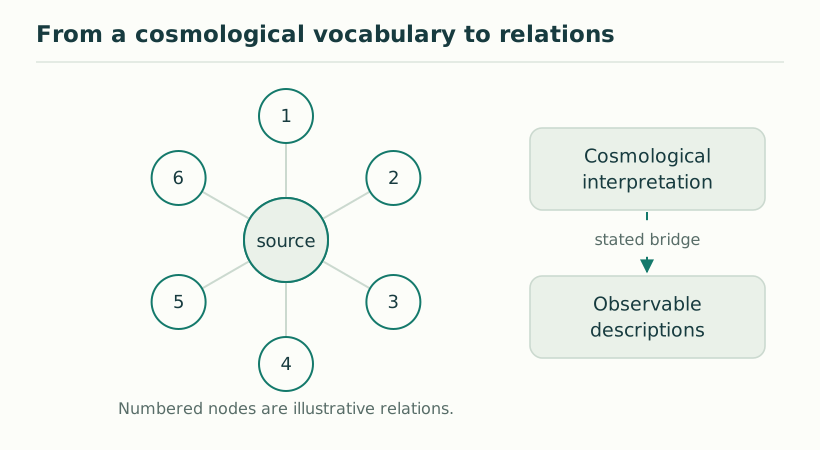
The source discusses the Monad as indivisible in manifestation while also attributing to it a more elementary metaphysical basis. It distinguishes substance from changing forms and considers the relation between embodiment and nonembodiment. This raises a useful conceptual issue: indivisibility depends on the operations and level of description under discussion. A thing can resist one kind of decomposition while admitting another kind of analysis.
A vector can be expressed as a sum of components without being a pile of detachable material pieces. Similarly, a system's state can have several coordinates even when the system cannot be separated into independently controllable subsystems. Mathematical decomposition is therefore not automatically physical divisibility.
The reverse distinction also matters. A model may treat an object as a point because its internal structure is irrelevant at a chosen scale. That approximation does not prove the object has no internal structure at any scale. The word elementary should always be tied to a specified explanatory level.
Let a system have states represented by a pair (q,p). The two coordinates may describe different observable properties of one system. They do not by themselves establish a tensor-product decomposition into two independent systems. To justify such a decomposition, one needs separate operations and a rule for composing subsystem states.
This example is especially relevant to a Monad model because it allows internal descriptive richness without immediately abandoning unity. The decisive question becomes which distinctions are operationally accessible and how they combine.
SMM requires enough structure to produce multiplicity while retaining a meaningful sense of common origin. The mathematical challenge is to specify that structure economically. A state space, a composition law and an update rule can provide an explicit starting point. Their properties must be justified independently of the outcomes the model hopes to explain.
For instance, selecting a three-dimensional carrier because observed space is three-dimensional may reproduce a target but does not derive it. A derivation would identify structural conditions that force the relevant carrier dimension and then show how its states become spatial relations.
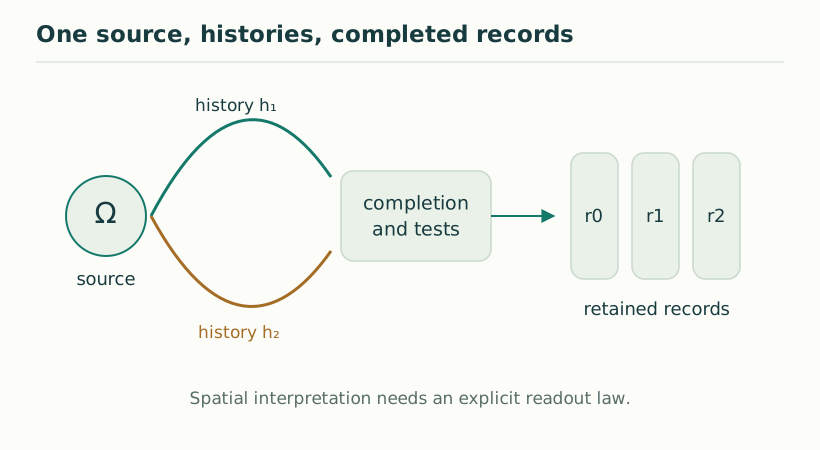
DTT offers a way to distinguish the structure of generation from the structure of completed appearances. Nested inner roles can organize a process that yields a physically indivisible completed record. The record's indivisibility does not imply that the preparation had no internal organization; it means that the specified observation cannot resolve that organization as separate completed events.
This requires an explicit observational interface. Without one, saying that a process is hidden or indivisible risks becoming unfalsifiable. With one, the theory can state exactly which operations distinguish internal states and which do not.
Suppose a state has two coordinates u and v, but every allowed readout depends only on u+v. The separate coordinates are mathematically present yet operationally unresolved by that interface. Adding a readout of u−v makes them separately reconstructible. Thus accessible structure depends jointly on the state carrier and the available tests. This is a useful model of how a completed record can be indivisible relative to one class of operations while a richer interface resolves further distinctions. DTT can formalize such changes through observational equivalence. It must then explain which tests are physically available, rather than letting the observer choose arbitrary mathematical probes.
A structural explanation predicts how allowed transformations, invariants and readouts fit together. Internal coordinates need not be material parts, and physically indivisible records may have an organized preparation. The SMM/DTT question is which aspects of that preparation survive completion and which remain operationally inaccessible. An explicit answer gives the claim of structured unity a mathematical content beyond the word indivisible.
KEEP THE CONNECTION
Scope of the argument. Historical interpretation and original conceptual analysis; illustrative mathematical constructions are not identifications of theological realities with physical objects.
Original public topic. This edition provides an independently written explanation; article-level references identify the passages and additional sources used.
Source register →