A057Public article topicExpanded article4 min read
The Different Names of the Single Monad
Organize the different names associated with the Single Monad in the source tradition. Use a contextual glossary to explain when names refer to similar roles and when their meanings differ.
The source associates the Single Monad with the Universal Intellect, the Pen and the Perfect Human Being, while noting ambiguity in some passages between the Monad and the Greatest Element. It uses images such as a seed and a tree to explain relations of origin and manifestation. Its own caution about overlapping names is important: a contextual glossary is more faithful than treating every expression as a universally interchangeable synonym.
02Names can identify functions
A pen suggests inscription, an intellect suggests intelligibility, and a seed suggests a generative relation to an organized result. These images emphasize different functions. One should ask what a name is doing in a particular passage: identifying an origin, describing a relation, explaining a capacity or comparing a process.
A useful reading method records the term, its immediate referent, the action attributed to it and the level of discussion. This prevents a metaphor introduced for one role from acquiring unintended claims when moved into another context.
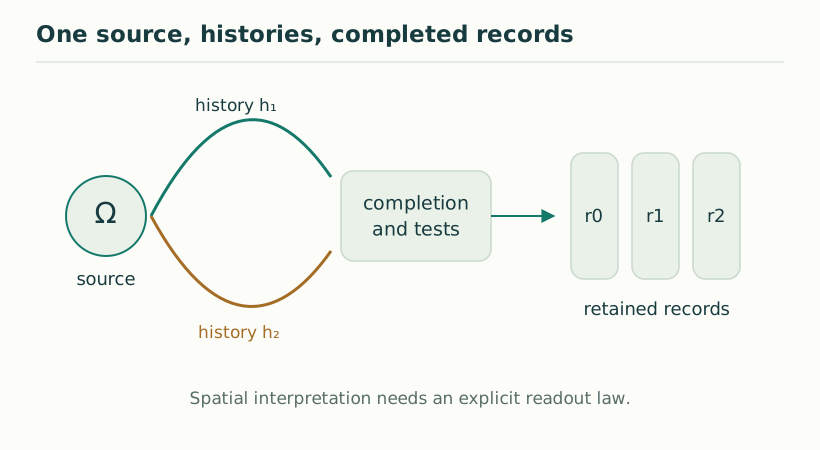
Figure 1. One source, histories, completed records. Conceptual reconstruction: composable source histories are tested and completed before a retained record becomes available. The source is not depicted as a point already located in space. View full size ↗
03A functional rather than numerical glossary
In a modern model, several descriptions may refer to one component because that component performs several functions. A retained state can carry memory, encode a phase reference and constrain a later readout. Calling it by those different roles does not multiply the underlying state, but neither does it establish that the roles are identical.
The distinction can be tested formally. Two roles coincide only if their definitions and consequences agree in the relevant model. A common poetic name is not sufficient to establish equality between two mathematical objects.
04The SMM connection
SMM organizes the world around a proposed generative unity. Its terminology becomes clearer when source, carrier, operation and result are distinguished. The source names an ontological role; a carrier represents available states; an operation changes or relates states; a record is an accessible outcome. One construction may connect all four, but it should not silently identify them.
For example, calling a state space the Pen does not explain how inscriptions arise. The model still needs an update rule and a record map. The metaphor can guide the question while the construction supplies the answer.
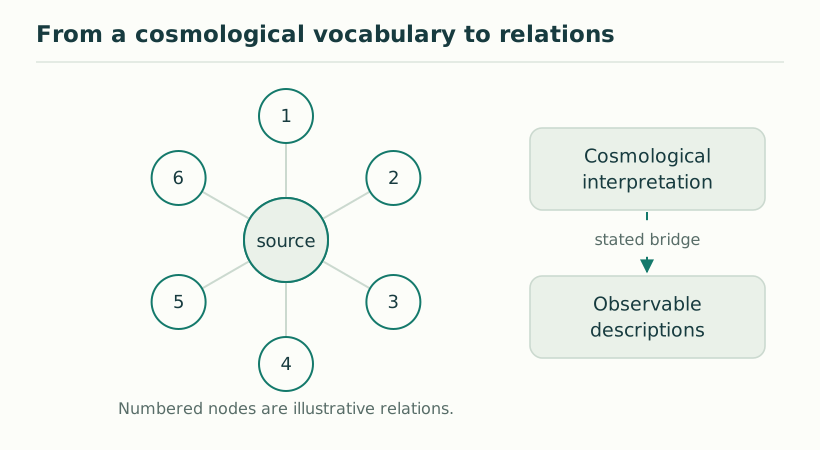
Figure 2. From a cosmological vocabulary to relations. The diagram is a reading aid for the SMM vocabulary: source, relations, manifested plurality, and observation. The arrangement does not assign physical locations to metaphysical terms. View full size ↗
05DTT and the translation of metaphors
The inscription image fits naturally with DTT's completed-record language. Inner generation concerns the preparation of a record, while outer completion concerns its availability. The seed image emphasizes how one organized precursor can support many later forms. Neither image alone explains the physical resources, timing or stability of the process.
A successful translation identifies a precise correspondence and also its limit. If inscription means a persistent memory state, the theory should specify how that state is written, protected and read. If generation means a sequence of nested operations, their dependencies must be explicit.
06A translation can preserve one relation and lose another
If the Pen is interpreted as an inscription role, the useful correspondence concerns the production of records. It does not automatically transfer every property of a literal pen, such as a spatial tip, an external hand or a consumable ink supply. Likewise, interpreting the Monad as a seed highlights organized potential without requiring a biological embryo. Stating these limits is not an empty caution; it identifies which parts of the image guide the formal construction. A good translation retains the relation under study and then supplies explicit mathematics where the metaphor stops. This allows historical vocabulary to enrich explanation without silently adding physical assumptions.
07A contextual glossary
Historical vocabulary is richest when its context remains visible. A term may emphasize intelligibility, inscription, generation or comprehensive representation. Where the source reports ambiguity between the Monad and Greatest Element, that ambiguity should be preserved rather than resolved by an invented equivalence. Consistent use of the vocabulary makes the transition to formal models clearer and helps readers locate disagreements about meaning.
KEEP THE CONNECTION
Key ideas
Names often emphasize functions rather than distinct objects.
Context determines whether two expressions share a referent.
A mathematical translation must distinguish source, carrier, operation and record.
Scope of the argument. Historical interpretation and original conceptual analysis; illustrative mathematical constructions are not identifications of theological realities with physical objects.
Original public topic. This edition provides an independently written explanation; article-level references identify the passages and additional sources used.