A022Public article topicExpanded article4 min read
Metaphysical Creation - from the COSMIC HEART
A proposed companion to the cosmic-heart discussion, focused on metaphysical creation and dependence. Explain how an account of existence differs from a dynamical description of material processes.
The linked source develops Ibn al-Arabi’s metaphysical triplicity: a generative relation involves an active pole, a receptive pole and a resulting act or manifestation. It connects this pattern with Intellect and Soul, subject and object, and the articulation of bodily extension. The article’s title in the public catalogue emphasizes metaphysical creation, while the linked text specifically discusses this threefold structure.
The important idea is relational. One does not explain a result by naming an agent alone; one must also specify what receives the action and how the relation produces a determinate outcome.
02Three roles are not three independent sources
An author, a writing surface and an inscription have different roles in one act of writing. Distinguishing the roles does not require three unrelated origins. Likewise, a single mathematical process can contain an operation, a state on which it acts and a result. The threefold description concerns the structure of the relation.
For SMM, this helps clarify how a single source can manifest through differentiated functions. Unity of source does not entail that a formal model has only one symbol or no internal distinctions. The challenge is to show how the distinctions depend on the source rather than being added as independent unexplained principles.
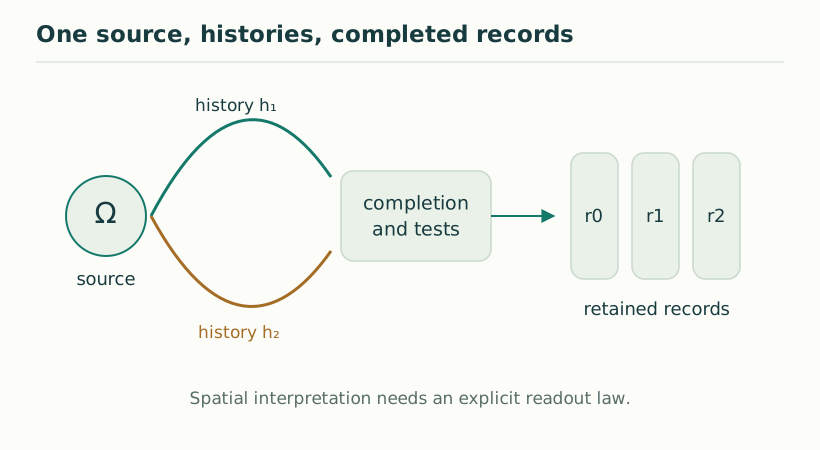
Figure 1. One source, histories, completed records. Conceptual reconstruction: composable source histories are tested and completed before a retained record becomes available. The source is not depicted as a point already located in space. View full size ↗
03A geometric example needs its assumptions
The source illustrates extension through successive paired constructions: points form lines, lines form a plane, and planes form a body. In a binary product construction, a segment has two vertices, a square four and a cube eight. The general vertex count is 2ᵈ for a d-dimensional hypercube.
This is not the universal minimum number of points needed to span dimension d. Three noncollinear points span a plane, and four noncoplanar points span three-dimensional affine space. The binary construction and the simplex construction are different geometries. Stating which is selected prevents a symbolic pattern from being mistaken for a theorem of unrestricted geometry.
A geometric example needs its assumptions
Construction
Line
Plane
Three-space
Binary product vertices
2
4
8
Minimal affine spanning set
2
3 noncollinear
4 noncoplanar
04Why the choice of construction matters
If a later physical argument uses the counts 1, 3 and 7, it must explain the receiver or combinatorial object from which they arise. For instance, a d-dimensional space has an exterior algebra whose positive-degree dimension is 2ᵈ−1. That identity is exact, but selecting this object as a physical record space is a separate step.
The lesson is constructive rather than dismissive. Symbolic triplicity may motivate a three-dimensional investigation. A mathematical model then needs explicit objects, operations and selection principles. Different admissible constructions can produce different counts, so the physical connection cannot rest on numerical resemblance alone.
dim Λ⁺(V) = Σ(k=1…d) C(d,k) = 2ᵈ − 1
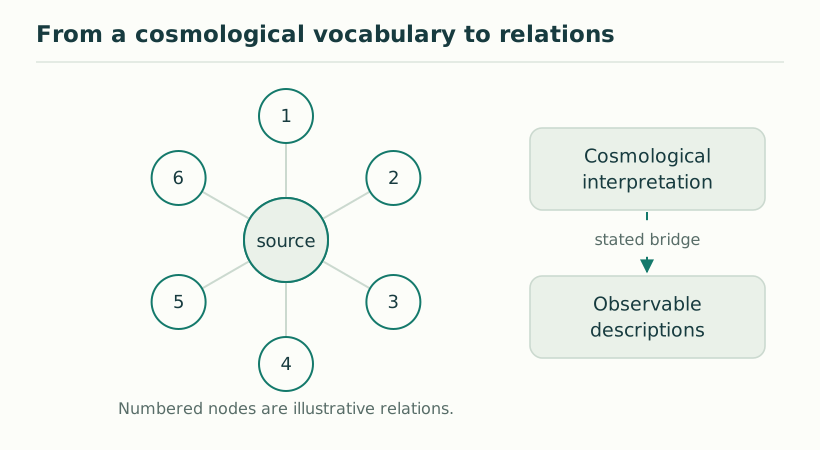
Figure 2. From a cosmological vocabulary to relations. The diagram is a reading aid for the SMM vocabulary: source, relations, manifested plurality, and observation. The arrangement does not assign physical locations to metaphysical terms. View full size ↗
05The DTT interpretation of active and receptive roles
DTT can interpret inner generation as the organized production of possibilities and completion as their retention in an observable record. An operation, a receiver and an accepted output form a useful three-part description. In quantum or algebraic models, each part can be represented by a map, a state space and a completion criterion.
The analogy should remain a guide to structure. A metaphysical receptive principle is not automatically a Hilbert space, and divine action is not identified with a laboratory operator. The modern model gains precision by defining those mathematical objects independently and explaining which aspect of the older relation inspired them.
06From triplicity to a testable construction
A useful worked model might specify an input state, a family of allowed operations and a receiver that retains only certain outcomes. One can then calculate which distinctions survive, whether composition is consistent and whether the retained state predicts future observations. These questions give the threefold relation operational content.
The resulting theory could support a conditional dimensional or phase result. To make a physical claim, it must also explain why nature selects that receiver and those operations. This is the point where metaphysical inspiration becomes a research programme: it guides the architecture, while explicit definitions and evidence determine the reach of the conclusions.
KEEP THE CONNECTION
Key ideas
Triplicity describes relational roles and need not imply three sources.
A cube’s binary vertex count is not a universal minimum for spatial dimension.
A physical use of combinatorial counts requires a specified receiver and selection principle.
Scope of the argument. Interpretive article with an elementary geometric correction; symbolic and physical claims remain distinct.
Original public topic. This edition provides an independently written explanation; article-level references identify the passages and additional sources used.