A023Public article topicExpanded article4 min read
The Discrete Nature of Time
Investigate what it means to describe time as discrete. Separate a minimum operational interval, discrete updates, and discrete recorded events before relating them to SMM.
01Several different claims are called discreteness
A system can have discrete energy levels while evolving with a continuous time parameter. A detector can record separate clicks even when its underlying equations are continuous. A model can also postulate discrete fundamental updates. These are different statements, and evidence for one does not automatically establish the others.
The source article presents Ibn al-Arabi’s indivisible day of event and connects it with renewed creation. This is a metaphysical account of the unit of divine action. Identifying that unit with a particular laboratory interval requires a physical model and a calibration that the philosophical description alone does not supply.
02A discrete order need not have a universal tick size
Consider events labelled by integers. Their order is discrete, but a clock could assign unequal durations between neighbouring events. Conversely, a regular clock can sample a continuous process at equal intervals. The appearance of an integer label therefore does not tell us whether time itself is granular.
DTT can use discrete inner histories without immediately committing to a universally measurable minimum second. The model should state whether discreteness belongs to operations, completed records, spectrum, phase or duration. These choices affect the predicted observations and the meaning of any continuum approximation.
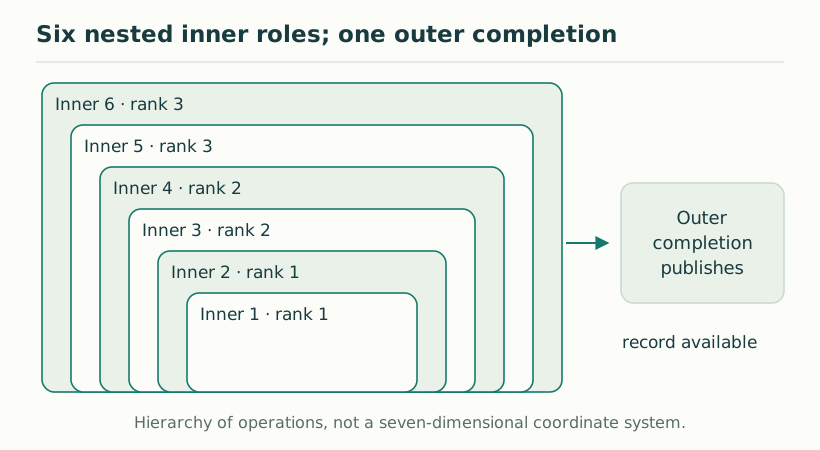
Figure 1. Six nested inner roles; one outer completion. The six inner roles are nested functional stages with readout ranks 1, 1, 2, 2, 3, 3. The outer completion publishes the resulting record. These are not seven independent time axes. View full size ↗
03How smooth behaviour can emerge
Let a record xₙ be sampled at intervals τ. If changes are slow on that scale, the sequence can be approximated by a smooth function x(t). A finite difference then approximates a derivative. The approximation is controlled by the relation between the variation scale of the process and the sampling interval.
For a sinusoid, the central difference gives an effective frequency factor sin(ωτ)/τ instead of ω. When |ωτ| is small, the difference is small; at higher frequencies it matters. This elementary calculation illustrates how a discrete model can reproduce a continuum law in one regime and depart from it in another. It is a toy calculation, not a DTT prediction.
[f(t+τ) − f(t−τ)]/(2τ) for f(t)=exp(iωt) gives i sin(ωτ) f(t)/τ
sin(ωτ)/τ = ω − ω³τ²/6 + …
04The danger of identifying a tick by convention
If a model declares that N inner operations equal one day, then dividing the chosen day by N yields an interval. This arithmetic does not determine N or establish that the interval is physically fundamental. A convention for grouping operations must be distinguished from a measured or dynamically selected scale.
The same issue appears when a minimum time is inferred from a desired constant. If the constant is used to set the tick and the tick is then used to recover the constant, the calculation is circular. A genuine prediction requires independent inputs and a clear dependency chain.
05Completion and retained structure
In SMM/DTT, discreteness can be formulated through distinct completion events while the inner organization has additional structure. The observable sequence can appear continuous when the relevant detectors average over many completions or when an effective limit exists. This gives a possible relation between discrete generation and continuous measurement.
The relation needs a theorem or a controlled approximation. A rapid sequence is not automatically equivalent to a particular differential equation. The update must preserve the appropriate symmetries, probabilities and conservation laws, and the discarded information must not produce uncontrolled memory effects.
06What would distinguish the model physically?
A discrete construction becomes testable when it predicts a specific departure in a defined regime: a dispersion correction, a response cutoff, a recurrence or another observable relation. The size and form must follow from the model rather than being selected after examining data. Different discrete models need not produce the same signature.
The conceptual contribution of the indivisible-event picture is to make generation and completion explicit. The physical contribution depends on the resulting dynamics. Separating these levels allows one to investigate discrete temporal structure rigorously without assuming that every quantum phenomenon already confirms it.
KEEP THE CONNECTION
Key ideas
Discrete spectra, detector clicks and discrete fundamental time are different claims.
A continuum limit needs controlled dynamics, not only a rapid update rate.
An inner tick must be independently defined and calibrated before it predicts a constant.
Scope of the argument. Metaphysical motivation and an explicit toy approximation; no minimum physical time is asserted.
Original public topic. This edition provides an independently written explanation; article-level references identify the passages and additional sources used.