
In this article
- Motion as a relation between appearances
- Identity is part of the problem
- Discrete displacement and an effective velocity
- Locality requires constraints on transitions
- The nested DTT picture
- What would make the explanation stronger?
Revisit motion when persistence is interpreted through renewed states. Ask what connects successive observations strongly enough to support the familiar description of an object moving.
The source article develops an interpretation of motion in which an object’s successive appearances at different places are more fundamental than a separate entity called motion. Within the renewed-creation account, the world is presented in successive states and apparent displacement is a relation between them. This is an ontological proposal about what persists through change, rather than a correction to the definition of velocity.
The central question for SMM/DTT is therefore constructive: what makes a sequence of appearances count as the motion of one object, and what constrains the allowed displacement between successive records?
Imagine two consecutive images containing an identical bright dot, first on the left and then on the right. The images alone do not prove that one object moved. One dot might have disappeared and another appeared. Tracking requires an identity rule, a transition model or retained information connecting the observations.
For a generative theory, this is not a minor detail. If particles are reconstructed at completion, the theory must explain why charge, mass-related behaviour and other identifying properties persist. A label inserted by the theorist is not enough unless the physical update preserves and exposes the corresponding relation.
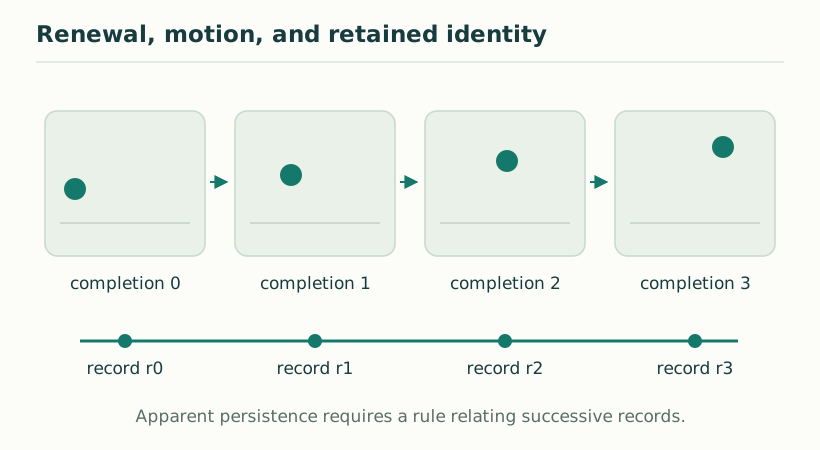
Let xₙ be a recorded position after completion n and let τ be the duration assigned by a physical clock to one update. The finite difference vₙ=(xₙ₊₁−xₙ)/τ gives an average velocity over that update. A smooth trajectory can approximate many such steps when observations do not resolve the microscopic structure.
This does not mean calculus is invalid or that continuous mechanics has been refuted. A continuum description may be an excellent effective theory. The relevant question is whether a specified discrete model reproduces the observed laws at accessible scales and whether it predicts controlled deviations outside that regime.
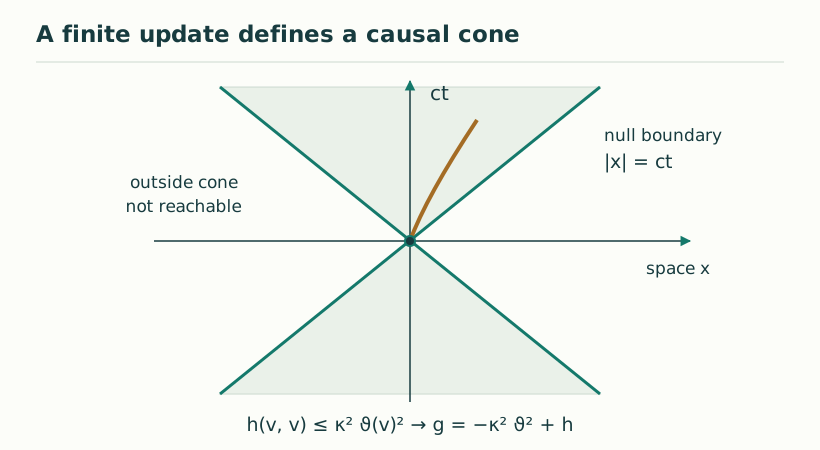
A sequence can jump between arbitrarily chosen positions unless the update restricts it. To obtain a finite propagation speed, the permitted operations must connect records in an appropriate neighbourhood structure. If those same operations define distance, their consistency becomes especially important: an unrestricted shortcut would change what counts as near.
A simple graph illustrates the requirement. Suppose one update allows a move along one edge. After n updates, only vertices within graph distance n are reachable. This produces a causal bound in update units. To interpret it physically, the graph metric, clock calibration and behaviour of different excitations all need justification.
The six inner stages can be used to organize construction of the relations that a completed spatial record exhibits. The outer completion then registers a new state. Motion concerns the comparison between these completed states, while the internal organization concerns how each state and its retained connections are produced.
This distinction prevents a misleading picture in which a particle physically runs through six hidden time axes and then reappears. The hierarchy is a proposed organization of generation. Its physical value depends on the update law, the memory retained and the observable transformation properties of the resulting records.
A persuasive SMM/DTT motion model would derive a propagation law from source dynamics, recover stable identity, and demonstrate how energy and momentum are represented. It would also explain why different observers agree on causal possibilities even when their coordinate descriptions differ.
The philosophical image of renewed appearance supplies motivation, but the quantitative content resides in these constraints. A useful intermediate achievement is a model with persistent records and guarded local transport, even if its locality is programmed rather than fundamentally selected. Clearly identifying that distinction shows what has been constructed and what still requires a deeper explanation.
KEEP THE CONNECTION
Scope of the argument. A generative interpretation and discrete toy model, not a replacement derivation of all mechanics.
Original public topic. This edition provides an independently written explanation; article-level references identify the passages and additional sources used.
Source register →