
In this article
- Why light speed is a structural constant
- A dimensional estimate and its limitation
- A local propagation example
- Six nested roles and three spatial directions
- What a common-source derivation would show
- The conceptual payoff
Introduce the relationship between spatial extension, temporal order, and the limiting speed. Use it as a bridge between the original cosmological discussion and later DTT reconstruction work.
The vacuum speed c relates spatial and temporal measurements in relativistic kinematics. It is not merely the speed of a particular lamp’s output. It appears in the causal structure that distinguishes timelike, null and spacelike separations. A theory seeking to explain c must therefore account for consistent rods, clocks and propagation, not only produce a number with units of speed.
The source article connects a six-plus-one creation scheme with spatial manifestation and observable time. Its useful conceptual claim is that space and time may share a generative origin. The inference to an invariant physical speed requires additional mathematical work.
If a model has a characteristic spatial step ℓ and a characteristic completion interval τ, then ℓ/τ has units of speed. A dimensionless factor υ can describe how many effective steps a signal advances per interval. Thus c_model=υℓ/τ is a possible calibration relation.
The formula is not yet a derivation of light speed. The quantities must be independently defined, the relevant mode must actually propagate at that speed, and the same limiting structure must apply to appropriate matter and clock comparisons. Otherwise the equation simply restates a chosen conversion between length and time.
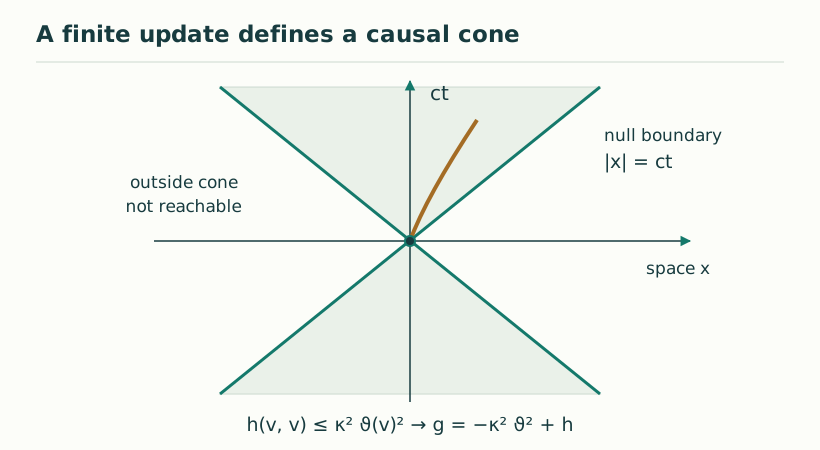
Consider records arranged in a line, with allowed operations connecting adjacent records. If a signal can advance at most one link per completed update, its reachable set expands by at most one link per update. With link length ℓ and update duration τ, this gives a causal bound in the chosen description.
A bound of this kind does not automatically produce Lorentz symmetry. A fixed lattice can retain preferred directions or a preferred frame. Recovering relativistic behaviour requires a suitable regime and additional structure, such as an appropriate dispersion relation and compatible clock transformation laws. The distinction between a maximum update speed and an invariant relativistic speed is essential.
In the current DTT hierarchy, the six inner stages are nested construction roles associated with the emergence of three-dimensional readout; the seventh role publishes a completed event. They should not be drawn as six independently running time axes. The paired organization is intended to support spatial relations, not to add six dimensions to ordinary spacetime by counting names.
To make this precise, a model must specify the operators or relations introduced at each stage and show how the resulting readout transforms. Counting three pairs suggests a structure but does not prove rank three, isotropy or a physical metric. Those are separate mathematical targets.
A strong SMM/DTT derivation would define distance using record relations, define a clock using an independent material readout, and define signal propagation through the same autonomous update. It would then prove that these measurements produce a common causal speed. Independent definitions matter because otherwise the desired equality can be built into the units.
For example, defining a unit length as whatever a signal travels in one chosen clock tick ensures a speed of one by convention. That is useful metrology, but it does not explain why other species or independently prepared clocks obey the same causal structure. Universality is the deeper claim.
The temporal-generation viewpoint encourages a concrete question: can the same process that makes spatial separation meaningful also constrain how influence crosses that separation? If the answer is yes under physically selected assumptions, the speed limit would be part of the emergence of geometry rather than an unrelated rule added afterward.
This remains a constructive programme. The existing relativistic relation provides the benchmark, while SMM/DTT proposes a different foundational route. Keeping dimensional calibration, propagation bounds and Lorentz invariance distinct makes the route assessable and avoids presenting a suggestive ratio as the entire explanation.
KEEP THE CONNECTION
Scope of the argument. Conditional model analysis; c=υℓ/τ is a dictionary whose physical ingredients require independent justification.
Original public topic. This edition provides an independently written explanation; article-level references identify the passages and additional sources used.
Source register →