
In this article
- From asking when to asking how
- A rotating featureless sphere
- Counting returns is not yet measuring duration
- How completion generates an outer order
- A worked clock comparison
- What it means to derive time
Investigate how time might originate with an ordered world rather than inside an already existing chronology. Present the cosmological and philosophical meanings of this question.
If time is itself to be explained, asking when it began can assume too much. The more constructive question is how an ordered and measurable temporal structure arises. The source article develops this distinction through Ibn al-Arabi’s account of the Universal Soul and the emergence of identifiable motion. It also uses the contrast between an undifferentiated sphere and visible markers to explain why motion and measurable time are not identical.
This is a particularly useful theme for DTT. A generative process must produce not only changes but the distinctions through which those changes become countable and comparable.
Imagine a perfectly featureless sphere described only by its visible appearance. Rotating it changes no visible marker. A receiver restricted to that appearance cannot determine the angle turned or count revolutions. Adding a distinguishable mark makes rotational phase observable. The difference lies in the available relational information, not in an observer’s decision to call the object a clock.
The thought experiment is deliberately idealized. Real devices offer many additional measurements. Its lesson is that a state change can remain invisible to a restricted observation map. A proposed primitive clock therefore needs both dynamics and an observable that distinguishes the relevant changes.
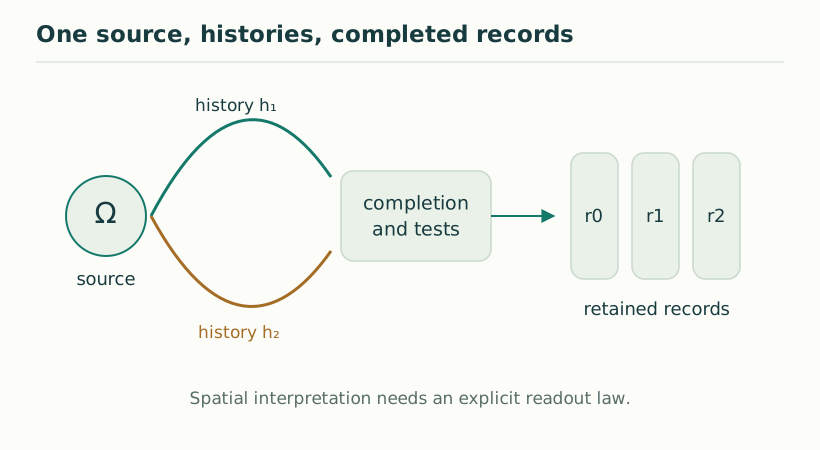
Once a marker returns to a reference position, a counter can register a cycle. This provides a sequence of completed returns. To treat every return as an equal duration, however, one needs a stability condition and a comparison standard. If the cycle period drifts unpredictably, a count remains a count but becomes a poor duration measure.
In a self-contained theory, this comparison cannot be supplied indefinitely by unexplained external clocks. The model must show why different physical processes support compatible clock readings. This is one reason why operational clock selection is a substantive part of the modern SMM/DTT programme.
Let an inner action have a distinguished completion condition. Whenever the condition is reached, a record becomes available. The ordered set of these records can serve as an outer temporal structure. The construction distinguishes an internal phase from a public count, even though both arise from the same process.
If the inner action is reversible, its recurrence alone does not select an arrow. One also needs a direction of record availability or another physical asymmetry. The current axiomatic work makes this distinction explicit: a return structure can be symmetric while the records accessible to an observer carry an order.
Suppose one completion cycle advances a counter by one and another internal operation changes the number of generated branches without advancing it. The clock is insensitive to branching only if its accessible statistics genuinely ignore that operation, including after later operations. It is not enough to label the branch operation timeless.
This provides a concrete test for a DTT proposal. Prepare the clock, perform the branch operation, and compare all specified delayed readouts with a control process. Agreement supports the asserted insensitivity within the tested model. A physical selection principle must then explain why the relevant clocks possess that coupling structure.
Deriving time is not necessarily producing a real number from nothing. It can mean reconstructing event order, selecting a class of equivalent clocks, or showing how a familiar continuum parameter approximates a discrete record process. These are different results and should be stated separately.
The strongest version connects them: one dynamics produces distinguishable completions, stable records and compatible duration measurements. The historical image of an unmarked sphere helps identify the first obstacle; modern operational models address the additional obstacles. The conceptual continuity lies in the need for distinguishability, while the physical content lies in the specified dynamics and measurable comparisons.
KEEP THE CONNECTION
Scope of the argument. Conceptual derivation of requirements, with a conditional operational clock example.
Original public topic. This edition provides an independently written explanation; article-level references identify the passages and additional sources used.
Source register →