A013Public article topicExpanded article4 min read
The Origin of the World
Explore why asking about the origin of the world differs from asking for an earlier event. Introduce the distinction between explanatory priority and temporal priority.
The origin of the world can mean the earliest state described by a physical model, the development of its present structure, or the ground of its existence. These are different questions. An explanation of how galaxies formed is not an explanation of why there is a universe; an account of metaphysical dependence is not a numerical history of cosmic expansion.
The source article emphasizes Ibn al-Arabi’s distinction between temporal precedence and the dependence of the world on its Creator. If time belongs to creation, the ground of creation cannot simply be placed at an earlier moment on the same time axis.
02The difficulty with an ordinary before
The word before ordinarily relates two events within an ordered history. Asking what happened before the entire temporal order assumes that the same relation continues beyond the domain being discussed. This may be a meaningful hypothesis in a larger physical model, but it is not automatically meaningful in every account of origin.
For example, a model with a first indexed state n=0 has no n=−1 unless its definition is extended. That mathematical fact does not prove that reality began there. It only states the domain of the model. Conversely, adding negative indices does not explain why the extended history exists.
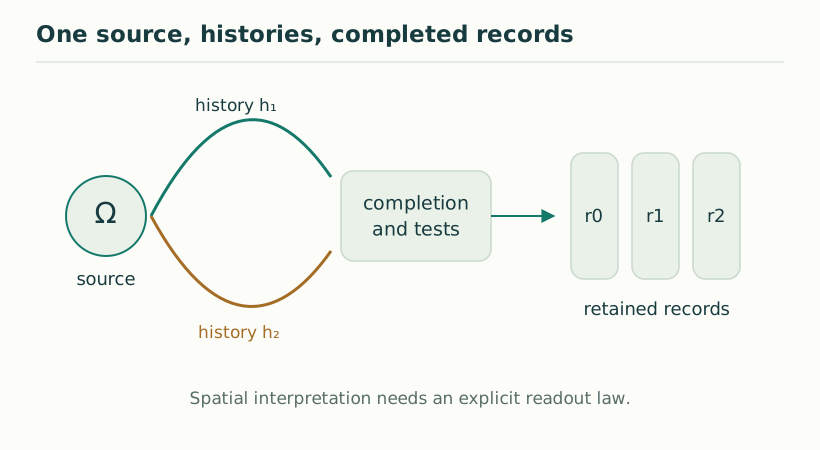
Figure 1. One source, histories, completed records. Conceptual reconstruction: composable source histories are tested and completed before a retained record becomes available. The source is not depicted as a point already located in space. View full size ↗
03Logical dependence is not elapsed duration
A conclusion can depend on a premise without a measurable delay between them. A geometric construction can depend on a definition even when both are written on the same page. These examples illustrate non-temporal dependence; they do not prove a particular theology, but they clarify why the language of grounding need not describe an earlier physical event.
This distinction is central to the Single Monad proposal. The source is intended to ground spatial and temporal distinctions, so it should not be described as a particle waiting in an empty room before beginning its work. That picture would silently assume the very space and time the model is trying to explain.
04The physical early universe and the metaphysical source
A physical cosmology starts from observations and a dynamical framework. Its earliest reliable regime is determined by the framework’s validity and available evidence. A mathematical boundary or singularity can signal a limit of the description rather than an established account of creation from nothing.
SMM/DTT asks a complementary constructive question: can observable geometry and clock order arise from a more primitive generative process? If so, the model must show how the familiar cosmological description emerges in its valid regime. An ontology of source dependence does not remove that obligation or decide every question about earlier physical phases.
05A simple generative example
Imagine an abstract transition system whose states carry no spatial coordinates. Relations among completed records allow an observer to reconstruct a graph, and repeated comparisons later support a distance. In this example, asking where the initial transition occurred in the reconstructed space is ill-posed: the spatial interpretation appears only after the relevant relational structure exists.
The example illustrates emergence of a descriptive domain. It does not establish that all physical geometry can be generated in this manner. To do that, one would need stable locality, a suitable dimensional limit and consistent matter propagation, not merely a collection of labels that can be drawn as a graph.
06What an origin explanation would accomplish
A strong origin account should identify which ingredients remain primitive and why the derived structure has its particular form. Replacing space with histories shifts the explanatory burden to the history rules, their composition and their completion. That shift is productive if the new primitives explain more with fewer independent choices.
The conceptual value of SMM lies in making the unity of origin explicit. The physical value of DTT depends on showing how that unity constrains observable geometry, clocks and matter. Keeping both questions in view allows the programme to investigate a fundamental origin without mistaking a change in vocabulary for a completed cosmological derivation.
KEEP THE CONNECTION
Key ideas
Temporal beginning and metaphysical grounding are different origin questions.
A model boundary does not by itself establish an absolute beginning of reality.
A non-spatial source must explain spatial relations without presupposing them.
Scope of the argument. Philosophical analysis and a toy emergence example, not a proof of a cosmological beginning.
Original public topic. This edition provides an independently written explanation; article-level references identify the passages and additional sources used.