A074Public article topicExpanded article4 min read
Why the Speed of Light is Constant?
Ask what would explain the universality of a limiting speed. Use the source discussion as a starting point for separating geometrical invariance, calibration, and the propagation of light.
The source proposes that a finite observed light speed arises from temporal generation and the relation between inner and outer descriptions. This is a motivation for a reconstruction program. A complete explanation must distinguish three questions: why there is a common limiting cone, why electromagnetic propagation follows it in vacuum, and how its speed is expressed in chosen units. These questions are related, but answering one does not automatically answer all three.
02A direct invariance calculation
In one-dimensional special relativity, velocities transform as u′ = (u−v)/(1−uv/c²). Substituting u=c gives u′=(c−v)/(1−v/c)=c for |v|<c. The invariance follows from the transformation law, which also transforms time. It is not obtained by ordinary subtraction of velocities while holding time unchanged.
Thus a DTT derivation must explain the appropriate clock and coordinate transformations, or another equivalent structure from which they follow. Orthogonality as a word, without a specified metric and transformation group, is not sufficient.
u′ = (u − v)/(1 − uv/c²)
u = c ⇒ u′ = c
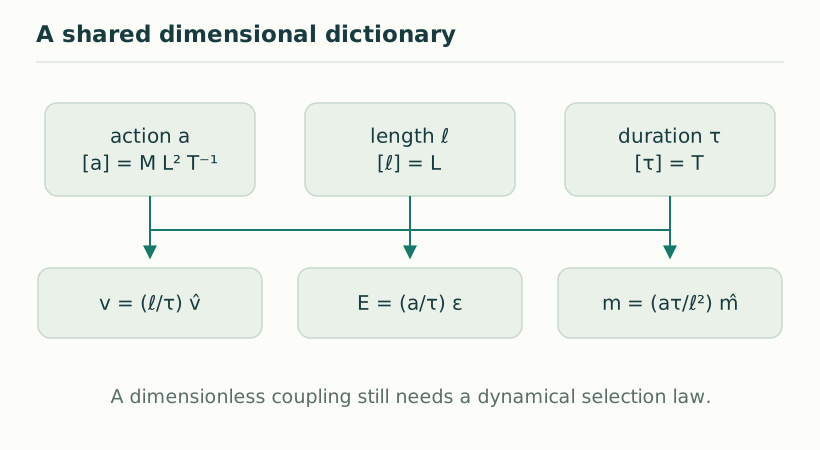
Figure 1. A shared dimensional dictionary. Dimensionless model outputs acquire physical units only after an action scale a, length scale ℓ, and time scale τ are supplied. These conversions are dimensional identities, not derivations of numerical constants. View full size ↗
03Why a photon rest frame is not available
The Lorentz factor diverges as the relative speed approaches c, so an inertial rest frame for a photon is not part of ordinary special relativity. One cannot use a supposed photon frame to infer that the speed of light is literally infinite or is a measured ratio 0/0. Along a null trajectory, proper time vanishes, while inertial observers still assign finite coordinate travel time over a nonzero distance.
These distinctions remove a common ambiguity without deciding the deeper ontological interpretation of light.
04A generative speed relation
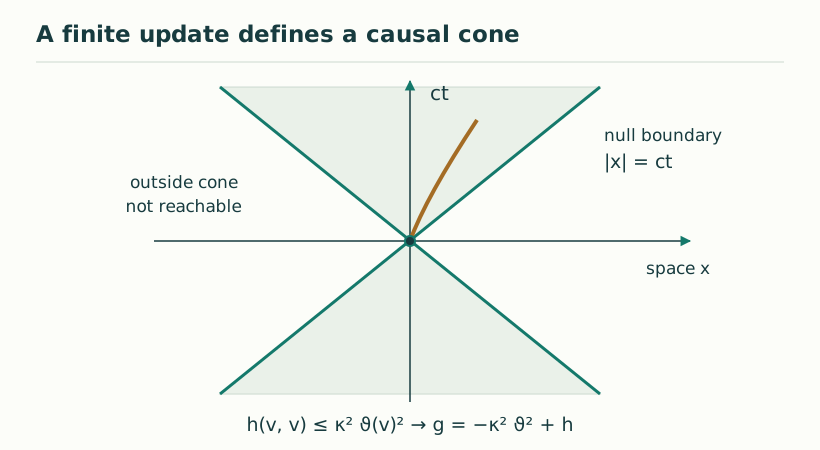
Suppose a model produces a spatial scale ℓ per completion interval τ and a dimensionless propagation coefficient κ. Then c_eff = κℓ/τ has the dimensions of speed. This is a possible readout relation. It becomes explanatory only if the source dynamics determines ℓ, τ and κ in a mutually consistent way and establishes the same limiting behavior for all relevant signals.
Choosing ℓ=cτ after importing the measured c is a calibration, not a derivation of c. Likewise, deriving one species' propagation speed does not establish universal Lorentz symmetry.
Figure 2. A finite update defines a causal cone. Illustrative finite-update geometry: displacement is bounded by update scale κ times projected inner duration. A Lorentzian metric or a shared light cone still requires the stated readout and field assumptions. View full size ↗
05The strongest SMM/DTT target
A common source offers the prospect of a joint geometry–clock–cone result. The geometry is measured from spatial records, clock intervals from an independently defined clock observable, and the cone from allowed signal propagation. Their agreement should follow from the same dynamics rather than being inserted through separate matching assumptions.
The six nested inner stages could participate in that dynamics, but merely counting them does not determine the ratio of distance to duration. The readouts and their physical calibration must be shown explicitly.
06One speed ratio is not yet Lorentz invariance
A lattice model can have a maximum update speed ℓ/τ while still selecting a preferred lattice frame and preferred directions. Therefore a finite propagation bound alone does not establish Lorentz symmetry. The effective transformations, isotropy and behavior of clocks and matter must also be examined. This example sharpens the DTT target: a common limiting cone is one part of the reconstruction, while its symmetry and universality are additional properties to derive. A successful continuum limit may recover those properties in a specified regime even if the microscopic description looks different, but the approximation and any surviving deviations must be calculated.
07Convention and physical invariance
In the SI, c has the exact value 299,792,458 metres per second because it helps define the metre. This does not make the universality of the propagation law a convention. Independent spatial, clock and propagation readouts must agree for a dynamical reason. A successful DTT account would derive that agreement, going beyond a dimensionally correct formula or an appealing geometric picture.
KEEP THE CONNECTION
Key ideas
Light-speed invariance follows from a spacetime transformation law.
A photon rest frame is not available in special relativity.
The strong DTT target is a joint derivation of geometry, clocks and the signal cone.
Scope of the argument. Conceptual interpretation with explicit mathematical examples; a source proposal is not presented as an established physical identification.
Original public topic. This edition provides an independently written explanation; article-level references identify the passages and additional sources used.