
In this article
- Love as an explanatory orientation
- A purpose is not yet an equation
- A stationary-action example
- Coherence as a more limited bridge
- SMM/DTT and organized return
- A return condition can constrain without driving
- From orientation to law
A proposed introduction to the principle of love in the source cosmology. Present its interpretive role in manifestation and relation without turning it into an uncalibrated physical force.
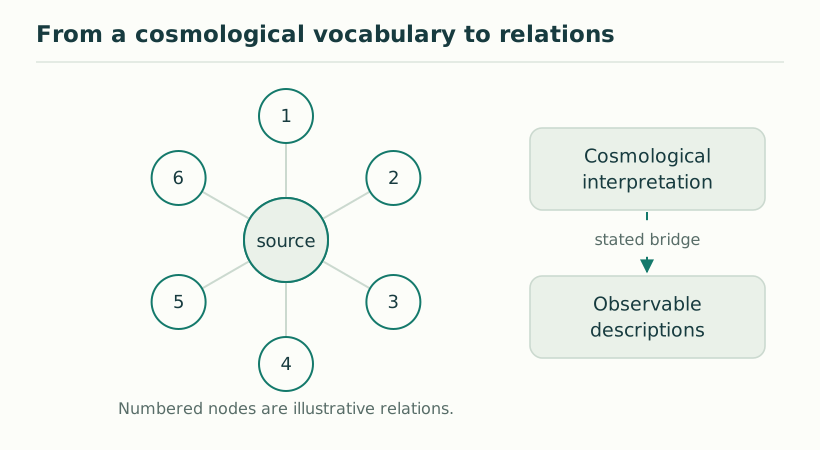
The source presents love as a principle of manifestation and reunion, relating it to motion and to a proposed origin of variational principles. Its language addresses why relation, differentiation and return matter within the cosmological account. A scientific translation must then ask a more specific question: which mathematical rule expresses the proposed tendency, and what observable dynamics follow from that rule?
Saying that a system tends toward unity does not uniquely specify its motion. It might minimize a distance, maximize an overlap, reduce an energy or preserve a coherence condition. These rules can produce different trajectories. A model must define the quantity being optimized or preserved, the allowed variations and any constraints.
This is where a philosophical principle can motivate mathematics without replacing it. The principle suggests a class of questions, while the chosen functional and dynamics determine the actual prediction.
For a path q(t), define S[q] = ∫L(q,q̇,t)dt. Requiring the first variation to vanish for endpoint-fixed variations gives the Euler–Lagrange equation d(∂L/∂q̇)/dt − ∂L/∂q = 0, under the usual differentiability assumptions. With L = mq̇²/2 − V(q), this becomes mq̈ = −dV/dq.
This derivation shows what a variational principle contains: a functional, a class of paths and a variation rule. It does not follow from the word love alone. Also, stationary action need not be a minimum; the relevant extremum structure depends on the problem.
A source model might interpret a preferred relation through phase agreement or stable completion. For two phase variables θ₁ and θ₂, an illustrative cost 1−cos(θ₁−θ₂) is minimized when their phases agree modulo 2π. This is a definite mathematical statement about a chosen function.
To make it a physical law, the theory must justify the function and specify the dynamics that responds to it. Several different functions could favor alignment while producing different rates, fluctuations and responses. The preference itself does not fix those details.
SMM emphasizes common origin; DTT distinguishes generative organization from completed appearance. A return or completion condition can therefore be a natural place to look for mathematical structure. A model might require a history to return to a specified equivalence class before producing a stable record.
That requirement could constrain admissible histories, but it would not automatically establish a universal force or a complete action principle. The useful research task is to derive a concrete completion law and show which dynamical consequences it actually entails.
Requiring a path to return to its starting state restricts which histories are admissible. It does not by itself say which admissible history occurs or how quickly it is traversed. A circle has many closed paths, including repeated circuits and paths with variable speed. An action, probability weight or autonomous update is needed to select among them. This distinction is valuable when connecting the Principle of Love with recurrent completion: a preferred relation, a closure condition and a dynamical law are separate mathematical ingredients. A strong SMM/DTT result would show why a specific closure principle leads to a particular law under explicit assumptions, rather than treating closure as a complete dynamics.
The philosophical principle can remain a language of relation, orientation and dependence while a model supplies operational definitions. A phase-alignment cost is one illustrative mathematical construction, not a measurement of love as a force. The substantive task is to justify a completion or return law and derive its consequences. This provides a disciplined route from cosmological intuition to a definite mathematical question.
KEEP THE CONNECTION
Scope of the argument. Conceptual interpretation with explicit mathematical examples; a source proposal is not presented as an established physical identification.
Original public topic. This edition provides an independently written explanation; article-level references identify the passages and additional sources used.
Source register →