
In this article
- Different meanings of dimension
- A spatial dimension is operationally demanding
- State-space dimensions
- What unseen can mean
- The SMM/DTT connection
- A dimension estimate depends on its definition
- Three spaces to keep separate
Study the dimensions of the unseen world within the source’s metaphysical vocabulary. Explain why a dimension in an interpretive cosmology need not be a measurable spatial coordinate.
The source proposes a dimensional interpretation of physical, imaginal and spiritual domains and explicitly notes that this arrangement is the author's reconstruction rather than a scheme directly enumerated by Ibn al-Arabi. That distinction is essential. The word dimension can mean an independent spatial coordinate, a mathematical degree of freedom or a metaphorical level of experience. These meanings should not be exchanged without an argument connecting them.
To establish an additional spatial dimension, one would need a way to define positions, displacements and measurable relations involving an independent coordinate. A hidden variable in an equation is not automatically such a dimension. Nor does a domain inaccessible to ordinary vision automatically occupy a lower-dimensional geometric space.
A plane drawn on paper is two-dimensional as an idealized geometry, but the physical paper has thickness. An image representing a three-dimensional scene can be two-dimensional without the represented scene losing a spatial coordinate. Representation and represented reality must be separated.

A system of two binary variables has four possible configurations. A probability distribution over those configurations needs several parameters, yet those parameters are not extra directions in the laboratory. Likewise, a quantum state space may have many dimensions that describe possible states rather than additional locations.
This distinction is useful when reading a theory that connects time, perception and dimensionality. One should identify whether the claimed dimension belongs to physical space, an internal carrier, a space of records or an interpretive hierarchy.
| Meaning of dimension | What is counted | Not automatically |
|---|---|---|
| Spatial | Independent coordinates of position | An internal state parameter |
| State space | Independent state variables | An extra direction in the laboratory |
| Interpretive level | Categories of experience or manifestation | A measured geometric axis |
Something can be unseen because no detector is sensitive to it, because it is hidden by circumstances, because it is an inferred theoretical structure or because it belongs to religious discourse. These are different reasons for nonvisibility. Scientific inference requires a defined relation to observable consequences, even when the inferred entity is not directly imaged.
A spiritual or imaginal category may instead organize meaning and experience within a tradition. Treating it carefully does not require assigning it an unsupported spatial coordinate or particle content.
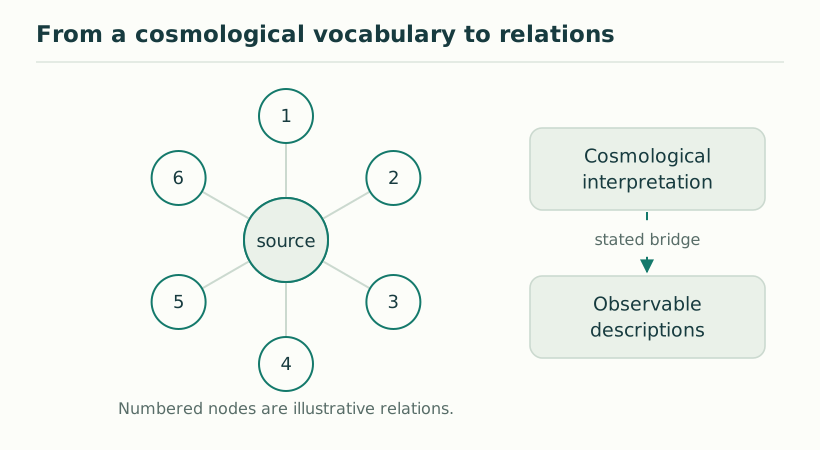
SMM's source is proposed as prior to ordinary spatial multiplicity. DTT asks how spatial relations arise through inner generation and completion. This suggests a disciplined construction problem: define a pre-spatial state system, specify accessible records, and derive a dimension from their relations through an explicit criterion.
Possible criteria include the number of independent local coordinates or the scaling of distinguishable neighborhoods. Their agreement, where claimed, must be proved. Calling three nested operations three dimensions is insufficient unless those operations generate the required independent geometry.
If the number of distinguishable records inside a neighborhood of radius r scales approximately as rᴰ, the exponent D can serve as one dimension estimate over that range. It need not automatically agree with every other notion of dimension, especially for irregular structures. A coordinate dimension, a spectral dimension and a scaling exponent may coincide in familiar smooth settings but differ in more general constructions. Thus a DTT claim of dimensional emergence should identify its criterion and show why it matches the dimension measured by physical operations. This is more precise than associating an interpretive realm with a numeral and then treating the numeral as a geometric fact.
Physical coordinate space, a mathematical state space and an interpretive hierarchy are different descriptive objects. They can be compared without being identified. This distinction protects the strongest DTT question: how can measurable spatial dimensionality emerge from a structure that does not assume it? It also allows the source’s account of unseen domains to retain its religious meaning without unsupported claims of measured coordinates.
KEEP THE CONNECTION
Scope of the argument. Conceptual interpretation with explicit mathematical examples; a source proposal is not presented as an established physical identification.
Original public topic. This edition provides an independently written explanation; article-level references identify the passages and additional sources used.
Source register →