A075Public article topicExpanded article4 min read
World formula and the Kaaba: interpreting a proposed correspondence
Examine the source’s proposed relationship between a world formula and the Kaaba. Treat the correspondence as an interpretive proposal and identify what an independent mathematical or physical argument would require.
01A symbolic correspondence with a mathematical core
The source relates a cubic equation to physical, psychical and spiritual domains and illustrates the relation through the Kaaba. This is a proposed symbolic correspondence. Its mathematical content can be examined precisely while the interpretive identification remains a separate claim. The key is to specify what X is: a real number, a complex number, an operator or another algebraic object can satisfy the same written equation in very different ways.
02Solving the scalar equation
For real X, the equation X³=1 has the single real solution X=1. Over the complex numbers, it factors as (X−1)(X²+X+1)=0 and has roots 1, exp(2πi/3) and exp(4πi/3). The latter two are nonreal complex conjugates. These three roots form a finite multiplicative group.
This is an exact algebraic result. It does not by itself produce three-dimensional space, a particle spectrum or a Lorentz transformation. Those require additional mathematical structures and physical identifications.
X³ − 1 = (X − 1)(X² + X + 1)
X ∈ {1, exp(2πi/3), exp(4πi/3)}
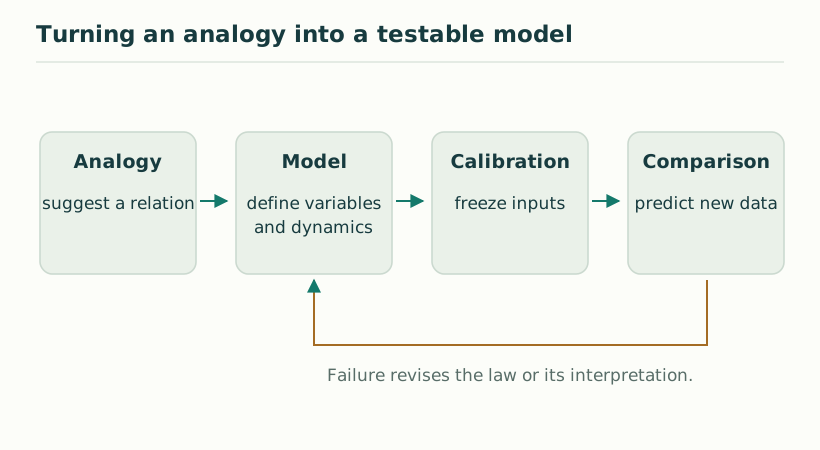
Figure 1. Turning an analogy into a testable model. A numerical or symbolic correspondence motivates a question. A physical claim needs a specified model, independent calibration, and a result that could disagree with observation. View full size ↗
03Involutions and third-order operations differ
The relation X²=1 describes an involution when X is an invertible transformation. The relation X³=1 describes a transformation whose order divides three. If the very same invertible object satisfies both, dividing the relations gives X=1. Therefore a model cannot casually combine the two as independent nontrivial properties of one unchanged X.
It may instead use different operations or representations, but then their definitions and mutual relations must be supplied. This small algebraic check is valuable because it reveals assumptions that symbolic writing can otherwise conceal.
04A constructive use of cyclic structure
A three-step permutation is a legitimate example: it sends state A to B, B to C and C back to A. Its cube is the identity. Such a map describes a recurrence pattern. It does not determine the duration of each step, the geometry of the states or the energy of the transition.
DTT can investigate recurrence as part of a completion process. The physical question is whether a particular cyclic operation follows from source principles and how its return produces an observable record.
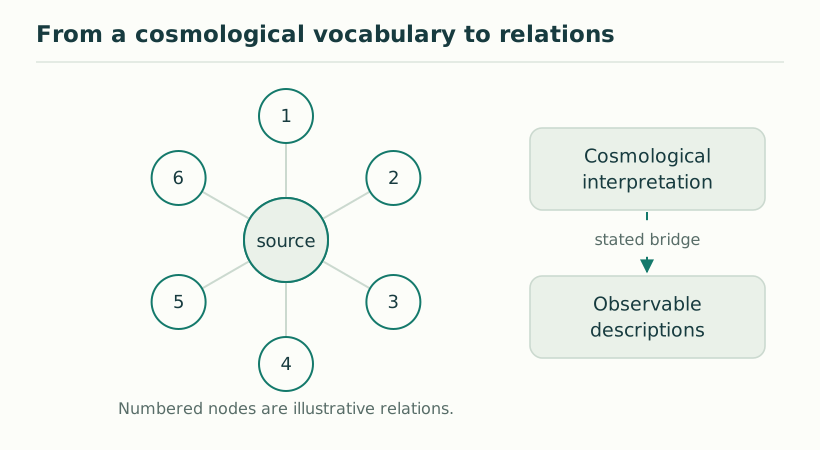
Figure 2. From a cosmological vocabulary to relations. The diagram is a reading aid for the SMM vocabulary: source, relations, manifested plurality, and observation. The arrangement does not assign physical locations to metaphysical terms. View full size ↗
05SMM and sacred geometry
A sacred structure can serve as a meaningful image of center, orientation and return within a religious cosmology. SMM uses such imagery to communicate unity and manifestation. A scientific derivation, however, must be independent of the choice of drawing: the same equations should have clear definitions and consequences before the architectural comparison is added.
This preserves the interpretive value of the correspondence. The geometry helps readers remember a relation; it does not supply missing physical premises merely by resembling the result.
06Operator solutions carry extra structure
Let P cycle three basis vectors, sending e₁ to e₂, e₂ to e₃ and e₃ to e₁. Then P³=I. This operator relation contains more structure than the scalar statement 1³=1 because P acts nontrivially on a state space. Yet even this richer example does not specify a physical time interval or an energy scale. Those require an interpretation of the states and a dynamical connection to measurement. The example shows a productive route for developing a symbolic equation: identify its carrier and action, derive its algebraic consequences, and only then propose physical readouts. Different carriers can realize the same equation with different observable content.
07Algebra and interpretation
The three complex cube roots have definite positions on the unit circle and a definite multiplication rule. Those algebraic facts are distinct from a cosmological interpretation of the roots. Keeping the distinction visible preserves both the mathematical lesson and the source’s symbolic intention. A universal physical claim would require a specified representation, dynamics and observational map in addition to the equation X³=1.
KEEP THE CONNECTION
Key ideas
The meaning of X must be specified before interpreting X³=1.
Second-order and third-order nontrivial operations cannot be conflated.
A symbolic correspondence can illustrate a relation without deriving physical law.
Scope of the argument. Conceptual interpretation with explicit mathematical examples; a source proposal is not presented as an established physical identification.
Original public topic. This edition provides an independently written explanation; article-level references identify the passages and additional sources used.