A076Public article topicExpanded article4 min read
Quantum Consciousness and Free Will
Introduce questions about consciousness, quantum descriptions, and free will as distinct problems. Examine the proposed connections while keeping interpretive possibilities separate from experimentally established mechanisms.
The source proposes a relation among physical and psychical domains, orthogonal temporal descriptions, consciousness and willing. These are ambitious interpretive connections. To develop them clearly, one must distinguish subjective experience, access to information, behavioral control and metaphysical freedom. A single word such as consciousness can otherwise conceal several different explanatory targets.
02A record is not automatically an experience
A camera stores information about a scene. A controller can use stored information to change its behavior. Neither description, by itself, settles whether the system has subjective experience. Thus a theory that explains the formation of records has made progress on information and observation, but has not automatically solved the question of experience.
This distinction is useful for DTT because outer completion can be defined operationally through readable records without requiring a theory of consciousness at every step. The additional connection to experience can then be stated as a further hypothesis rather than hidden inside the definition of measurement.
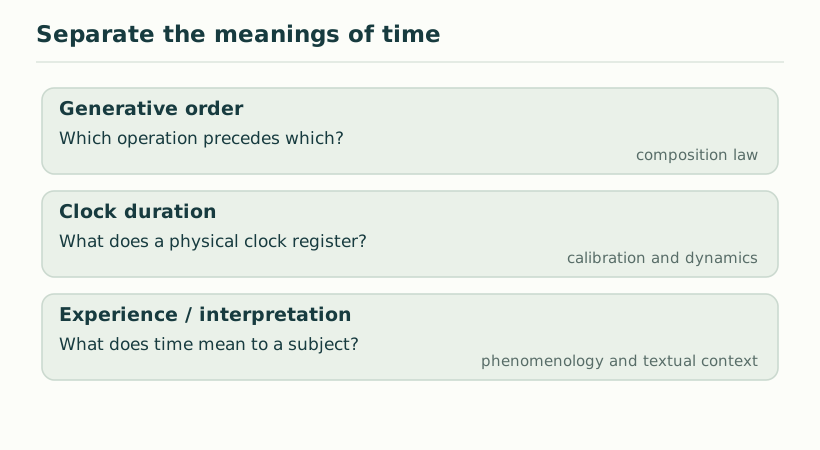
Figure 1. Separate the meanings of time. An interpretive map separates generative order, measured duration, and experienced or theological meanings. A relation between them is a question to formulate, not an automatic identification. View full size ↗
03Quantum uncertainty and agency
A random outcome is not equivalent to a freely chosen action. If a decision were replaced by an uncontrolled coin toss, randomness alone would not explain reasons, responsibility or intentional control. Conversely, a system can exhibit complex goal-directed behavior under a deterministic model. These observations show why the free-will question cannot be settled simply by pointing to quantum indeterminacy.
A proposed account of agency must explain how information, goals, available actions and feedback are related. Its philosophical interpretation can then be discussed separately.
04A minimal operational model
Let mₙ be a retained internal state, rₙ an incoming record and aₙ an action selected by a rule π(mₙ,rₙ). A memory update mₙ₊₁ = F(mₙ,rₙ,aₙ) makes the process explicit. This model can represent learning or control at an abstract level without deciding whether it is conscious.
The example clarifies what would need to be added by a DTT proposal: a justified relation between generative completion, retained information and action selection, together with consequences that differ from an arbitrary controller model.
aₙ = π(mₙ, rₙ)
mₙ₊₁ = F(mₙ, rₙ, aₙ)
05The SMM/DTT connection
SMM can motivate a unified account of observer and observed rather than treating awareness as an external spectator. DTT can ask how an observer's present access depends on completed records and how memory supports an experienced sequence. These are substantial conceptual questions even before claims about a psychical particle world are made.
A physical theory of an additional domain would require its state space, couplings and measurable consequences. Merely assigning it an orthogonal time coordinate does not establish its existence or explain neural and behavioral observations.
06An empirical bridge must identify a discriminating consequence
Suppose two accounts predict exactly the same reports, neural records and behavior under every specified procedure. Those procedures cannot distinguish the accounts, even if their ontological language differs. A physical consciousness proposal therefore needs a consequence that differs under clearly defined conditions, or it should be presented as an interpretation of shared observations. This does not deny the importance of subjective experience. It identifies what would make a proposed mechanism scientifically distinguishable. For DTT, the bridge from completed records to experience is a separate hypothesis whose operational content must be explained, rather than inferred from the existence of quantum probabilities or an additional temporal coordinate.
07An operationally clear scope
Generative dynamics, retained information, action and reported experience are distinct explanatory targets. A model can improve the record-to-action mechanism without thereby solving the subjective-experience question. The source’s proposal remains a philosophical motivation for connecting them. Progress becomes identifiable when each connection is stated explicitly, with the physical mechanism and additional interpretive assumptions kept visible rather than folded into one ambiguous term.
KEEP THE CONNECTION
Key ideas
Records, subjective experience and agency are distinct targets.
Randomness alone does not explain free choice.
DTT can study observer records without silently assuming a consciousness mechanism.
Scope of the argument. Conceptual interpretation with explicit mathematical examples; a source proposal is not presented as an established physical identification.
Original public topic. This edition provides an independently written explanation; article-level references identify the passages and additional sources used.