A077Public article topicExpanded article4 min read
From one source to many observable records
Revisit oneness and multiplicity from the viewpoint of observation. Focus on how many distinguishable records could arise from a shared generative account and what preserves their differences.
The source presents particle-like and wave-like descriptions as different manifestations of a common generative reality and connects their distinction with inner and outer time. The useful modern question is how one model can produce both coherent probability amplitudes and localized records. A verbal appeal to oneness does not determine the numerical relationship between them; the relation must be expressed through state composition and measurement rules.
02A simple interference calculation
If two alternatives contribute amplitudes a and b, the probability associated with their coherent sum is |a+b|² = |a|²+|b|²+2Re(conj(a)b). The last term depends on relative phase. If a and b have equal magnitudes and opposite phase, their sum vanishes even though each contribution separately is nonzero.
This elementary algebra explains why adding amplitudes differs from adding ordinary probabilities. The observed record distribution depends on how alternatives combine before detection. Feynman's discussion of quantum interference provides a clear primary exposition of this distinction.
|a+b|² = |a|² + |b|² + 2Re(conj(a)b)
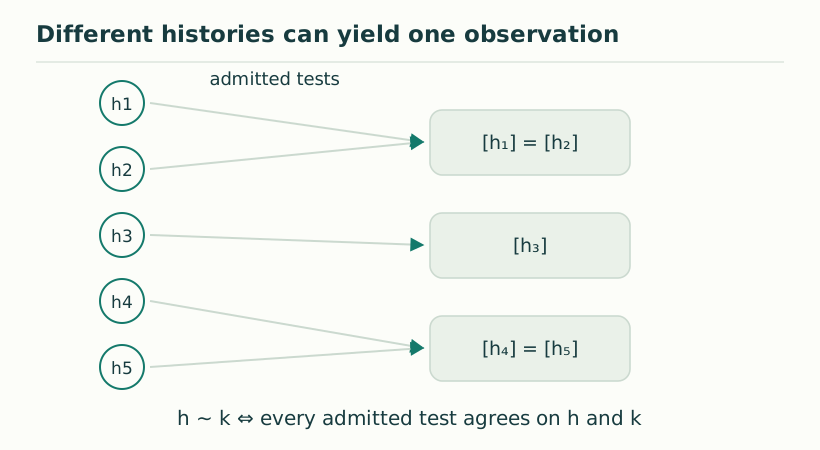
Figure 1. Different histories can yield one observation. The observational equivalence h ∼ k means that all admitted tests give the same result. Changing the test language can split an equivalence class and expose previously hidden distinctions. View full size ↗
03Localized records do not imply classical alternatives
A detector can produce one localized click while the distribution of many clicks reflects interference. The discreteness of the registered outcome does not by itself show that the process before registration followed one classical path with ordinary probabilities.
For a source model, the task is therefore twofold: explain coherent composition and explain completed outcomes. Either part alone is incomplete. A rule producing clicks without the correct interference pattern fails, as does a wave description with no account of the record statistics.
04SMM and constrained multiplicity
SMM seeks a common origin for the different records. A mathematical formulation should show how the records remain distinguishable while obeying shared constraints. One can represent a family of outcomes by readouts Rₐ applied to a common state, but the physical content lies in the relations among those readouts and in the dynamics of the state.
An arbitrary source capable of emitting any desired result explains little. A restricted source that predicts interference, normalization and transformation behavior has substantive explanatory content.
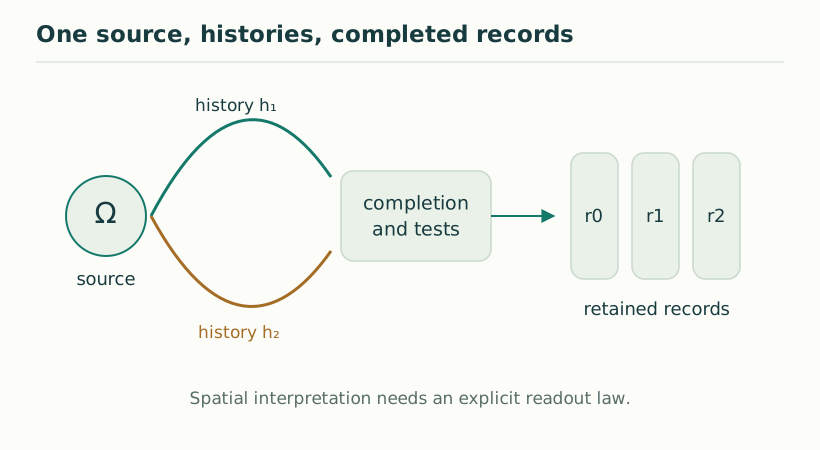
Figure 2. One source, histories, completed records. Conceptual reconstruction: composable source histories are tested and completed before a retained record becomes available. The source is not depicted as a point already located in space. View full size ↗
05DTT and completion
DTT can interpret inner generation as the organization of contributions and outer completion as the availability of a record. To establish more than an analogy, it needs a rule connecting the inner state to probabilities and a reason that the rule takes the required form. Introducing complex amplitudes and the squared norm by assumption can recover ordinary quantum calculations, but does not yet derive them from temporal principles.
The six inner stages are nested roles in this proposed generation, not six distinct laboratory times. Their relevance must appear through specific composition or completion constraints.
06Which information destroys the simple interference picture?
If a record distinguishes the two alternatives perfectly, the relevant observable description can become a mixture rather than their coherent sum. In a simple model, amplitudes become correlated with orthogonal marker states, so tracing out the unread marker removes the cross term. If the marker states overlap, a corresponding interference contribution can remain. This makes the record interface central rather than incidental. DTT’s completion rule must explain which distinctions are retained as records and which alternatives remain coherent. The result is not merely a choice between particles and waves; it is a statement about how joint state structure and accessible information determine outcome probabilities.
07One state and many records
Phase-carrying contributions can combine before localized outcomes are registered. Coherent addition differs from a classical mixture, while both yield distributions over records. The common-origin idea becomes precise through one state and one probability rule supporting several outcomes. The remaining SMM/DTT task is to derive the state-composition and completion structure from source principles, rather than importing the successful quantum rules without explanation.
KEEP THE CONNECTION
Key ideas
Coherent amplitudes and localized records are compatible.
A common-origin account must reproduce the interference term.
DTT needs a derived connection between inner composition and outcome probabilities.
Scope of the argument. Conceptual interpretation with explicit mathematical examples; a source proposal is not presented as an established physical identification.
Original public topic. This edition provides an independently written explanation; article-level references identify the passages and additional sources used.